QUESTION IMAGE
Question
chapter quiz
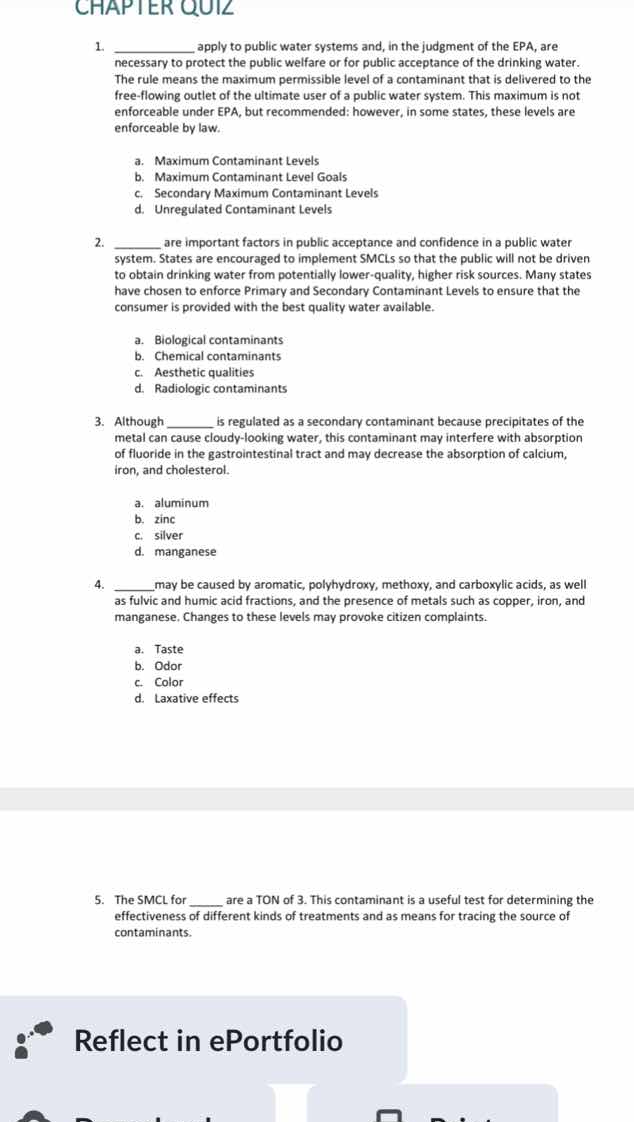
- ______ apply to public water systems and, in the judgment of the epa, are necessary to protect the public welfare or for public acceptance of the drinking water. the rule means the maximum permissible level of a contaminant that is delivered to the free-flowing outlet of the ultimate user of a public water system. this maximum is not enforceable under epa, but recommended; however, in some states, these levels are enforceable by law.
a. maximum contaminant levels
b. maximum contaminant level goals
c. secondary maximum contaminant levels
d. unregulated contaminant levels
- ______ are important factors in public acceptance and confidence in a public water system. states are encouraged to implement smcls so that the public will not be driven to obtain drinking water from potentially lower-quality, higher risk sources. many states have chosen to enforce primary and secondary contaminant levels to ensure that the consumer is provided with the best quality water available.
a. biological contaminants
b. chemical contaminants
c. aesthetic qualities
d. radiologic contaminants
- although ______ is regulated as a secondary contaminant because precipitates of the metal can cause cloudy-looking water, this contaminant may interfere with absorption of fluoride in the gastrointestinal tract and may decrease the absorption of calcium, iron, and cholesterol.
a. aluminum
b. zinc
c. silver
d. manganese
- ______ may be caused by aromatic, polyhydroxy, methoxy, and carboxylic acids, as well as fulvic and humic acid fractions, and the presence of metals such as copper, iron, and manganese. changes to these levels may provoke citizen complaints.
a. taste
b. odor
c. color
d. laxative effects
- the smcl for ______ are a ton of 3. this contaminant is a useful test for determining the effectiveness of different kinds of treatments and as means for tracing the source of contaminants.
Brief Explanations
- The description matches non-enforceable EPA-recommended levels for public water systems, which are Maximum Contaminant Level Goals.
- Aesthetic qualities directly impact public acceptance of drinking water, as they relate to appearance, taste, etc., that drive public confidence.
- Aluminum is regulated as a secondary contaminant, and it interferes with absorption of fluoride, calcium, iron, and cholesterol while causing cloudy water.
- Color in water is often caused by the listed acids and metals, and changes lead to citizen complaints.
- The Secondary Maximum Contaminant Level (SMCL) for turbidity is 3 NTU, and it is used to test treatment effectiveness and trace contaminant sources.

Snap & solve any problem in the app
Get step-by-step solutions on Sovi AI
Photo-based solutions with guided steps
Explore more problems and detailed explanations
- b. Maximum Contaminant Level Goals
- c. Aesthetic qualities
- a. aluminum
- c. Color
- Turbidity