QUESTION IMAGE
Question
chapter review
layout
name: demonte domino
date: 11/27/2026
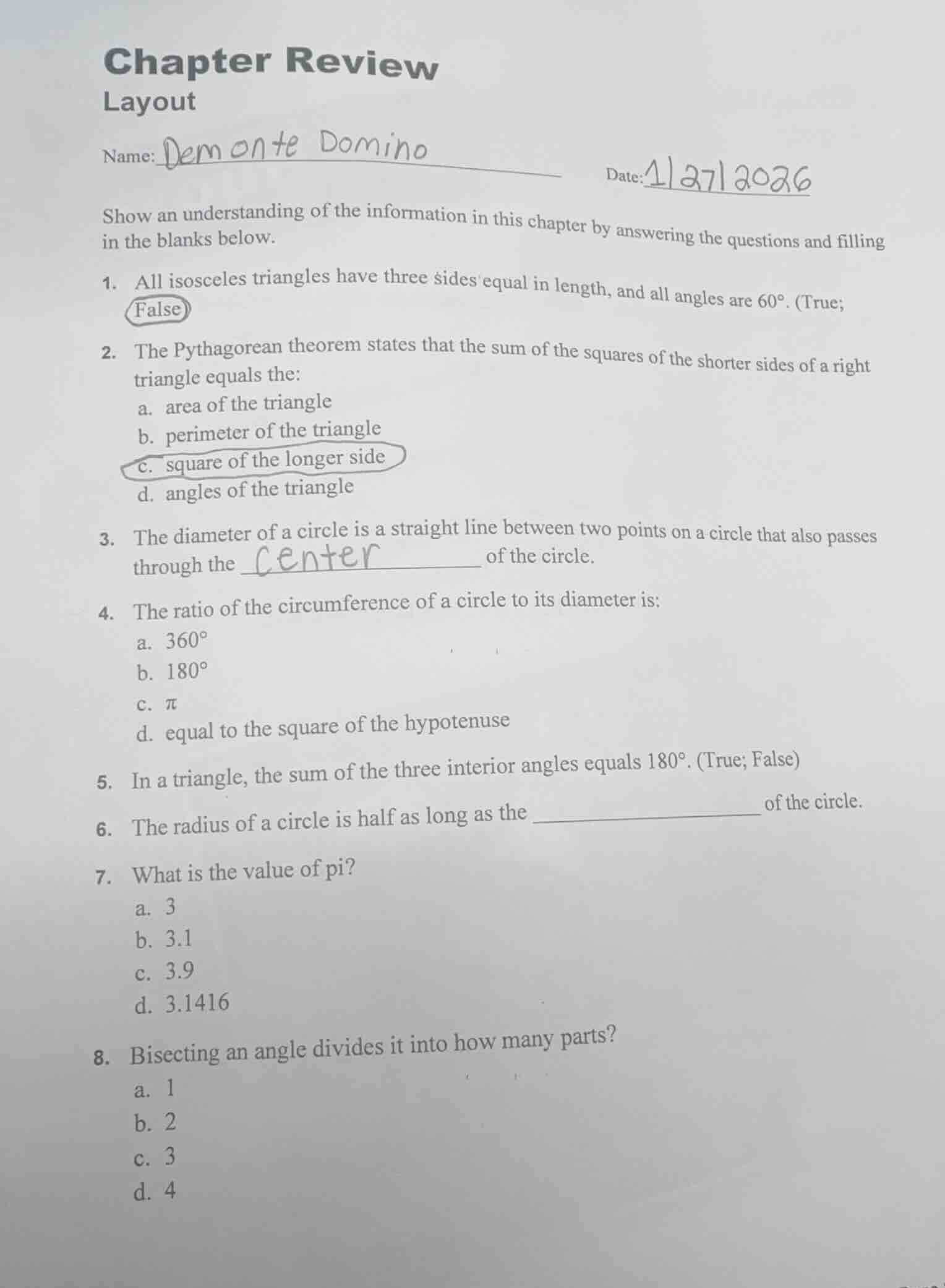
show an understanding of the information in this chapter by answering the questions and filling in the blanks below.
- all isosceles triangles have three sides equal in length, and all angles are 60°. (true; false)
- the pythagorean theorem states that the sum of the squares of the shorter sides of a right triangle equals the:
a. area of the triangle
b. perimeter of the triangle
c. square of the longer side
d. angles of the triangle
- the diameter of a circle is a straight line between two points on a circle that also passes through the ______ of the circle.
- the ratio of the circumference of a circle to its diameter is:
a. 360°
b. 180°
c. π
d. equal to the square of the hypotenuse
- in a triangle, the sum of the three interior angles equals 180°. (true; false)
- the radius of a circle is half as long as the ______ of the circle.
- what is the value of pi?
a. 3
b. 3.1
c. 3.9
d. 3.1416
- bisecting an angle divides it into how many parts?
a. 1
b. 2
c. 3
d. 4
Question 1
An isosceles triangle has at least two equal sides and two equal angles. An equilateral triangle (a special case) has three equal sides and all angles \(60^\circ\), but not all isosceles triangles are equilateral. So the statement is false.
The Pythagorean theorem for a right - triangle with legs \(a\), \(b\) and hypotenuse \(c\) (the longer side) states that \(a^{2}+b^{2}=c^{2}\), i.e., the sum of the squares of the shorter sides equals the square of the longer side.
By definition, the diameter of a circle is a straight line segment that passes through the center of the circle and whose endpoints lie on the circle.

Snap & solve any problem in the app
Get step-by-step solutions on Sovi AI
Photo-based solutions with guided steps
Explore more problems and detailed explanations
False