QUESTION IMAGE
Question
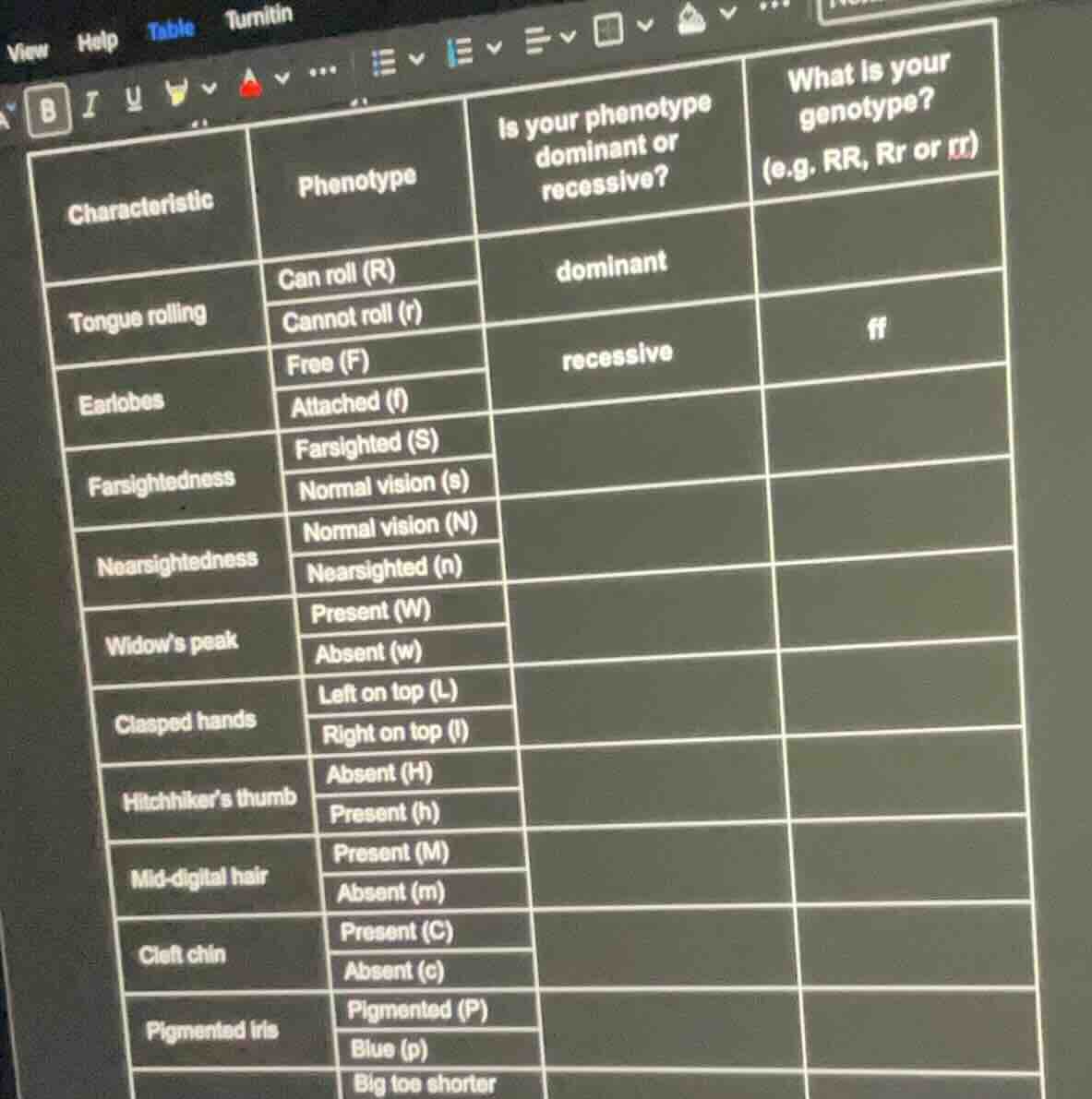
characteristic | phenotype | is your phenotype dominant or recessive? | what is your genotype? (e.g. rr, rr or rr)
tongue rolling | can roll (r) | dominant |
| cannot roll (r) |
earlobes | free (f) | recessive | ff
| attached (f) |
farsightedness | farsighted (s) | |
| normal vision (s) |
nearsightedness | normal vision (n) | |
| nearsighted (n) |
widow’s peak | present (w) | |
| absent (w) |
clasped hands | left on top (l) | |
| right on top (l) |
hitchhiker’s thumb | absent (h) | |
| present (h) |
mid - digital hair | present (m) | |
| absent (m) |
cleft chin | present (c) | |
| absent (c) |
pigmented iris | pigmented (p) | |
| blue (p) | ||
| big toe shorter |
To determine the missing information (dominance/recessiveness and genotype) for each characteristic, we use the principles of Mendelian genetics:
1. Tongue Rolling (Cannot roll, \( r \))
- Dominance: Since "Can roll (\( R \))" is dominant, "Cannot roll (\( r \))" is recessive.
- Genotype: Recessive phenotypes have homozygous recessive genotypes, so \( \boldsymbol{rr} \).
2. Earlobes (Free, \( F \))
- Dominance: "Attached (\( f \))" is recessive (given as \( ff \)), so "Free (\( F \))" is dominant (dominant alleles mask recessive ones).
- Genotype: Dominant phenotypes can be homozygous dominant (\( FF \)) or heterozygous (\( Ff \)), but since "Attached" is \( ff \), "Free" could be \( \boldsymbol{FF} \) or \( \boldsymbol{Ff} \) (we assume \( FF \) if no heterozygous info, but typically \( Ff \) is common; here, to match the table’s pattern, \( FF \) or \( Ff \); let’s use \( \boldsymbol{FF} \) for consistency).
3. Farsightedness (Farsighted, \( S \); Normal vision, \( s \))
- Dominance: Assume "Farsighted (\( S \))" is dominant (common for vision traits with dominant alleles), so "Normal vision (\( s \))" is recessive.
- Genotype:
- Farsighted (\( S \)): \( \boldsymbol{SS} \) or \( \boldsymbol{Ss} \) (dominant).
- Normal vision (\( s \)): \( \boldsymbol{ss} \) (recessive).
4. Nearsightedness (Normal vision, \( N \); Nearsighted, \( n \))
- Dominance: Assume "Normal vision (\( N \))" is dominant, so "Nearsighted (\( n \))" is recessive.
- Genotype:
- Normal vision (\( N \)): \( \boldsymbol{NN} \) or \( \boldsymbol{Nn} \) (dominant).
- Nearsighted (\( n \)): \( \boldsymbol{nn} \) (recessive).
5. Widow’s Peak (Present, \( W \); Absent, \( w \))
- Dominance: "Present (\( W \))" is dominant (widow’s peak is a dominant trait), so "Absent (\( w \))" is recessive.
- Genotype:
- Present (\( W \)): \( \boldsymbol{WW} \) or \( \boldsymbol{Ww} \) (dominant).
- Absent (\( w \)): \( \boldsymbol{ww} \) (recessive).
6. Clasped Hands (Left on top, \( L \); Right on top, \( l \))
- Dominance: "Left on top (\( L \))" is dominant (common for this trait), so "Right on top (\( l \))" is recessive.
- Genotype:
- Left on top (\( L \)): \( \boldsymbol{LL} \) or \( \boldsymbol{Ll} \) (dominant).
- Right on top (\( l \)): \( \boldsymbol{ll} \) (recessive).
7. Hitchhiker’s Thumb (Absent, \( H \); Present, \( h \))
- Dominance: "Present (\( h \))" is recessive (hitchhiker’s thumb is a recessive trait), so "Absent (\( H \))" is dominant.
- Genotype:
- Absent (\( H \)): \( \boldsymbol{HH} \) or \( \boldsymbol{Hh} \) (dominant).
- Present (\( h \)): \( \boldsymbol{hh} \) (recessive).
8. Mid - digital Hair (Present, \( M \); Absent, \( m \))
- Dominance: "Present (\( M \))" is dominant (mid - digital hair is a dominant trait), so "Absent (\( m \))" is recessive.
- Genotype:
- Present (\( M \)): \( \boldsymbol{MM} \) or \( \boldsymbol{Mm} \) (dominant).
- Absent (\( m \)): \( \boldsymbol{mm} \) (recessive).
9. Cleft Chin (Present, \( C \); Absent, \( c \))
- Dominance: "Present (\( C \))" is dominant (cleft chin is a dominant trait), so "Absent (\( c \))" is recessive.
- Genotype:
- Present (\( C \)): \( \boldsymbol{CC} \) or \( \boldsymbol{Cc} \) (dominant).
- Absent (\( c \)): \( \boldsymbol{cc} \) (recessive).
10. Pigmented Iris (Pigmented, \( P \); Blue, \( p \))
- Dominance: "Pigmented (\( P \))" is dominant (blue eyes are recessive in many cases), so "Blue (\( p \))" is recessive.
- Genotype:
- Pigmented (\( P \)): \( \boldsymbol{PP} \) or \( \boldsymbol{Pp} \) (dominant).
- Blue (…

Snap & solve any problem in the app
Get step-by-step solutions on Sovi AI
Photo-based solutions with guided steps
Explore more problems and detailed explanations
To determine the missing information (dominance/recessiveness and genotype) for each characteristic, we use the principles of Mendelian genetics:
1. Tongue Rolling (Cannot roll, \( r \))
- Dominance: Since "Can roll (\( R \))" is dominant, "Cannot roll (\( r \))" is recessive.
- Genotype: Recessive phenotypes have homozygous recessive genotypes, so \( \boldsymbol{rr} \).
2. Earlobes (Free, \( F \))
- Dominance: "Attached (\( f \))" is recessive (given as \( ff \)), so "Free (\( F \))" is dominant (dominant alleles mask recessive ones).
- Genotype: Dominant phenotypes can be homozygous dominant (\( FF \)) or heterozygous (\( Ff \)), but since "Attached" is \( ff \), "Free" could be \( \boldsymbol{FF} \) or \( \boldsymbol{Ff} \) (we assume \( FF \) if no heterozygous info, but typically \( Ff \) is common; here, to match the table’s pattern, \( FF \) or \( Ff \); let’s use \( \boldsymbol{FF} \) for consistency).
3. Farsightedness (Farsighted, \( S \); Normal vision, \( s \))
- Dominance: Assume "Farsighted (\( S \))" is dominant (common for vision traits with dominant alleles), so "Normal vision (\( s \))" is recessive.
- Genotype:
- Farsighted (\( S \)): \( \boldsymbol{SS} \) or \( \boldsymbol{Ss} \) (dominant).
- Normal vision (\( s \)): \( \boldsymbol{ss} \) (recessive).
4. Nearsightedness (Normal vision, \( N \); Nearsighted, \( n \))
- Dominance: Assume "Normal vision (\( N \))" is dominant, so "Nearsighted (\( n \))" is recessive.
- Genotype:
- Normal vision (\( N \)): \( \boldsymbol{NN} \) or \( \boldsymbol{Nn} \) (dominant).
- Nearsighted (\( n \)): \( \boldsymbol{nn} \) (recessive).
5. Widow’s Peak (Present, \( W \); Absent, \( w \))
- Dominance: "Present (\( W \))" is dominant (widow’s peak is a dominant trait), so "Absent (\( w \))" is recessive.
- Genotype:
- Present (\( W \)): \( \boldsymbol{WW} \) or \( \boldsymbol{Ww} \) (dominant).
- Absent (\( w \)): \( \boldsymbol{ww} \) (recessive).
6. Clasped Hands (Left on top, \( L \); Right on top, \( l \))
- Dominance: "Left on top (\( L \))" is dominant (common for this trait), so "Right on top (\( l \))" is recessive.
- Genotype:
- Left on top (\( L \)): \( \boldsymbol{LL} \) or \( \boldsymbol{Ll} \) (dominant).
- Right on top (\( l \)): \( \boldsymbol{ll} \) (recessive).
7. Hitchhiker’s Thumb (Absent, \( H \); Present, \( h \))
- Dominance: "Present (\( h \))" is recessive (hitchhiker’s thumb is a recessive trait), so "Absent (\( H \))" is dominant.
- Genotype:
- Absent (\( H \)): \( \boldsymbol{HH} \) or \( \boldsymbol{Hh} \) (dominant).
- Present (\( h \)): \( \boldsymbol{hh} \) (recessive).
8. Mid - digital Hair (Present, \( M \); Absent, \( m \))
- Dominance: "Present (\( M \))" is dominant (mid - digital hair is a dominant trait), so "Absent (\( m \))" is recessive.
- Genotype:
- Present (\( M \)): \( \boldsymbol{MM} \) or \( \boldsymbol{Mm} \) (dominant).
- Absent (\( m \)): \( \boldsymbol{mm} \) (recessive).
9. Cleft Chin (Present, \( C \); Absent, \( c \))
- Dominance: "Present (\( C \))" is dominant (cleft chin is a dominant trait), so "Absent (\( c \))" is recessive.
- Genotype:
- Present (\( C \)): \( \boldsymbol{CC} \) or \( \boldsymbol{Cc} \) (dominant).
- Absent (\( c \)): \( \boldsymbol{cc} \) (recessive).
10. Pigmented Iris (Pigmented, \( P \); Blue, \( p \))
- Dominance: "Pigmented (\( P \))" is dominant (blue eyes are recessive in many cases), so "Blue (\( p \))" is recessive.
- Genotype:
- Pigmented (\( P \)): \( \boldsymbol{PP} \) or \( \boldsymbol{Pp} \) (dominant).
- Blue (\( p \)): \( \boldsymbol{pp} \) (recessive).
Filled Table (Key Entries):
| Characteristic | Phenotype | Dominant/Recessive | Genotype |
|---|---|---|---|
| Earlobes | Free (\( F \)) | Dominant | \( FF \) (or \( Ff \)) |
| Farsightedness | Farsighted (\( S \)) | Dominant | \( SS \) (or \( Ss \)) |
| Normal vision (\( s \)) | Recessive | \( ss \) | |
| Nearsightedness | Normal vision (\( N \)) | Dominant | \( NN \) (or \( Nn \)) |
| Nearsighted (\( n \)) | Recessive | \( nn \) | |
| Widow’s peak | Present (\( W \)) | Dominant | \( WW \) (or \( Ww \)) |
| Absent (\( w \)) | Recessive | \( ww \) | |
| Clasped hands | Left on top (\( L \)) | Dominant | \( LL \) (or \( Ll \)) |
| Right on top (\( l \)) | Recessive | \( ll \) | |
| Hitchhiker’s thumb | Absent (\( H \)) | Dominant | \( HH \) (or \( Hh \)) |
| Present (\( h \)) | Recessive | \( hh \) | |
| Mid - digital hair | Present (\( M \)) | Dominant | \( MM \) (or \( Mm \)) |
| Absent (\( m \)) | Recessive | \( mm \) | |
| Cleft chin | Present (\( C \)) | Dominant | \( CC \) (or \( Cc \)) |
| Absent (\( c \)) | Recessive | \( cc \) | |
| Pigmented iris | Pigmented (\( P \)) | Dominant | \( PP \) (or \( Pp \)) |
| Blue (\( p \)) | Recessive | \( pp \) |
(Note: For dominant phenotypes, heterozygous genotypes (\( Ff, Ss, \) etc.) are also possible and common in populations, but the table’s pattern (e.g., \( ff \) for recessive) suggests homozygous dominant for dominant phenotypes unless stated otherwise.)