QUESTION IMAGE
Question
characteristics of life
chapter 13 (p. 17 & 18)
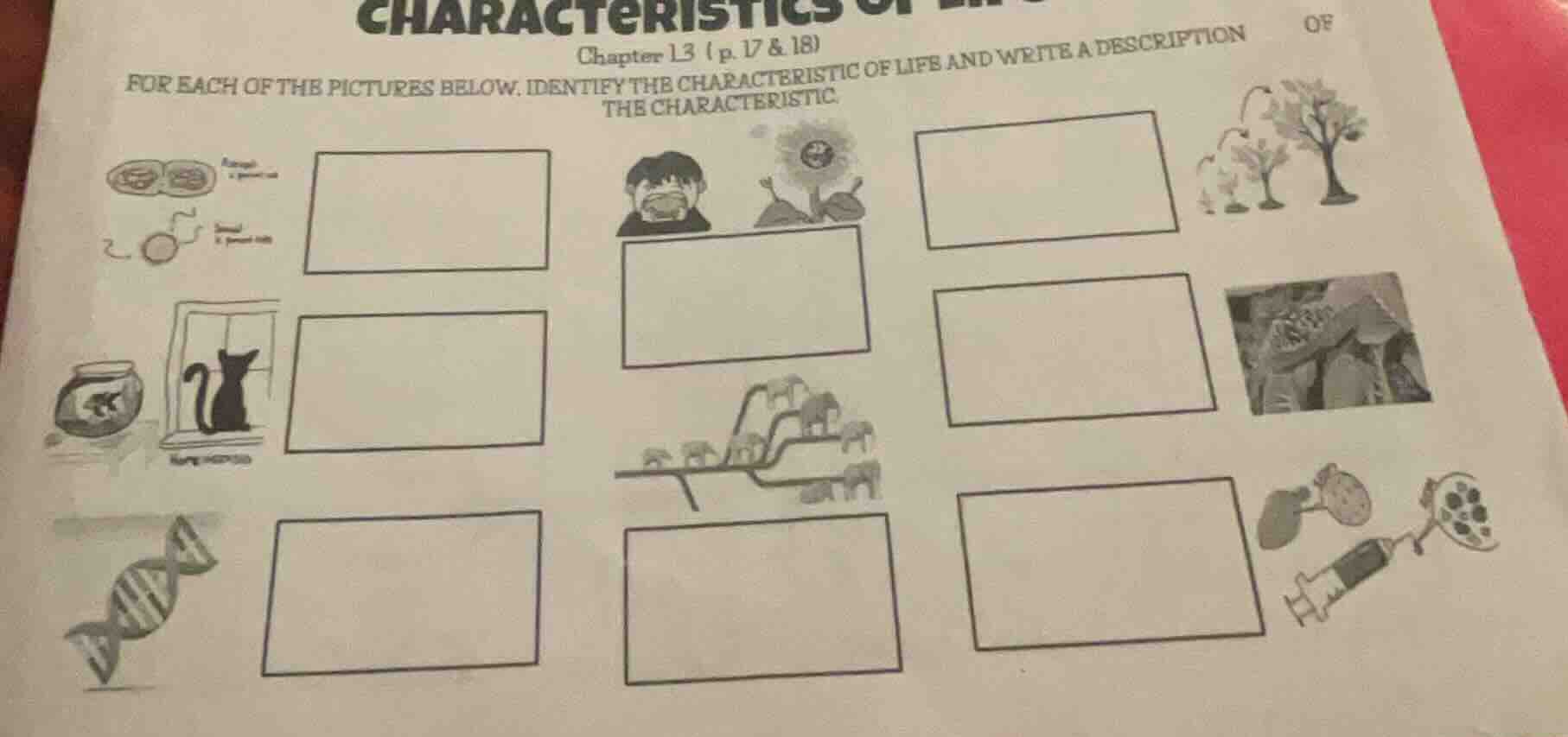
for each of the pictures below, identify the characteristic of life and write a description of the characteristic.
To solve this, we analyze each picture based on characteristics of life (e.g., reproduction, growth, response to stimuli, organization, heredity, evolution, metabolism, homeostasis):
1. First Picture (Cell Division - Bacteria)
- Characteristic: Reproduction (or Cell Division)
- Description: Organisms produce offspring (or cells divide to make more cells). Bacteria reproduce asexually, shown by one bacterium becoming two.
2. Second Picture (Child Eating, Sunflower)
- Characteristic: Metabolism (Obtaining Energy/Nutrients)
- Description: Organisms take in materials for energy, growth, and repair. The child eats food, and the sunflower performs photosynthesis to get energy.
3. Third Picture (Plant Growth Stages)
- Characteristic: Growth and Development
- Description: Organisms increase in size and change over time. The plant grows from a seedling to a mature tree.
4. Fourth Picture (Fish in Tank, Cat at Window)
- Characteristic: Response to Stimuli (or Interaction with Environment)
- Description: Organisms react to their surroundings. The cat responds to the fish (or its environment), and the fish interacts with its tank environment.
5. Fifth Picture (DNA)
- Characteristic: Heredity (Passing Traits)
- Description: Organisms pass genetic information to offspring. DNA carries genes that are inherited.
6. Sixth Picture (Evolutionary Tree - Elephants)
- Characteristic: Evolution (Change Over Time in Populations)
- Description: Species change over generations. The tree shows elephant species evolving from a common ancestor.
7. Seventh Picture (Venus Flytrap)
- Characteristic: Response to Stimuli (or Adaptation for Nutrition)
- Description: The Venus flytrap responds to prey (stimulus) by closing its trap to obtain nutrients, showing adaptation and response.
8. Eighth Picture (Organ Transplants/Cell)
- Characteristic: Homeostasis (or Organization - Cells/Organs)
- Description: Organisms maintain internal balance (homeostasis) or are organized (cells → tissues → organs). The image shows organs (liver, pancreas) and cells, highlighting biological organization or medical efforts to maintain health (homeostasis).
For each blank, match the picture to the characteristic and write the description (e.g., for the first cell division picture: Characteristic: Reproduction; Description: Bacteria reproduce by cell division, creating more cells).

Snap & solve any problem in the app
Get step-by-step solutions on Sovi AI
Photo-based solutions with guided steps
Explore more problems and detailed explanations
To solve this, we analyze each picture based on characteristics of life (e.g., reproduction, growth, response to stimuli, organization, heredity, evolution, metabolism, homeostasis):
1. First Picture (Cell Division - Bacteria)
- Characteristic: Reproduction (or Cell Division)
- Description: Organisms produce offspring (or cells divide to make more cells). Bacteria reproduce asexually, shown by one bacterium becoming two.
2. Second Picture (Child Eating, Sunflower)
- Characteristic: Metabolism (Obtaining Energy/Nutrients)
- Description: Organisms take in materials for energy, growth, and repair. The child eats food, and the sunflower performs photosynthesis to get energy.
3. Third Picture (Plant Growth Stages)
- Characteristic: Growth and Development
- Description: Organisms increase in size and change over time. The plant grows from a seedling to a mature tree.
4. Fourth Picture (Fish in Tank, Cat at Window)
- Characteristic: Response to Stimuli (or Interaction with Environment)
- Description: Organisms react to their surroundings. The cat responds to the fish (or its environment), and the fish interacts with its tank environment.
5. Fifth Picture (DNA)
- Characteristic: Heredity (Passing Traits)
- Description: Organisms pass genetic information to offspring. DNA carries genes that are inherited.
6. Sixth Picture (Evolutionary Tree - Elephants)
- Characteristic: Evolution (Change Over Time in Populations)
- Description: Species change over generations. The tree shows elephant species evolving from a common ancestor.
7. Seventh Picture (Venus Flytrap)
- Characteristic: Response to Stimuli (or Adaptation for Nutrition)
- Description: The Venus flytrap responds to prey (stimulus) by closing its trap to obtain nutrients, showing adaptation and response.
8. Eighth Picture (Organ Transplants/Cell)
- Characteristic: Homeostasis (or Organization - Cells/Organs)
- Description: Organisms maintain internal balance (homeostasis) or are organized (cells → tissues → organs). The image shows organs (liver, pancreas) and cells, highlighting biological organization or medical efforts to maintain health (homeostasis).
For each blank, match the picture to the characteristic and write the description (e.g., for the first cell division picture: Characteristic: Reproduction; Description: Bacteria reproduce by cell division, creating more cells).