QUESTION IMAGE
Question
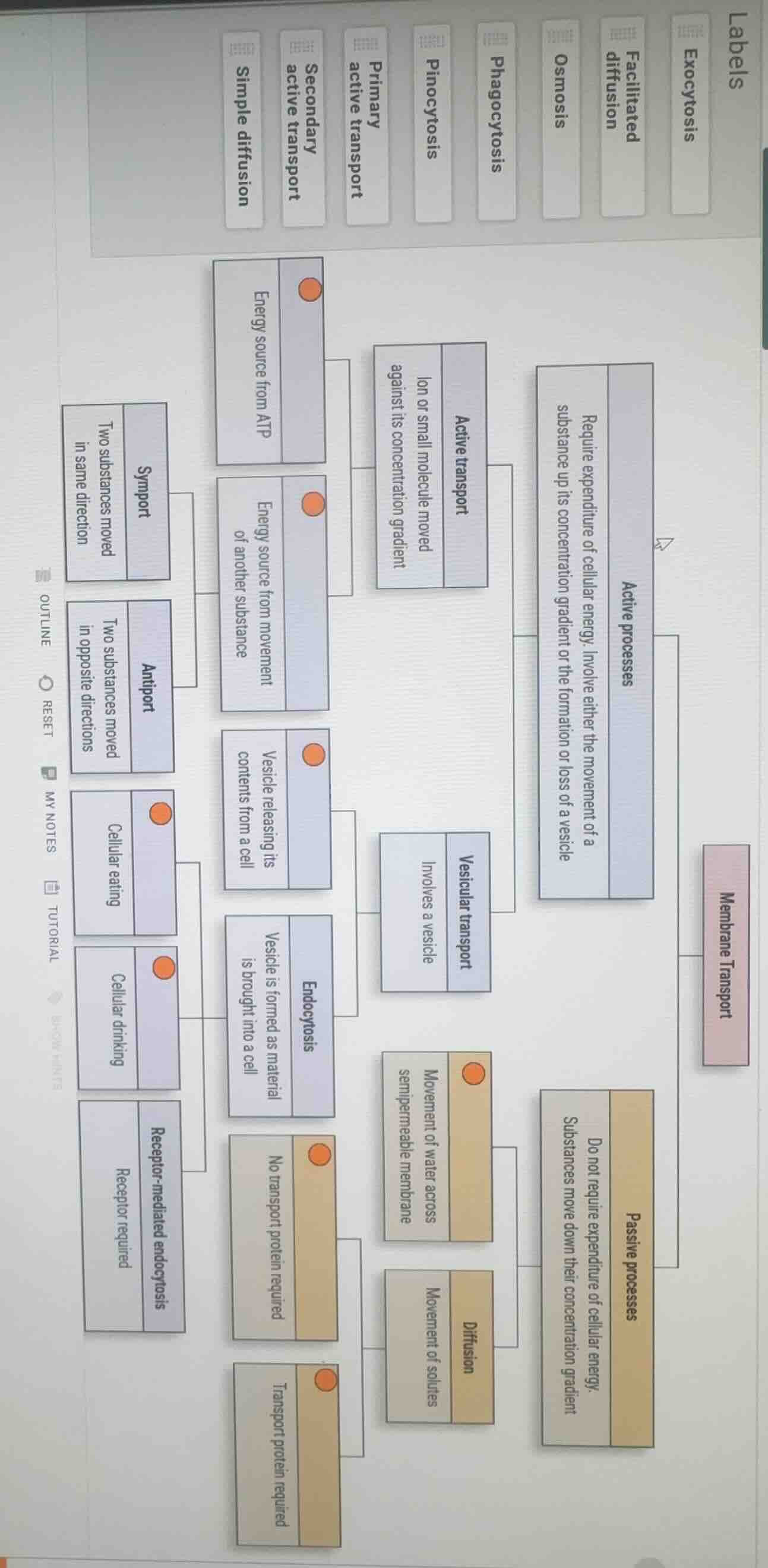
the chart is about membrane transport, including active processes and passive processes. active processes: require expenditure of cellular energy. involve either the movement of a substance up its concentration gradient or the formation or loss of a vesicle. it includes active transport (ion or small molecule moved against its concentration gradient) and vesicular transport (involves a vesicle). active transport is divided into primary active transport (energy source from atp), secondary active transport (energy source from movement of another substance), and also has symport (two substances moved in same direction) and antiport (two substances moved in opposite directions). vesicular transport includes exocytosis (vesicle releasing its contents from a cell) and endocytosis. endocytosis is divided into phagocytosis (cellular eating), pinocytosis (cellular drinking), and receptor - mediated endocytosis (receptor required). passive processes: do not require expenditure of cellular energy. substances move down their concentration gradient. it includes osmosis (movement of water across semipermeable membrane) and diffusion. diffusion is divided into simple diffusion (no transport protein required) and facilitated diffusion (transport protein required).
To solve the membrane transport concept map, we analyze each category and match with the labels:
Active Processes
- Active transport: Moves ions/small molecules against concentration gradient.
- Primary active transport: Energy from ATP (matches "Energy source from ATP").
- Secondary active transport: Energy from movement of another substance (matches "Energy source from movement of another substance").
- Symport/Antiport: Subtypes of secondary active transport (symport: same direction; antiport: opposite direction).
- Vesicular transport: Involves vesicles.
- Exocytosis: Vesicle releases contents from cell (matches "Vesicle releasing its contents from a cell").
- Endocytosis: Vesicle forms as material enters cell (matches "Vesicle is formed as material is brought into a cell").
- Phagocytosis: Cellular eating (matches "Cellular eating").
- Pinocytosis: Cellular drinking (matches "Cellular drinking").
- Receptor - mediated endocytosis: Requires receptors (matches "Receptor - mediated endocytosis; Receptor required").
Passive Processes
- Passive processes: No energy needed; substances move down concentration gradient.
- Osmosis: Movement of water across a semipermeable membrane (matches "Movement of water across semipermeable membrane").
- Diffusion: Movement of solutes.
- Simple diffusion: No transport protein needed (matches "No transport protein required").
- Facilitated diffusion: Transport protein required (matches "Transport protein required").
Final Label Matching (from top - to - bottom, left - to - right for active/passive branches):
- Active processes → "Require expenditure of cellular energy..."
- Active transport → "Ion or small molecule moved against its concentration gradient"
- Primary active transport → "Energy source from ATP"
- Secondary active transport → "Energy source from movement of another substance"
- Symport → "Two substances moved in same direction"
- Antiport → "Two substances moved in opposite directions"
- Vesicular transport → "Involves a vesicle"
- Exocytosis → "Vesicle releasing its contents from a cell"
- Endocytosis → "Vesicle is formed as material is brought into a cell"
- Phagocytosis → "Cellular eating"
- Pinocytosis → "Cellular drinking"
- Receptor - mediated endocytosis → "Receptor - mediated endocytosis; Receptor required"
- Passive processes → "Do not require expenditure of cellular energy..."
- Osmosis → "Movement of water across semipermeable membrane"
- Diffusion → "Movement of solutes"
- Simple diffusion → "No transport protein required"
- Facilitated diffusion → "Transport protein required"

Snap & solve any problem in the app
Get step-by-step solutions on Sovi AI
Photo-based solutions with guided steps
Explore more problems and detailed explanations
(Key Matches):
- Primary active transport: Energy source from ATP
- Secondary active transport: Energy source from movement of another substance
- Symport: Two substances moved in same direction
- Antiport: Two substances moved in opposite directions
- Exocytosis: Vesicle releasing its contents from a cell
- Endocytosis: Vesicle is formed as material is brought into a cell
- Phagocytosis: Cellular eating
- Pinocytosis: Cellular drinking
- Receptor - mediated endocytosis: Receptor - mediated endocytosis; Receptor required
- Osmosis: Movement of water across semipermeable membrane
- Simple diffusion: No transport protein required
- Facilitated diffusion: Transport protein required
(Note: The exact answer depends on the specific labeling task, but the above explains how to map each concept to the labels.)