QUESTION IMAGE
Question
check for understanding
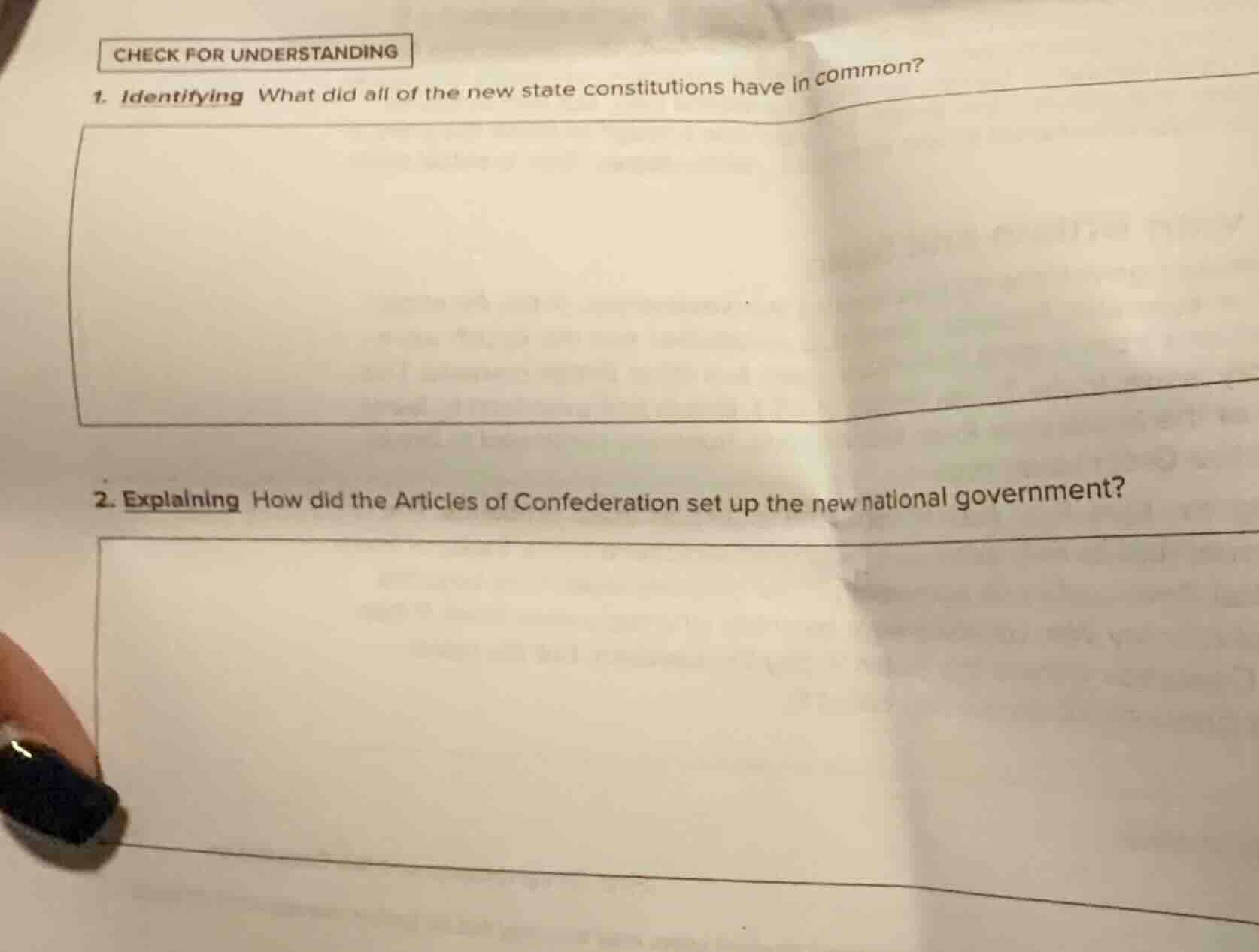
- identifying what did all of the new state constitutions have in common?
- explaining how did the articles of confederation set up the new national government?
Question 1
New state constitutions after the American Revolution commonly included elements like popular sovereignty (power from the people), bill of rights (protecting individual liberties), separation of powers (dividing government functions), and limiting government power, often with a republican form of government (representative democracy) and provisions for amending the constitution. They also emphasized individual rights, rule of law, and a structure to govern the state with checks on power.
The Articles of Confederation established a confederation (a loose alliance) of sovereign states. It created a single - chamber Continental Congress where each state had one vote, with no separate executive or judicial branches. The national government had limited powers: it could declare war, make treaties, coin money, and manage relations with Native Americans, but it could not tax states directly, regulate trade, or enforce laws (relying on states to comply). States retained most sovereignty, and amendments to the Articles required unanimous state approval.

Snap & solve any problem in the app
Get step-by-step solutions on Sovi AI
Photo-based solutions with guided steps
Explore more problems and detailed explanations
All new state constitutions commonly included popular sovereignty (power derived from the people), a bill of rights (protecting individual liberties), separation of powers (dividing government into legislative, executive, and judicial branches), a republican form of government (representative democracy), and mechanisms to limit government power (e.g., term limits, checks on authority) while prioritizing individual rights, rule of law, and procedures for amending the constitution.