QUESTION IMAGE
Question
choose the correct word to complete each sentence. answers may be used more than once.
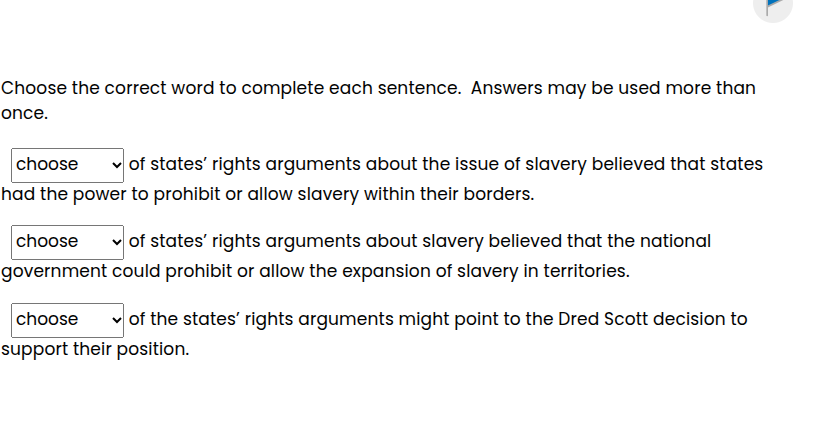
____ of states’ rights arguments about the issue of slavery believed that states had the power to prohibit or allow slavery within their borders.
____ of states’ rights arguments about slavery believed that the national government could prohibit or allow the expansion of slavery in territories.
____ of the states’ rights arguments might point to the dred scott decision to support their position.
To solve this, we analyze each sentence based on states' rights and slavery arguments:
Sentence 1:
Supporters of states’ rights (who believed states had power over slavery within their borders) would fit. The term is Supporters (or a similar term emphasizing those who backed states’ authority).
Sentence 2:
Opponents of states’ rights (who believed the national government controlled slavery in territories) would fit. The term is Opponents (or a similar term emphasizing those who favored federal authority over states’ rights here).
Sentence 3:
Either side (Supporters or Opponents) could use the Dred Scott decision (which limited federal power over slavery in territories, favoring states’ rights in a way) to support their position. So a term like Either side or a specific group (e.g., Supporters if they use it to show states’ power, or Opponents if framed differently) works.
Filled Answers (common historical terms):
- Supporters of states’ rights arguments about the issue of slavery believed that states had the power to prohibit or allow slavery within their borders.
- Opponents of states’ rights arguments about slavery believed that the national government could prohibit or allow the expansion of slavery in territories.
- Supporters (or Either side) of the states’ rights arguments might point to the Dred Scott decision to support their position.
(Note: The exact word depends on the provided word bank, but these are the logical historical terms. If a word bank had options like "Supporters," "Opponents," "Proponents," etc., these would align.)

Snap & solve any problem in the app
Get step-by-step solutions on Sovi AI
Photo-based solutions with guided steps
Explore more problems and detailed explanations
To solve this, we analyze each sentence based on states' rights and slavery arguments:
Sentence 1:
Supporters of states’ rights (who believed states had power over slavery within their borders) would fit. The term is Supporters (or a similar term emphasizing those who backed states’ authority).
Sentence 2:
Opponents of states’ rights (who believed the national government controlled slavery in territories) would fit. The term is Opponents (or a similar term emphasizing those who favored federal authority over states’ rights here).
Sentence 3:
Either side (Supporters or Opponents) could use the Dred Scott decision (which limited federal power over slavery in territories, favoring states’ rights in a way) to support their position. So a term like Either side or a specific group (e.g., Supporters if they use it to show states’ power, or Opponents if framed differently) works.
Filled Answers (common historical terms):
- Supporters of states’ rights arguments about the issue of slavery believed that states had the power to prohibit or allow slavery within their borders.
- Opponents of states’ rights arguments about slavery believed that the national government could prohibit or allow the expansion of slavery in territories.
- Supporters (or Either side) of the states’ rights arguments might point to the Dred Scott decision to support their position.
(Note: The exact word depends on the provided word bank, but these are the logical historical terms. If a word bank had options like "Supporters," "Opponents," "Proponents," etc., these would align.)