QUESTION IMAGE
Question
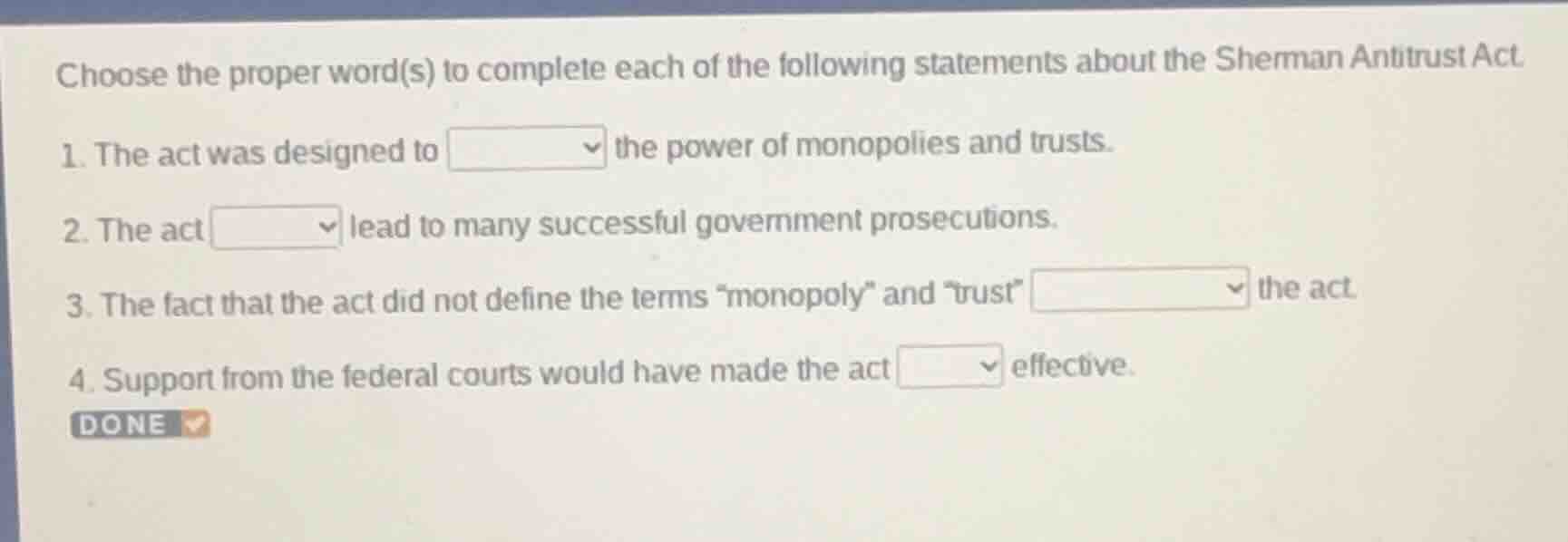
choose the proper word(s) to complete each of the following statements about the sherman antitrust act
- the act was designed to
the power of monopolies and trusts.
- the act
lead to many successful government prosecutions.
- the fact that the act did not define the terms \monopoly\ and \trust\
the act.
- support from the federal courts would have made the act
effective.
done
To solve this, we analyze each statement based on the Sherman Antitrust Act's history and purpose:
Statement 1
The Sherman Antitrust Act aimed to restrict (or similar terms like "limit") the power of monopolies/trusts. The context of antitrust legislation is to curb excessive market power, so a word like "restrict" (or "limit," "reduce") fits.
Statement 2
Historically, the Sherman Act did not (or "failed to") lead to many successful prosecutions initially (due to vague definitions and judicial interpretations). So "did not" is appropriate.
Statement 3
Not defining "monopoly" and "trust" weakened (or "hampered," "limited") the act, as ambiguity made enforcement difficult. Thus, a word like "weakened" works.
Statement 4
Federal court support would have made the act more effective (since judicial backing is critical for enforcement). So "more" is the logical choice.
Final Answers (assuming common dropdown options, e.g., for each blank):
- restrict (or limit/reduce)
- did not
- weakened (or hampered/limited)
- more
(Note: Exact wording depends on dropdown options, but the above reflects historical context and logical meaning.)

Snap & solve any problem in the app
Get step-by-step solutions on Sovi AI
Photo-based solutions with guided steps
Explore more problems and detailed explanations
To solve this, we analyze each statement based on the Sherman Antitrust Act's history and purpose:
Statement 1
The Sherman Antitrust Act aimed to restrict (or similar terms like "limit") the power of monopolies/trusts. The context of antitrust legislation is to curb excessive market power, so a word like "restrict" (or "limit," "reduce") fits.
Statement 2
Historically, the Sherman Act did not (or "failed to") lead to many successful prosecutions initially (due to vague definitions and judicial interpretations). So "did not" is appropriate.
Statement 3
Not defining "monopoly" and "trust" weakened (or "hampered," "limited") the act, as ambiguity made enforcement difficult. Thus, a word like "weakened" works.
Statement 4
Federal court support would have made the act more effective (since judicial backing is critical for enforcement). So "more" is the logical choice.
Final Answers (assuming common dropdown options, e.g., for each blank):
- restrict (or limit/reduce)
- did not
- weakened (or hampered/limited)
- more
(Note: Exact wording depends on dropdown options, but the above reflects historical context and logical meaning.)