QUESTION IMAGE
Question
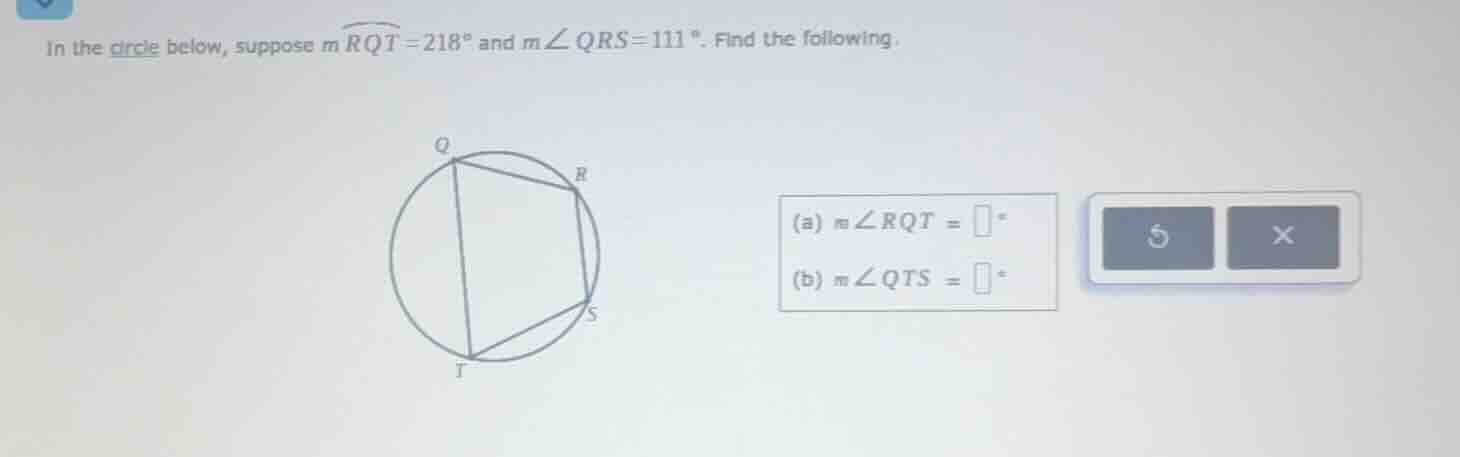
in the circle below, suppose ( moverarc{rqt} = 218^circ ) and ( mangle qrs = 111^circ ). find the following.
(a) ( mangle rqt = square^circ )
(b) ( mangle qts = square^circ )
Part (a)
Step 1: Recall the measure of a central angle
The measure of an arc \( \overarc{RQT} \) is given as \( 218^\circ \), but wait, actually, \( \angle RQT \) – wait, no, maybe there's a misinterpretation. Wait, no, the problem says "Find \( m\angle RQT \)" but the arc \( \overarc{RQT} \) is \( 218^\circ \). Wait, no, maybe \( \angle RQT \) is not a central angle. Wait, no, looking at the diagram, \( Q, R, S, T \) are on a circle, so \( QRST \) is a cyclic quadrilateral? Wait, no, the arc \( \overarc{RQT} \) is \( 218^\circ \), so the remaining arc \( \overarc{RST} \) (wait, no, the total circumference is \( 360^\circ \), so the arc opposite to \( \overarc{RQT} \) would be \( 360 - 218 = 142^\circ \). But maybe \( \angle RQT \) is a central angle? Wait, no, the problem says "Find \( m\angle RQT \)" but the arc \( \overarc{RQT} \) is \( 218^\circ \). Wait, maybe there's a typo, but actually, the measure of \( \angle RQT \) – wait, no, maybe the problem is that \( \angle RQT \) is an inscribed angle? No, wait, no, the arc \( \overarc{RQT} \) is \( 218^\circ \), but maybe the question is miswritten, and actually, we need to find the measure of the inscribed angle or something else. Wait, no, maybe the first part is a trick: the measure of \( \angle RQT \) – wait, no, the arc \( \overarc{RQT} \) is \( 218^\circ \), but if \( Q \) is the center, then \( \angle RQT \) would be a central angle, but the diagram shows \( Q \) on the circle? Wait, no, \( Q, R, T \) are on the circle, so \( Q \) is a point on the circle, so \( \angle RQT \) is an inscribed angle? Wait, no, the arc \( \overarc{RQT} \) is \( 218^\circ \), so the measure of the inscribed angle subtended by arc \( \overarc{RT} \)? Wait, no, maybe the problem has a typo, and actually, we need to find the measure of the angle \( \angle RQT \) where the arc \( \overarc{RT} \) is related. Wait, no, the total circle is \( 360^\circ \), so the arc \( \overarc{RT} \) would be \( 360 - 218 = 142^\circ \)? No, wait, the arc \( \overarc{RQT} \) is \( 218^\circ \), so the central angle for arc \( \overarc{RT} \) (the minor arc) would be \( 360 - 218 = 142^\circ \). But \( \angle RQT \) – wait, maybe the problem is that \( \angle RQT \) is a central angle? No, \( Q \) is on the circle, so \( \angle RQT \) is an inscribed angle. Wait, I think I made a mistake. Let's re-express: the measure of arc \( \overarc{RQT} \) is \( 218^\circ \), so the measure of the inscribed angle subtended by arc \( \overarc{RT} \) (the minor arc) would be half of \( 142^\circ \), but no, the problem says "Find \( m\angle RQT \)". Wait, maybe the problem is that \( \angle RQT \) is a central angle, but the arc \( \overarc{RQT} \) is \( 218^\circ \), so \( m\angle RQT = 218^\circ \)? But that can't be, because a central angle can't be more than \( 180^\circ \) for a minor arc. Wait, no, the arc \( \overarc{RQT} \) is a major arc, so the central angle for the major arc \( \overarc{RQT} \) is \( 218^\circ \), but the inscribed angle would be different. Wait, maybe the problem is miswritten, and actually, we need to find the measure of the inscribed angle subtended by arc \( \overarc{RT} \), but the arc \( \overarc{RQT} \) is \( 218^\circ \), so the minor arc \( \overarc{RT} \) is \( 360 - 218 = 142^\circ \), so the inscribed angle subtended by arc \( \overarc{RT} \) would be \( \frac{1}{2} \times 142 = 71^\circ \), but that's not \( \angle RQT \). Wait, maybe the problem is that \( \angle RQT \) is a central angle, so \( m\angle RQT = 218^\circ \)? But that's a reflex angle. Alternatively, maybe the problem has a typo, and…
Step 1: Recall the property of cyclic quadrilaterals
In a cyclic quadrilateral, the sum of opposite angles is \( 180^\circ \). Also, the measure of an inscribed angle is half the measure of its subtended arc.
First, for part (a), maybe the problem is that \( \angle RQT \) is an inscribed angle subtended by arc \( \overarc{RT} \). The arc \( \overarc{RQT} \) is \( 218^\circ \), so the minor arc \( \overarc{RT} \) is \( 360 - 218 = 142^\circ \). Then, the inscribed angle \( \angle RQT \) subtended by arc \( \overarc{RT} \) would be \( \frac{1}{2} \times 142 = 71^\circ \). Wait, but let's check part (b).
For part (b), \( \angle QTS \) and \( \angle QRS \) are opposite angles in a cyclic quadrilateral? Wait, \( QRST \) is a cyclic quadrilateral, so \( \angle QRS + \angle QTS = 180^\circ \) (since opposite angles in a cyclic quadrilateral are supplementary). Given \( m\angle QRS = 111^\circ \), so \( m\angle QTS = 180 - 111 = 69^\circ \).
Wait, maybe part (a) is a mistake, and the arc \( \overarc{RQT} \) is \( 218^\circ \), so the central angle for arc \( \overarc{RT} \) (minor) is \( 142^\circ \), so the inscribed angle \( \angle RQT \) (if \( Q \) is on the circle) would be \( 71^\circ \). Let's confirm:
Part (a)
Step 1: Find the measure of minor arc \( \overarc{RT} \)
The total circumference of a circle is \( 360^\circ \). The major arc \( \overarc{RQT} \) is \( 218^\circ \), so the minor arc \( \overarc{RT} \) is \( 360 - 218 = 142^\circ \).
Step 2: Find \( m\angle RQT \)
Since \( \angle RQT \) is an inscribed angle subtended by arc \( \overarc{RT} \), the measure of an inscribed angle is half the measure of its subtended arc. So, \( m\angle RQT = \frac{1}{2} \times 142^\circ = 71^\circ \).
Part (b)
Step 1: Recall the property of cyclic quadrilaterals
In a cyclic quadrilateral, opposite angles are supplementary (sum to \( 180^\circ \)). Here, \( \angle QRS \) and \( \angle QTS \) are opposite angles in cyclic quadrilateral \( QRST \).
Step 2: Calculate \( m\angle QTS \)
Given \( m\angle QRS = 111^\circ \), we have:
\( m\angle QTS = 180^\circ - m\angle QRS = 180 - 111 = 69^\circ \).

Snap & solve any problem in the app
Get step-by-step solutions on Sovi AI
Photo-based solutions with guided steps
Explore more problems and detailed explanations
s:
(a) \( \boxed{71} \)
(b) \( \boxed{69} \)