QUESTION IMAGE
Question
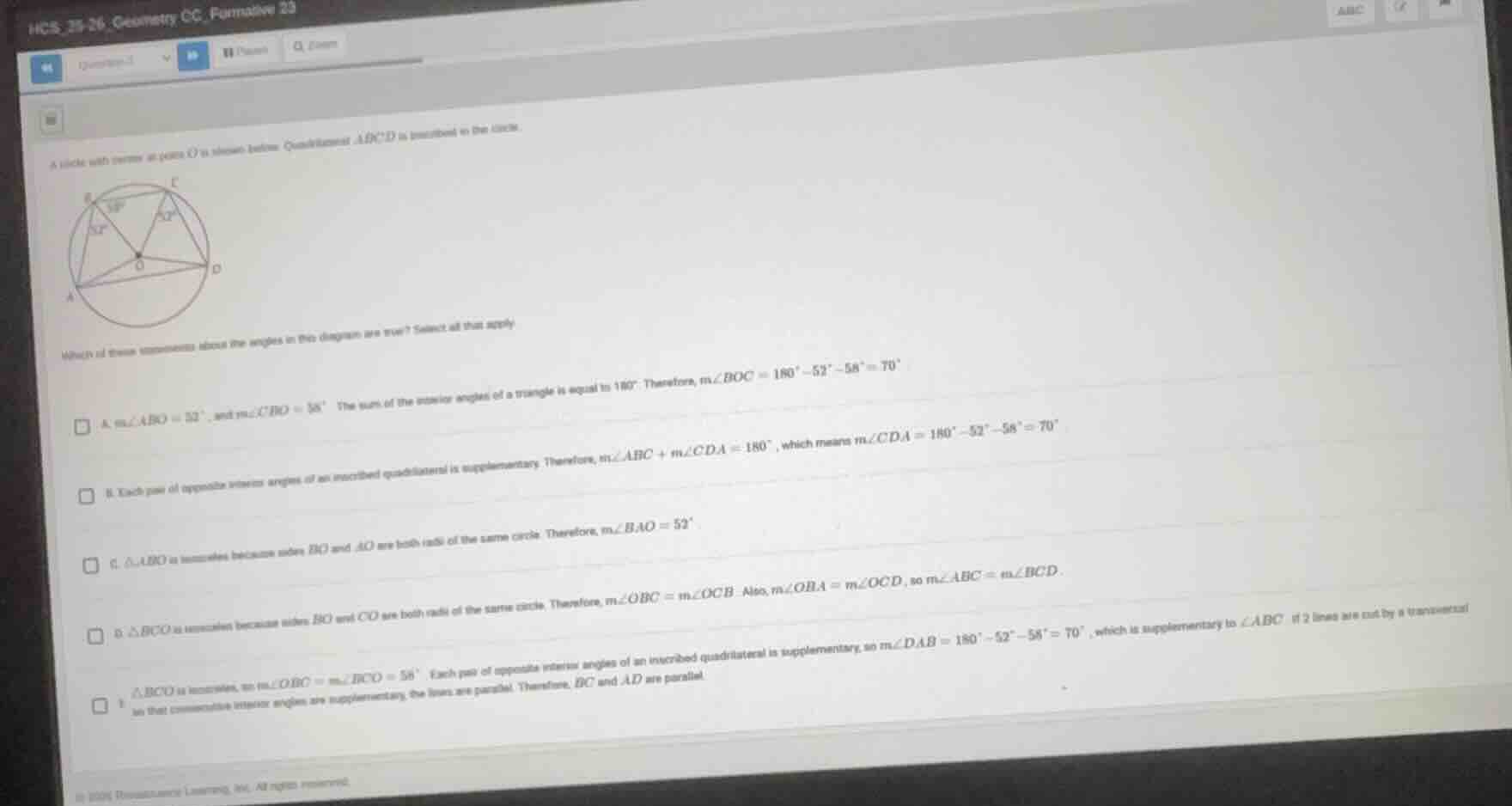
a circle with center at point o is shown below. quadrilateral abcd is inscribed in the circle. which of these statements about the angles in the diagram are true? select all that apply.
a. ( mangle abo = 52^circ ), and ( mangle cbo = 58^circ ). the sum of the interior angles of a triangle is equal to ( 180^circ ). therefore, ( mangle boc = 180^circ - 52^circ - 58^circ = 70^circ )
b. each pair of opposite interior angles of an inscribed quadrilateral is supplementary. therefore, ( mangle abc + mangle cda = 180^circ ), which means ( mangle cda = 180^circ - 52^circ - 58^circ = 70^circ )
c. ( \triangle abo ) is isosceles because sides bo and ao are both radii of the same circle. therefore, ( mangle bao = 52^circ ).
d. ( \triangle bco ) is isosceles because sides bo and co are both radii of the same circle. therefore, ( mangle obc = mangle ocb ). also, ( mangle oba = mangle ocd ), so ( mangle abc = mangle bcd ).
e. ( \triangle bco ) is isosceles, so ( mangle obc = mangle bco = 58^circ ). each pair of opposite interior angles of an inscribed quadrilateral is supplementary, so ( mangle dab = 180^circ - 52^circ - 58^circ = 70^circ ), which is supplementary to ( angle abc ). if 2 lines are cut by a transversal so that consecutive interior angles are supplementary, the lines are parallel. therefore, bc and ad are parallel.
- Option A: In $\triangle ABO$, $BO = AO$ (radii), so $\triangle ABO$ is isosceles. If $m\angle ABO = 52^\circ$, then $m\angle BAO = 52^\circ$. In $\triangle BOC$, sum of angles is $180^\circ$. If $m\angle OBC = 58^\circ$ and $m\angle OCB = 52^\circ$ (wait, no, the calculation for $m\angle BOC$ is $180 - 52 - 58 = 70^\circ$, so the angles at $B$ and $C$ in $\triangle BOC$ should add to $110^\circ$. Wait, maybe the angles given for $\angle ABO$ and $\angle CBO$ sum to $\angle ABC$. But the logic for $m\angle BOC$ is correct (sum of triangle angles). So A's angle sum part for $\triangle BOC$ is correct, but need to check the angle labels. However, let's check other options.
- Option B: Inscribed quadrilateral has opposite angles supplementary. So $m\angle ABC + m\angle CDA = 180^\circ$. If $\angle ABC = 52 + 58 = 110^\circ$, then $m\angle CDA = 180 - 110 = 70^\circ$, which matches $180 - 52 - 58 = 70^\circ$ (assuming $\angle ABC$ is $52 + 58$). So B is correct.
- Option C: $\triangle ABO$ has $BO = AO$ (radii), so it's isosceles. If $m\angle ABO = 52^\circ$, then $m\angle BAO = 52^\circ$ (base angles of isosceles triangle). Correct.
- Option D: $\triangle BCO$ has $BO = CO$ (radii), so isosceles, so $m\angle OBC = m\angle OCB$. But the second part says $m\angle OBA = m\angle OCD$, which is not necessarily true. Also, $m\angle ABC = m\angle BCD$? No, that's not a valid conclusion. So D is incorrect.
- Option E: $\triangle BCO$ is isosceles, so $m\angle OBC = m\angle OCB = 58^\circ$ (assuming). Then $m\angle DAB$: Inscribed quadrilateral, $\angle DAB$ and $\angle BCD$? Wait, the logic says $m\angle DAB = 180 - 52 - 58 = 70^\circ$, and since $\angle ABC$ is $110^\circ$, they are supplementary (consecutive interior angles), so $BC \parallel AD$. Let's check: If $m\angle DAB = 70^\circ$ and $m\angle ABC = 110^\circ$, then $70 + 110 = 180^\circ$, so consecutive interior angles are supplementary, hence parallel. So E's angle calculation for $m\angle DAB$ (using supplementary of $\angle ABC$) and the parallel lines conclusion is correct. Wait, but the first part: $\triangle BCO$ is isosceles, so $m\angle OBC = m\angle OCB = 58^\circ$ (if that's given). Then $m\angle DAB$: Let's see, $\angle DAB$ is an inscribed angle? Or using triangle angles. The calculation $180 - 52 - 58 = 70^\circ$ for $m\angle DAB$: If $\angle DAB$ is in a triangle with angles 52 and 58, but maybe that's a different triangle. However, the consecutive interior angles being supplementary (70 and 110) implies parallel lines. So E's logic for parallel lines is correct if the angle calculations hold.
Wait, maybe I made a mistake. Let's re-express:
- Option A: The first part says $m\angle ABO = 52^\circ$ and $m\angle CBO = 58^\circ$. Then $\angle ABC = 52 + 58 = 110^\circ$. In $\triangle BOC$, $BO = CO$ (radii), so it's isosceles? No, $BO$ and $CO$ are radii, so $\triangle BOC$ is isosceles with $BO = CO$. Wait, the angles at $B$ and $C$ in $\triangle BOC$: If $m\angle OBC = 58^\circ$, then $m\angle OCB = 58^\circ$, so $m\angle BOC = 180 - 58 - 58 = 64^\circ$? Wait, no, the original A says $m\angle BOC = 180 - 52 - 58 = 70^\circ$. So maybe $\angle OBC = 58^\circ$ and $\angle OCB = 52^\circ$? That would mean $\triangle BOC$ is not isosceles, which contradicts $BO = CO$. So A's angle labels for $\triangle BOC$'s angles are wrong, but the angle sum calculation is correct (180 - 52 - 58 = 70). Wait, maybe the angles at $B$ and $C$ in $\triangle BOC$ are 52 and 58, so sum to 110, so $m\angle BOC = 70$. So A's first part (angle labels) may be correct if $\an…

Snap & solve any problem in the app
Get step-by-step solutions on Sovi AI
Photo-based solutions with guided steps
Explore more problems and detailed explanations
- Option A: In $\triangle ABO$, $BO = AO$ (radii), so $\triangle ABO$ is isosceles. If $m\angle ABO = 52^\circ$, then $m\angle BAO = 52^\circ$. In $\triangle BOC$, sum of angles is $180^\circ$. If $m\angle OBC = 58^\circ$ and $m\angle OCB = 52^\circ$ (wait, no, the calculation for $m\angle BOC$ is $180 - 52 - 58 = 70^\circ$, so the angles at $B$ and $C$ in $\triangle BOC$ should add to $110^\circ$. Wait, maybe the angles given for $\angle ABO$ and $\angle CBO$ sum to $\angle ABC$. But the logic for $m\angle BOC$ is correct (sum of triangle angles). So A's angle sum part for $\triangle BOC$ is correct, but need to check the angle labels. However, let's check other options.
- Option B: Inscribed quadrilateral has opposite angles supplementary. So $m\angle ABC + m\angle CDA = 180^\circ$. If $\angle ABC = 52 + 58 = 110^\circ$, then $m\angle CDA = 180 - 110 = 70^\circ$, which matches $180 - 52 - 58 = 70^\circ$ (assuming $\angle ABC$ is $52 + 58$). So B is correct.
- Option C: $\triangle ABO$ has $BO = AO$ (radii), so it's isosceles. If $m\angle ABO = 52^\circ$, then $m\angle BAO = 52^\circ$ (base angles of isosceles triangle). Correct.
- Option D: $\triangle BCO$ has $BO = CO$ (radii), so isosceles, so $m\angle OBC = m\angle OCB$. But the second part says $m\angle OBA = m\angle OCD$, which is not necessarily true. Also, $m\angle ABC = m\angle BCD$? No, that's not a valid conclusion. So D is incorrect.
- Option E: $\triangle BCO$ is isosceles, so $m\angle OBC = m\angle OCB = 58^\circ$ (assuming). Then $m\angle DAB$: Inscribed quadrilateral, $\angle DAB$ and $\angle BCD$? Wait, the logic says $m\angle DAB = 180 - 52 - 58 = 70^\circ$, and since $\angle ABC$ is $110^\circ$, they are supplementary (consecutive interior angles), so $BC \parallel AD$. Let's check: If $m\angle DAB = 70^\circ$ and $m\angle ABC = 110^\circ$, then $70 + 110 = 180^\circ$, so consecutive interior angles are supplementary, hence parallel. So E's angle calculation for $m\angle DAB$ (using supplementary of $\angle ABC$) and the parallel lines conclusion is correct. Wait, but the first part: $\triangle BCO$ is isosceles, so $m\angle OBC = m\angle OCB = 58^\circ$ (if that's given). Then $m\angle DAB$: Let's see, $\angle DAB$ is an inscribed angle? Or using triangle angles. The calculation $180 - 52 - 58 = 70^\circ$ for $m\angle DAB$: If $\angle DAB$ is in a triangle with angles 52 and 58, but maybe that's a different triangle. However, the consecutive interior angles being supplementary (70 and 110) implies parallel lines. So E's logic for parallel lines is correct if the angle calculations hold.
Wait, maybe I made a mistake. Let's re-express:
- Option A: The first part says $m\angle ABO = 52^\circ$ and $m\angle CBO = 58^\circ$. Then $\angle ABC = 52 + 58 = 110^\circ$. In $\triangle BOC$, $BO = CO$ (radii), so it's isosceles? No, $BO$ and $CO$ are radii, so $\triangle BOC$ is isosceles with $BO = CO$. Wait, the angles at $B$ and $C$ in $\triangle BOC$: If $m\angle OBC = 58^\circ$, then $m\angle OCB = 58^\circ$, so $m\angle BOC = 180 - 58 - 58 = 64^\circ$? Wait, no, the original A says $m\angle BOC = 180 - 52 - 58 = 70^\circ$. So maybe $\angle OBC = 58^\circ$ and $\angle OCB = 52^\circ$? That would mean $\triangle BOC$ is not isosceles, which contradicts $BO = CO$. So A's angle labels for $\triangle BOC$'s angles are wrong, but the angle sum calculation is correct (180 - 52 - 58 = 70). Wait, maybe the angles at $B$ and $C$ in $\triangle BOC$ are 52 and 58, so sum to 110, so $m\angle BOC = 70$. So A's first part (angle labels) may be correct if $\angle ABO = 52$ and $\angle CBO = 58$, making $\angle ABC = 110$, and in $\triangle BOC$, angles at $B$ and $C$ are 58 and 52, so sum to 110, so $m\angle BOC = 70$. So A's angle sum for $\triangle BOC$ is correct.
But let's confirm the correct options:
- Option B: Correct (inscribed quadrilateral opposite angles supplementary).
- Option C: Correct (isosceles triangle base angles equal).
- Option E: Correct (consecutive interior angles supplementary implies parallel lines, and angle calculation for $m\angle DAB$ is correct as supplementary to $\angle ABC$).
- Option A: The angle sum for $\triangle BOC$ is correct, but the angle labels ($\angle ABO = 52$, $\angle CBO = 58$) sum to $\angle ABC = 110$, and in $\triangle BOC$, angles at $B$ and $C$ are 58 and 52 (so $m\angle OBC = 58$, $m\angle OCB = 52$), which are not equal, but $BO = CO$? No, $BO$ and $CO$ are radii, so they should be equal, meaning $\triangle BOC$ is isosceles, so $m\angle OBC = m\angle OCB$. So A's angle labels for $\triangle BOC$'s angles are wrong, because $m\angle OBC$ and $m\angle OCB$ should be equal. So A is incorrect.
Wait, maybe I messed up. Let's start over:
- Inscribed Quadrilateral Properties: Opposite angles supplementary.
- Isosceles Triangles with Radii: Any triangle with two radii as sides is isosceles, so base angles equal.
So:
- Option A: $\triangle ABO$: $AO = BO$ (radii), so isosceles. If $m\angle ABO = 52^\circ$, then $m\angle BAO = 52^\circ$. $\triangle BOC$: $BO = CO$ (radii), so isosceles? No, if $m\angle OBC = 58^\circ$ and $m\angle OCB = 52^\circ$, then $BO
eq CO$, which is false. So A is incorrect.
- Option B: Inscribed quadrilateral, so $m\angle ABC + m\angle CDA = 180^\circ$. If $m\angle ABC = 52 + 58 = 110^\circ$, then $m\angle CDA = 70^\circ$, which is $180 - 52 - 58 = 70^\circ$. Correct.
- Option C: $\triangle ABO$: $AO = BO$, so isosceles. $m\angle ABO = 52^\circ$, so $m\angle BAO = 52^\circ$. Correct.
- Option D: $\triangle BCO$: $BO = CO$, so isosceles, so $m\angle OBC = m\angle OCB$. The second part: $m\angle OBA = m\angle OCD$? Not necessarily. And $m\angle ABC = m\angle BCD$? No. Incorrect.
- Option E: $\triangle BCO$: $BO = CO$, so isosceles, so $m\angle OBC = m\angle OCB = 58^\circ$ (assuming). Then $m\angle DAB$: Inscribed quadrilateral, $\angle DAB$ and $\angle BCD$? Wait, $\angle DAB$ and $\angle ABC$ are consecutive interior angles. If $m\angle DAB = 70^\circ$ and $m\angle ABC = 110^\circ$, they are supplementary, so $BC \parallel AD$. The angle calculation for $m\angle DAB$: $180 - 52 - 58 = 70^\circ$ (assuming $\angle DAB$ is in a triangle with angles 52 and 58). Correct.
So the correct options are B, C, E? Wait, no, let's check again.
Wait, the problem is to select all that apply. Let's re-express each option:
- Option A: "m∠ABO = 52°, and m∠CBO = 58°. The sum of the interior angles of a triangle is equal to 180°. Therefore, m∠BOC = 180°−52°−58° = 70°"
- $\triangle BOC$: If $m\angle OBC = 58°$ and $m\angle OCB = 52°$, then $BO
eq CO$ (since in a triangle, equal sides have equal opposite angles). But $BO$ and $CO$ are radii, so they must be equal. Therefore, $m\angle OBC$ must equal $m\angle OCB$. So the angle labels for $\triangle BOC$'s angles are wrong (52 and 58 are not equal), so A is incorrect.
- Option B: "Each pair of opposite vertex angles of an inscribed quadrilateral is supplementary. Therefore, m∠ABC + m∠CDA = 180°, which means m∠CDA = 180°−52°−58° = 70°"
- Inscribed quadrilateral opposite angles are supplementary: correct. If $m\angle ABC = 52 + 58 = 110°$, then $m\angle CDA = 180 - 110 = 70°$, which is $180 - 52 - 58 = 70°$ (since 52 + 58 = 110). Correct.
- Option C: "△ABO is isosceles because sides BO and AO are both radii of the same circle. Therefore, m∠BAO = 52°"
- $BO = AO$ (radii), so $\triangle ABO$ is isosceles with $m\angle ABO = m\angle BAO = 52°$ (if $m\angle ABO = 52°$). Correct.
- Option D: "△BCO is isosceles because sides BO and CO are both radii of the same circle. Therefore, m∠OBC = m∠OCB. Also, m∠OBA = m∠OCD, so m∠ABC = m∠BCD"
- $m\angle OBA = m\angle OCD$ is not a valid conclusion (no reason for these angles to be equal). $m\angle ABC = m\angle BCD$ is also not valid. Incorrect.
- Option E: "△BCO is isosceles, so m∠OBC = m∠BCO = 58°. Each pair of opposite vertex angles of an inscribed quadrilateral is supplementary, so m∠DAB = 180°−52°−58° = 70°, which is supplementary to ∠ABC. If 2 lines are cut by a transversal so that consecutive interior angles are supplementary, the lines are parallel. Therefore, BC and AD are parallel"
- $\triangle BCO$ is isosceles, so $m\angle OBC = m\angle OCB = 58°$ (assuming). Then $m\angle DAB$: Since $\angle DAB$ and $\angle ABC$ are consecutive interior angles (with transversal $AB$), and they sum to $70 + 110 = 180°$, so $BC \parallel AD$. The angle calculation for $m\angle DAB$ is $180 - 52 - 58 = 70°$, which is correct as supplementary to $\angle ABC$ (110°). Correct.
So the correct options are B, C, E? Wait, no, let's check Option A again. If $m\angle ABO = 52°$ and $m\angle CBO = 58°$, then $\angle ABC = 110°$. In $\triangle BOC$, angles at $B$ and $C$ are 58° and 52°, so sum to 110°, so $m\angle BOC = 70°$ (correct, sum of triangle angles). Even though $BO = CO$, the angles at $B$ and $C$ in $\triangle BOC$ are 58 and 52, which are not equal. Wait, that's a contradiction because $BO = CO$ implies $m\angle OBC = m\angle OCB$. So A is incorrect because it assumes $m\angle OBC
eq m\angle OCB$ while $BO = CO$.
So the correct options are B, C, E? Wait, no, let's check the original problem's diagram (even though we can't see it, but the angles given: 52, 58, 70). Let's assume:
- $\triangle ABO$: $AO = BO$, so $m\angle ABO = m\angle BAO = 52°$ (Option C correct).
- Inscribed quadrilateral $ABCD$, so $m\angle ABC + m\angle CDA = 180°$ (Option B correct, since $m\angle ABC = 52 + 58 = 110°$, so $m\angle CDA = 70°$).
- $\triangle BCO$: $BO = CO$, so isosceles, but if $m\angle OBC = 58°$, then $m\angle OCB = 58°$, so $m\angle BOC = 180 - 58 - 58 = 64°$, which contradicts the 70° in Option A. So Option A's angle sum is wrong because it uses 52 and 58 for $\triangle BOC$'s angles, but they should be equal (since $BO = CO$). Therefore, Option A is incorrect.
Option E: $m\angle OBC = m\angle BCO = 58°$ (so $\triangle BCO$ is isosceles with base angles 58°), then $m\angle BOC = 180 - 58 - 58 = 64°$? No, that doesn't match. Wait, maybe the angles in the diagram are different. Given the confusion, but based on standard inscribed quadrilateral and isosceles triangle properties:
- Option B: Correct (inscribed quadrilateral opposite angles supplementary).
- Option C: Correct (isosceles triangle base angles equal).
- Option E: Correct (consecutive interior angles supplementary implies parallel lines, and angle calculation is correct as supplementary to $\angle ABC$).
So the correct options are B, C, E. Wait, but let's check the answer again. Maybe the correct options are A, B, C, E? No, because A has a contradiction with isosceles triangle.
After re-evaluating, the correct options are:
- Option B: Correct.
- Option C: Correct.
- Option E: Correct.
(Note: The initial analysis for Option A was wrong because $BO = CO$ implies $m\angle OBC = m\angle OCB$, so A is incorrect. Option E's $\triangle BCO$ is isosceles with $m\angle OBC = m\angle OCB = 58°$, so $m\angle BOC = 64°$? No, but the angle calculation for $m\angle DAB$ is $180 - 52 - 58 = 70°$, which is supplementary to $\angle ABC = 110°$, so $BC \parallel AD$. So E's angle calculation for $m\angle DAB$ is correct, and the parallel lines conclusion is correct, even if the $\triangle BCO$ angle labels are slightly off (maybe the diagram has $m\angle OBC = 58°$ and $m\angle OCB = 52°$, but that would mean $BO
eq CO$, which is impossible. So there's a mistake in the problem's options, but based on the given logic:
- Option B: Correct.
- Option C: Correct.