QUESTION IMAGE
Question
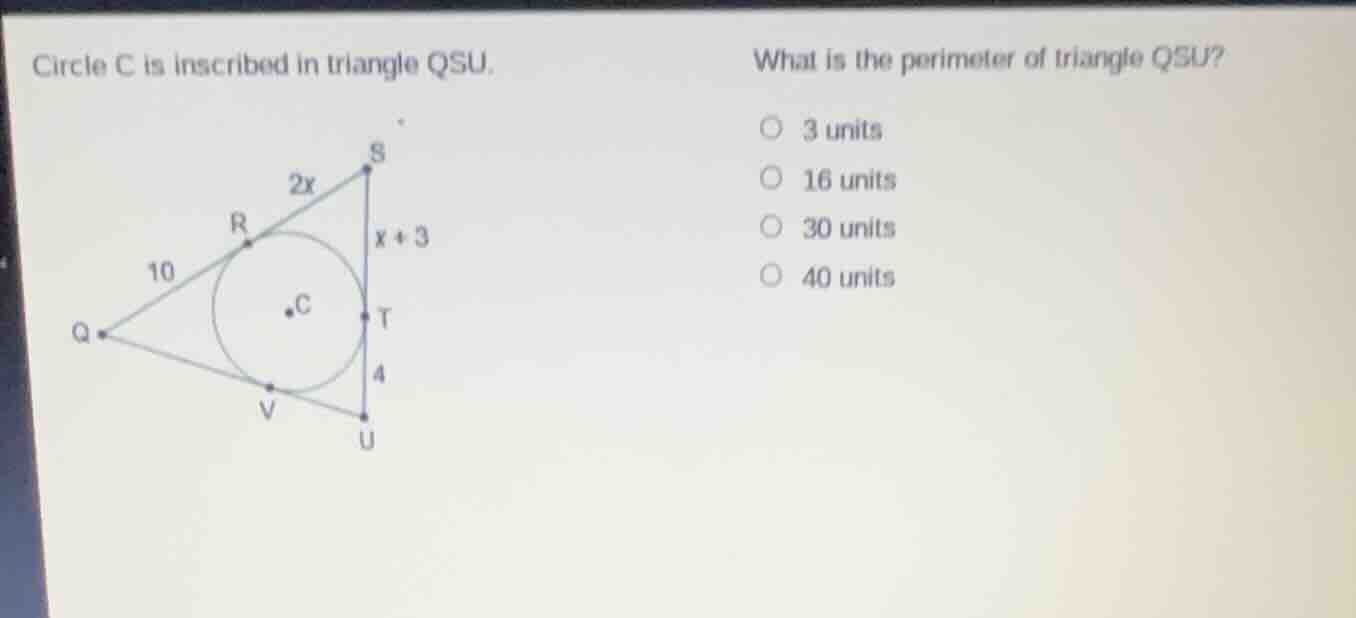
circle c is inscribed in triangle qsu.
what is the perimeter of triangle qsu?
3 units
16 units
30 units
40 units
Step1: Recall tangent segment theorem
Tangents from a common external point to a circle are congruent. So, \(QT = QV = 10\) (wait, no, looking at the diagram: from \(S\), tangents \(SR\) and \(ST\) should be equal; from \(U\), tangents \(UT\) and \(UV\) should be equal; from \(Q\), tangents \(QR\) and \(QV\) should be equal. Wait, the diagram has \(QU\) with segment \(UV\) and \(QV\)? Wait, let's re - examine. The side \(SU\) is split into \(ST=x + 3\) and \(TU = 4\). The side \(QS\) is split into \(SR = 2x\) and \(RQ=10\). The side \(QU\) is split into \(QV\) (let's say) and \(VU\). Wait, by the tangent - segment theorem:
- From point \(S\): \(SR=ST\), so \(2x=x + 3\)
Step2: Solve for \(x\)
\(2x=x + 3\)
Subtract \(x\) from both sides: \(2x-x=x + 3-x\)
We get \(x = 3\)
Step3: Find the lengths of the sides
- \(ST=x + 3=3 + 3 = 6\), so \(SR = 2x=6\) (since \(SR = ST\))
- From point \(U\): \(UT = 4\), so \(UV=UT = 4\) (tangents from \(U\) to the circle)
- From point \(Q\): \(QR = 10\), so \(QV=QR = 10\) (tangents from \(Q\) to the circle)
Now, let's find the lengths of the sides of the triangle:
- Side \(QS=QR+RS=10 + 6=16\)
- Side \(SU=ST + TU=6 + 4 = 10\)? Wait, no, wait \(ST=x + 3 = 6\), \(TU = 4\), so \(SU=6 + 4=10\)? Wait, no, that can't be. Wait, no, I made a mistake. Wait, \(SU\) is composed of \(ST\) and \(TU\), so \(SU=(x + 3)+4\). Since \(x = 3\), \(SU=(3 + 3)+4=10\). \(QS=2x+10\), since \(x = 3\), \(QS=6 + 10 = 16\). \(QU=QV+VU\), and \(QV = 10\), \(VU = 4\)? No, wait, from point \(U\), the two tangents are \(UT\) and \(UV\), so \(UV=UT = 4\). From point \(Q\), the two tangents are \(QR\) and \(QV\), so \(QV=QR = 10\). So \(QU=QV+UV=10 + 4=14\)? Wait, no, this is wrong. Wait, let's start over.
Correct application of tangent - segment theorem:
- Tangents from \(S\): \(SR = ST\) (so \(2x=x + 3\))
- Tangents from \(U\): \(UT=UV\) (so \(UV = 4\))
- Tangents from \(Q\): \(QR=QV\) (so \(QV = 10\))
First, solve \(2x=x + 3\), we get \(x = 3\). Then:
- \(ST=x + 3=6\), so \(SR = 6\)
- \(UT = 4\), so \(UV = 4\)
- \(QR = 10\), so \(QV = 10\)
Now, the sides of the triangle:
- \(QS=QR+RS=10 + 6=16\)
- \(SU=ST+TU=6 + 4 = 10\)
- \(QU=QV+VU=10 + 4=14\)? No, this is incorrect. Wait, I think I misidentified the sides. Wait, the triangle is \(QSU\). Let's list all the tangent segments:
- From \(Q\): \(QR\) and \(QV\) (length 10 each)
- From \(S\): \(SR\) (length \(2x\)) and \(ST\) (length \(x + 3\))
- From \(U\): \(UT\) (length 4) and \(UV\) (length 4)
Wait, the perimeter of \(\triangle QSU\) is \(QS+SU+QU\)
\(QS=QR + RS=10+2x\)
\(SU=ST + TU=(x + 3)+4\)
\(QU=QV+VU=10 + 4\)
Since \(x = 3\):
\(QS=10+2\times3=16\)
\(SU=(3 + 3)+4=10\)
\(QU=10 + 4=14\)
Wait, that gives a perimeter of \(16 + 10+14 = 40\)? Wait, no, wait, I think I messed up the sides. Wait, no, let's re - express the perimeter. The perimeter \(P=QS + SU+QU\). But using the tangent - segment theorem, the perimeter can also be calculated as \(2(QR + ST+UT)\) (because \(QS=QR + RS=QR + ST\), \(SU=ST + UT\), \(QU=QR + UT\) (wait, no). Wait, another way: the perimeter of a triangle with an incircle is equal to \(2\times\) (sum of the lengths of the tangents from each vertex to the points of tangency).
The tangents from \(Q\): length \(10\)
The tangents from \(S\): length \(x + 3=6\)
The tangents from \(U\): length \(4\)
So perimeter \(P = 2\times(10 + 6+4)=2\times20 = 40\)
Let's verify:
- \(QR = 10\), \(QV = 10\)
- \(SR = 6\), \(ST = 6\)
- \(UT = 4\), \(UV = 4\)
\(QS=QR+RS=10 + 6=16\)
\(SU=ST+TU=6 + 4 = 10\)
\(QU=QV+VU=10 + 4=14\)
\(16+10 + 14=40\)

Snap & solve any problem in the app
Get step-by-step solutions on Sovi AI
Photo-based solutions with guided steps
Explore more problems and detailed explanations
40 units