QUESTION IMAGE
Question
claim - evidence - reasoning
name:
class period:
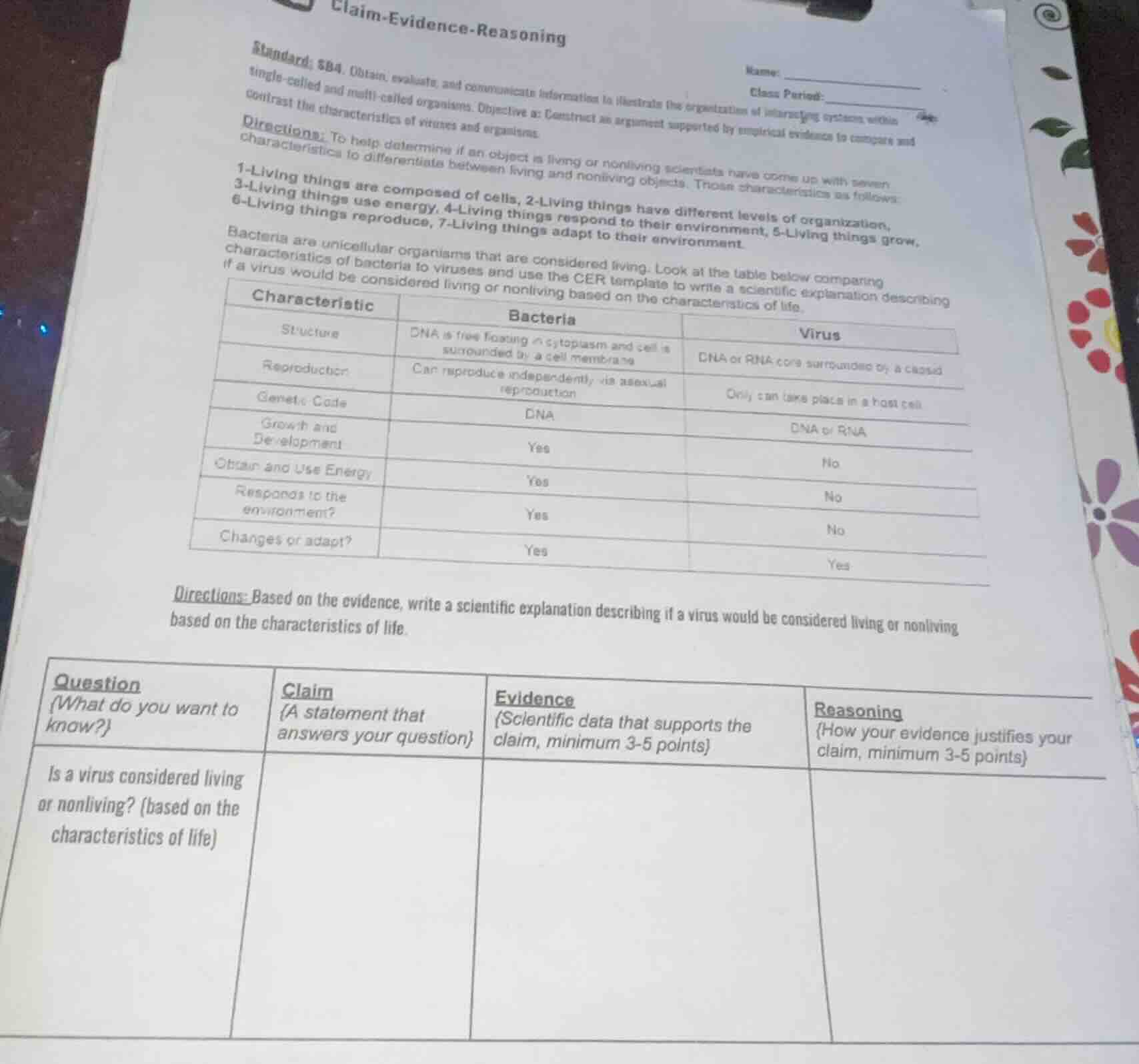
standard: sb4. obtain, evaluate, and communicate information to illustrate the organization of interacting systems within single - celled and multi - celled organisms. objective: construct an argument supported by empirical evidence to compare and contrast the characteristics of viruses and organisms.
directions: to help determine if an object is living or nonliving scientists have come up with seven characteristics to differentiate between living and nonliving objects. those characteristics are as follows:
1 - living things are composed of cells, 2 - living things have different levels of organization,
3 - living things use energy, 4 - living things respond to their environment, 5 - living things grow,
6 - living things reproduce, 7 - living things adapt to their environment.
bacteria are unicellular organisms that are considered living. look at the table below comparing characteristics of bacteria to viruses and use the cer template to write a scientific explanation describing if a virus would be considered living or nonliving based on the characteristics of life.
| characteristic | bacteria | virus |
|---|---|---|
| reproduction | can reproduce independently via asexual reproduction | only can take place in a host cell |
| genetic code | dna | dna or rna |
| growth and development | yes | no |
| obtain and use energy | yes | no |
| respond to the environment? | yes | no |
| changes or adapt? | yes | yes |
directions: based on the evidence, write a scientific explanation describing if a virus would be considered living or nonliving based on the characteristics of life.
| question (what do you want to know?) | claim (a statement that answers your question) | evidence (scientific data that supports the claim, minimum 3 - 5 points) | reasoning (how your evidence justifies your claim, minimum 3 - 5 points) |
| is a virus considered living or nonliving? (based on the characteristics of life) |
Claim:
A virus is considered nonliving.
Evidence:
- Viruses do not have cells (their structure is a DNA/RNA core with a capsid, no cellular structure like bacteria’s cytoplasm and cell membrane).
- Viruses cannot reproduce independently (they need a host cell, while bacteria reproduce asexually on their own).
- Viruses do not grow and develop (bacteria do, viruses do not).
- Viruses do not obtain or use energy (bacteria do, viruses rely on host cells for energy - related processes).
- Viruses do not respond to their environment (bacteria do, viruses show no independent response).
Reasoning:
The characteristics of life include being composed of cells, having different levels of organization, using energy, responding to the environment, growing, reproducing, and adapting. Viruses lack most of these: they have no cellular structure, can’t reproduce or use energy independently, don’t grow/develop, and don’t respond to the environment. Even though they adapt (evolve) over time, the absence of the other key life characteristics means they don’t meet the criteria for being living. Bacteria, as a living example, exhibit all these traits, highlighting the differences.

Snap & solve any problem in the app
Get step-by-step solutions on Sovi AI
Photo-based solutions with guided steps
Explore more problems and detailed explanations
Claim: A virus is considered nonliving.
Evidence:
- Viruses lack a cellular structure (bacteria have DNA in cytoplasm with a cell membrane, viruses have a DNA/RNA core and capsid).
- Viruses cannot reproduce independently (require a host cell; bacteria reproduce asexually on their own).
- Viruses do not grow and develop (bacteria do).
- Viruses do not obtain or use energy (bacteria do).
- Viruses do not respond to the environment (bacteria do).
Reasoning:
Life characteristics (cell - based, energy use, growth, reproduction, response to environment) are mostly absent in viruses. Bacteria, a living organism, has all these traits. Viruses’ dependence on hosts for key life processes (reproduction, energy) and lack of cellular organization mean they are nonliving, even with adaptive evolution.