QUESTION IMAGE
Question
class
date
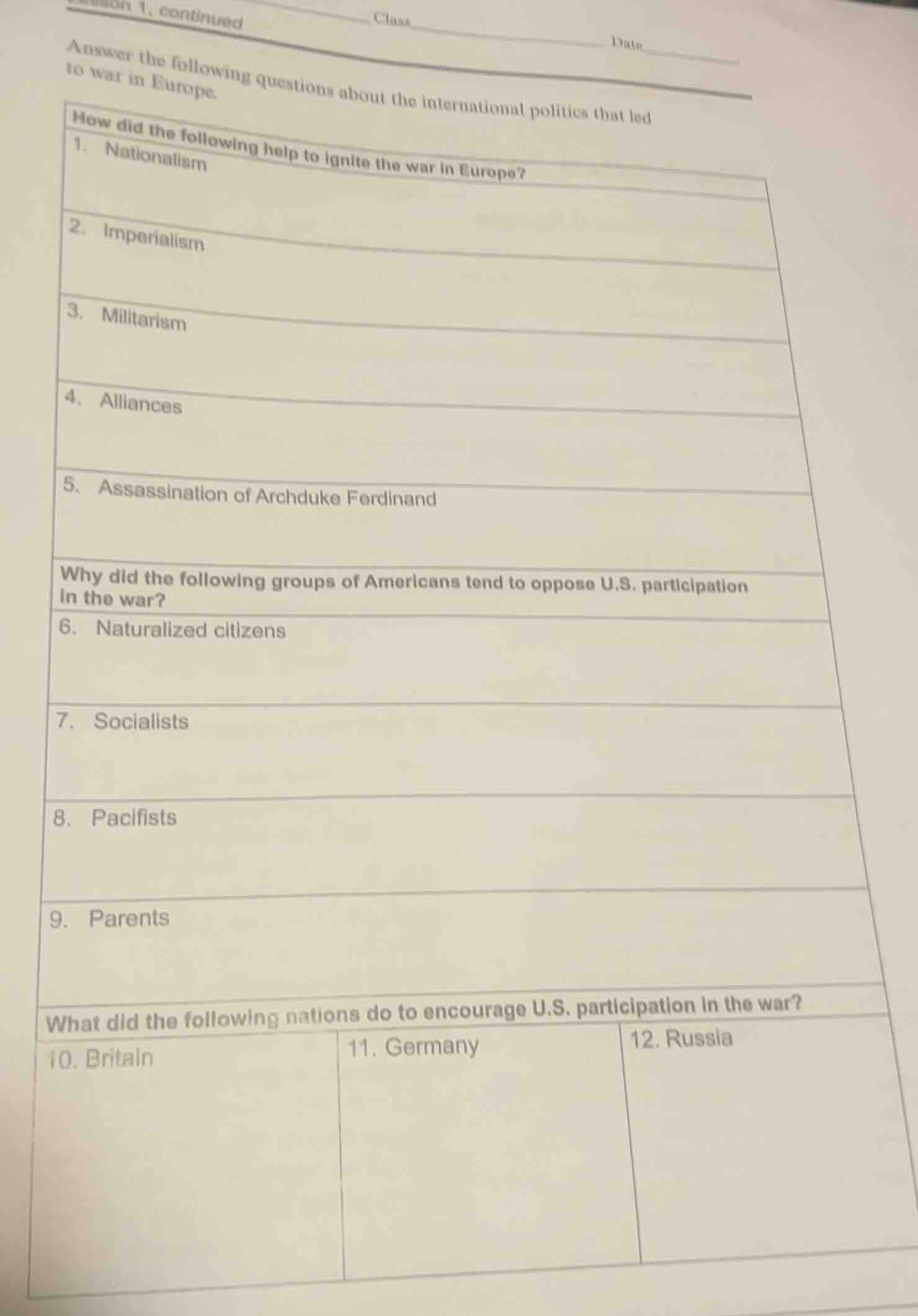
answer the following questions about the international politics that led to war in europe.
how did the following help to ignite the war in europe?
- nationalism
- imperialism
- militarism
- alliances
- assassination of archduke ferdinand
why did the following groups of americans tend to oppose u.s. participation in the war?
- naturalized citizens
- socialists
- pacifists
- parents
what did the following nations do to encourage u.s. participation in the war?
- britain
- germany
- russia
Brief Explanations
- Nationalism: Fueled rivalries between ethnic groups and nations in Europe, as groups sought self-rule or dominance, creating tensions that escalated into conflict.
- Imperialism: European powers competed fiercely for overseas colonies and resources, leading to bitter rivalries and mistrust between nations.
- Militarism: Nations built up large, modern militaries, glorified military strength, and adopted aggressive war plans, making war more likely.
- Alliances: Pre-war secret and formal alliances created a rigid system; when one nation was attacked, allied nations were obligated to join, expanding a local conflict into a full-scale war.
- Assassination of Archduke Ferdinand: The 1914 murder of Austria-Hungary's Archduke Franz Ferdinand by a Serbian nationalist gave Austria-Hungary a reason to declare war on Serbia, triggering the alliance system and starting the war.
- Naturalized citizens: Many had ties to their home countries in Europe, leading them to oppose taking sides or fighting against people from their origin nations.
- Socialists: Viewed the war as a conflict between wealthy elites, not workers, and opposed fighting for capitalist and imperialist interests.
- Pacifists: Held moral and ethical beliefs against all war, rejecting any form of violent conflict.
- Parents: Feared losing their sons to combat, and opposed the human cost of the war for their families.
- Britain: Blockaded German ports to cut off supplies, shared propaganda about German atrocities, and maintained close cultural and economic ties with the U.S. to build support.
- Germany: Used unrestricted submarine warfare, sinking U.S. merchant ships (like the Lusitania) and passenger vessels, which outraged the American public and pushed the U.S. toward war.
- Russia: As an Allied power, shared intelligence about German aggression, and framed the war as a fight against autocracy, aligning with U.S. ideals to gain support.

Snap & solve any problem in the app
Get step-by-step solutions on Sovi AI
Photo-based solutions with guided steps
Explore more problems and detailed explanations
- Nationalism stoked ethnic/national rivalries and tensions.
- Imperialism created colonial resource competition and mistrust.
- Militarism built up armies and normalized war planning.
- Alliances turned a local conflict into a continent-wide war.
- The assassination was the immediate trigger for Austria-Hungary's declaration of war on Serbia, activating alliances.
- They had cultural/ethnic ties to European nations and opposed taking sides.
- They saw the war as an elite capitalist conflict, not a workers' fight.
- They held moral opposition to all violent warfare.
- They feared losing their children to combat.
- Britain used propaganda, maintained U.S. trade, and shared German atrocity reports.
- Germany used unrestricted submarine warfare, sinking U.S. ships.
- Russia shared anti-German intelligence and framed the war as a fight for democratic values.