QUESTION IMAGE
Question
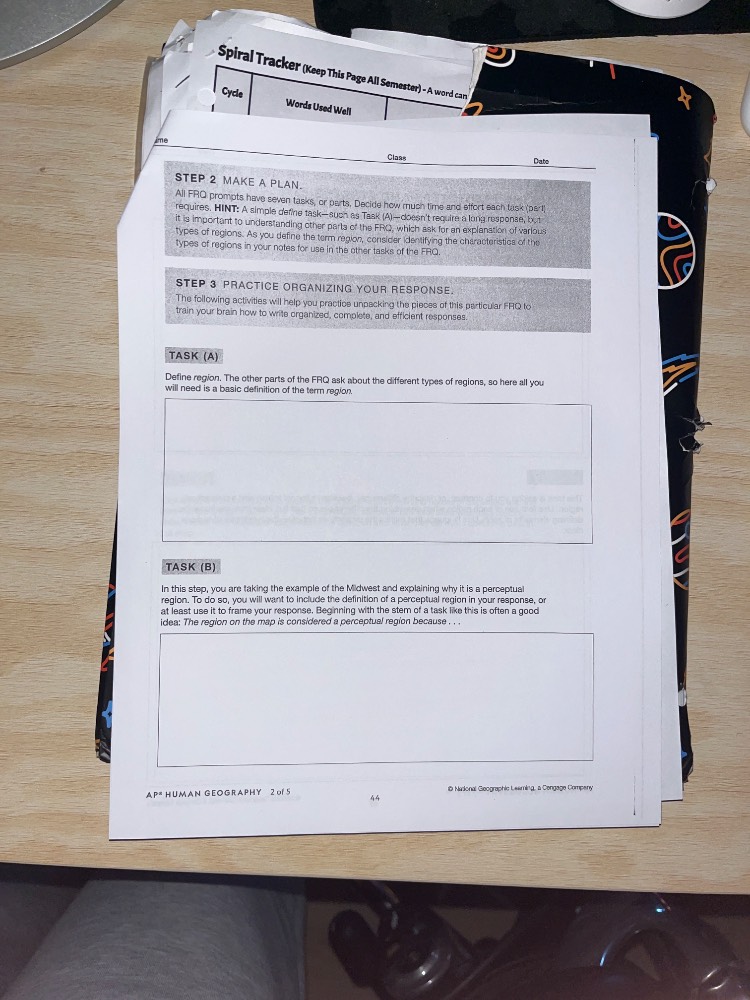
class date step 2 make a plan. all frq prompts have seven tasks, or parts. decide how much time and effort each part requires. tint a simple define task—such as task (a)—doesnt require a long response, but it is important to understanding other parts of the frq, which ask for an explanation of various types of regions. as you define the term region, consider identifying the characteristics of the type of region in your notes to use in the other tasks of the frq. step 3 practice organizing your response. the following activities will help you practice unmasking the pieces of this particular frq to train your brain how to write organized, concise, and efficient responses. task (a) define region. the other parts of the frq ask about the different types of regions, so here all you will need to is a basic definition of the term region. task (b) in this step, you are taking the example of the midwest and explaining why it is a perceptual region. to do so, you will want to include the definition of a perceptual region in your response, or at least use the term in your explanation. a sentence frame like this is often a good idea: the region on the map is considered a perceptual region because... ap human geography 2 of 5 © national geographic learning, a cengage company
TASK (A)
A region in geography is an area of Earth's surface with distinct, shared characteristics (physical, cultural, economic, etc.) that set it apart from other areas. These characteristics can be natural (like climate, landforms) or human - made (like language, religion, political boundaries), and regions help in organizing and understanding spatial patterns.
A perceptual region (or vernacular region) is defined by people's subjective perceptions, feelings, and associations about an area, rather than strict, objective boundaries. The Midwest is a perceptual region because people's ideas of it are based on shared cultural, social, and sometimes economic perceptions (e.g., notions of "Midwestern" culture, values, or landscape, even though there's no exact, universally - agreed - upon boundary). To explain, we first recall the definition of a perceptual region, then apply it to the Midwest: it's a region where people's mental maps and cultural/social understandings create a sense of a unified area, like the idea of "Midwestern" identity (friendly, agricultural - leaning, etc.) that people associate with states like Iowa, Illinois, Minnesota, etc., even if the boundary between Midwest and other regions (like the Northeast or Great Plains) isn't a sharp, physical or political line.

Snap & solve any problem in the app
Get step-by-step solutions on Sovi AI
Photo-based solutions with guided steps
Explore more problems and detailed explanations
A region is an area of Earth's surface defined by one or more distinct characteristics (physical, cultural, economic, etc.) that distinguish it from surrounding areas.