QUESTION IMAGE
Question
class:
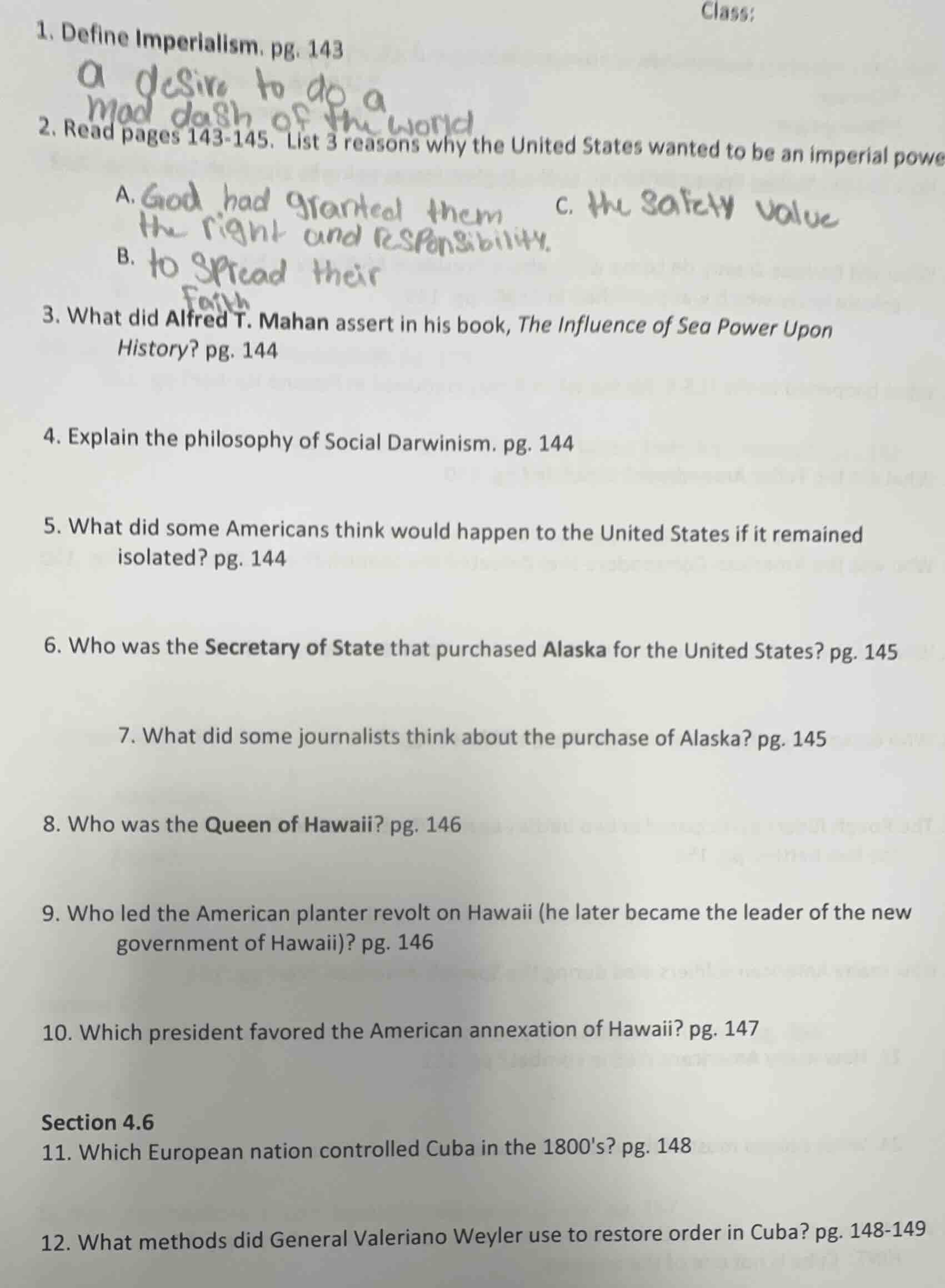
- define imperialism. pg. 143
- read pages 143-145. list 3 reasons why the united states wanted to be an imperial power
- what did alfred t. mahan assert in his book, the influence of sea power upon history? pg. 144
- explain the philosophy of social darwinism. pg. 144
- what did some americans think would happen to the united states if it remained isolated? pg. 144
- who was the secretary of state that purchased alaska for the united states? pg. 145
- what did some journalists think about the purchase of alaska? pg. 145
- who was the queen of hawaii? pg. 146
- who led the american planter revolt on hawaii (he later became the leader of the new government of hawaii)? pg. 146
- which president favored the american annexation of hawaii? pg. 147
section 4.6
- which european nation controlled cuba in the 1800s? pg. 148
- what methods did general valeriano weyler use to restore order in cuba? pg. 148-149
Brief Explanations
- Defined using standard historical academic definitions.
- Compiled standard historical motivations for U.S. imperialism.
- Summarized Mahan's core thesis from his text.
- Explained the core tenets of the ideology tied to Darwinian ideas.
- Cited common contemporary American fears of isolation.
- Identified the key political figure in the Alaska purchase.
- Noted the critical contemporary media nickname for the purchase.
- Named the last reigning monarch of Hawaii.
- Identified the leader of the 1893 Hawaiian coup.
- Cited the president who supported Hawaiian annexation.
- Named the colonial power controlling Cuba pre-1898.
- Described Weyler's controversial counterinsurgency tactic.

Snap & solve any problem in the app
Get step-by-step solutions on Sovi AI
Photo-based solutions with guided steps
Explore more problems and detailed explanations
- Imperialism is a policy where a strong nation extends its political, military, and economic control over weaker territories or nations.
2.
A. The belief in manifest destiny (God-granted right/responsibility to spread their civilization and faith)
B. Economic motives (access to new markets and raw materials)
C. Strategic/military motives (gaining naval bases and global power to ensure national security)
- Alfred T. Mahan asserted that a strong navy, control of strategic sea lanes, and overseas naval bases were essential for a nation to become a global military and economic power.
- Social Darwinism is the philosophy that applies Charles Darwin's theory of natural selection ("survival of the fittest") to human societies, arguing that wealthy, powerful nations and groups were "naturally" superior and justified in dominating weaker ones as part of a natural evolutionary process.
- Some Americans believed the U.S. would face economic decline (lack of new markets), lose global influence, and risk being left behind by other imperial powers if it remained isolated.
- William H. Seward
- Some journalists mocked the purchase, calling Alaska "Seward's Folly" or "Seward's Icebox," believing it was a worthless, frozen territory.
- Queen Liliuokalani
- Sanford B. Dole
- President Benjamin Harrison (he submitted an annexation treaty to Congress in 1893; it was later approved under President William McKinley)
- Spain
- General Valeriano Weyler implemented "reconcentration camps," forcing Cuban civilians into fortified, unsanitary camps to cut off support for Cuban rebels, leading to widespread disease and starvation.