QUESTION IMAGE
Question
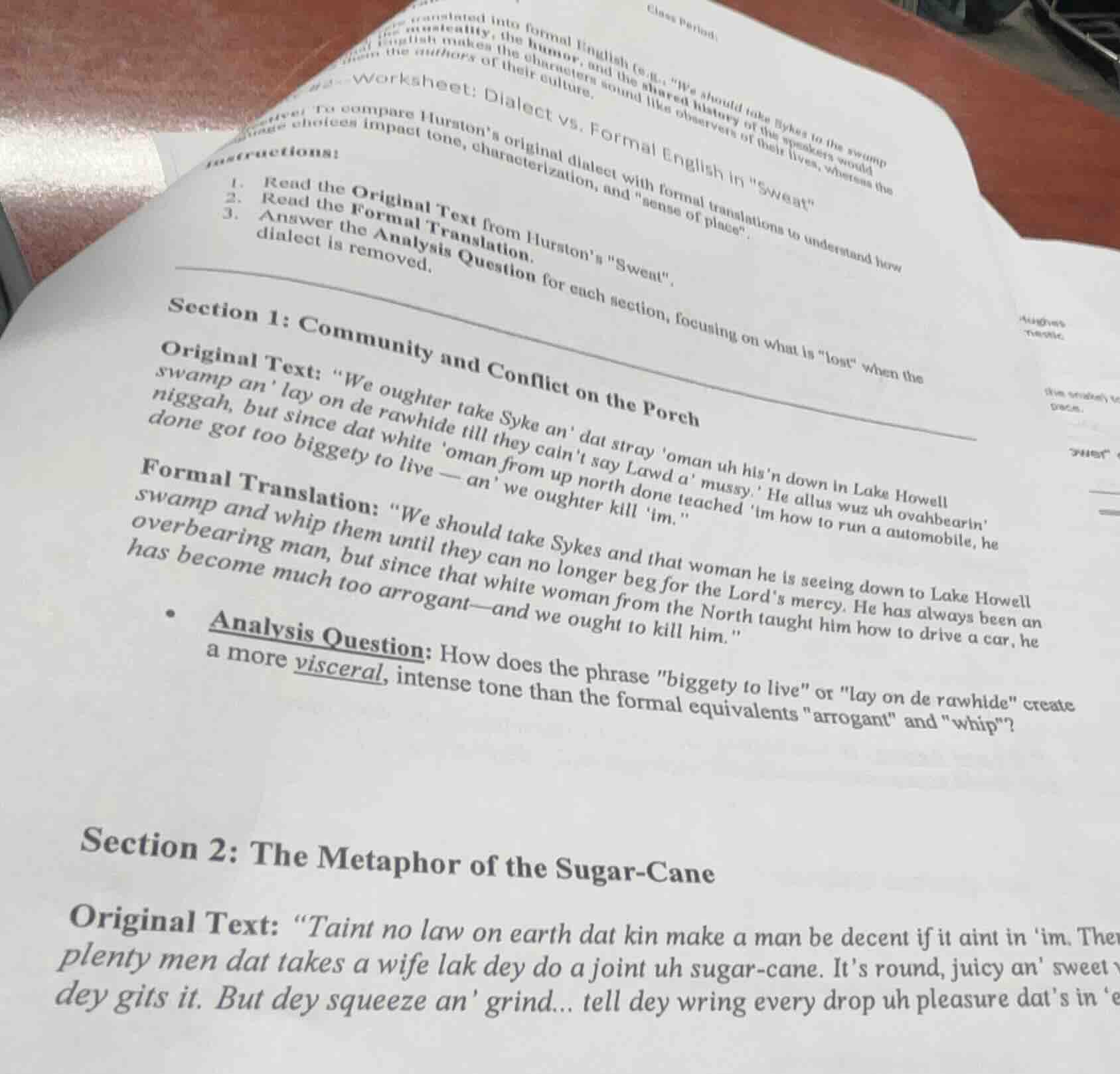
class period:worksheet: dialect vs. formal english in \sweat\objective: to compare hurstons original dialect with formal translations to understand how language choices impact tone, characterization, and \sense of place\.instructions:1. read the original text from hurstons \sweat\.2. read the formal translation.3. answer the analysis question for each section, focusing on what is \lost\ when the dialect is removed.section 1: community and conflict on the porchoriginal text: \we oughter take syke an dat stray oman uh hisn down in lake howell swamp an lay on de rawhide till they caint say lawd a mussy. he allus wuz uh ovahbearin niggah, but since dat white oman from up north done teached im how to run a automobile, he done got too biggety to live — an we oughter kill im.\formal translation: \we should take sykes and that woman he is seeing down to lake howell swamp and whip them until they can no longer beg for the lords mercy. he has always been an overbearing man, but since that white woman from the north taught him how to drive a car, he has become much too arrogant—and we ought to kill him.\• analysis question: how does the phrase \biggety to live\ or \lay on de rawhide\ create a more visceral, intense tone than the formal equivalents \arrogant\ and \whip\?section 2: the metaphor of the sugar-caneoriginal text: \taint no law on earth dat kin make a man be decent if it aint in im. there plenty men dat takes a wife lak dey do a joint uh sugar-cane. its round, juicy an sweet when dey gits it. but dey squeeze an grind... tell dey wring every drop uh pleasure dats in e
- For "biggety to live" vs. "arrogant": The dialect phrase is a colloquial, regionally specific term that carries the raw, familiar frustration of the community's everyday speech. It feels like a direct, unfiltered judgment from people who know Sykes personally, rather than the detached, formal label "arrogant."
- For "lay on de rawhide" vs. "whip": The dialect phrase uses vivid, folksy imagery tied to rural, agricultural life (rawhide as a tool/punishment). It conveys a visceral, brutal intensity and a shared cultural understanding of the violence being discussed, whereas "whip" is a generic, less emotionally charged verb.
The dialect terms are rooted in the characters' lived experience, making their anger and judgment feel more immediate, personal, and intense than the polished, neutral formal equivalents.

Snap & solve any problem in the app
Get step-by-step solutions on Sovi AI
Photo-based solutions with guided steps
Explore more problems and detailed explanations
The dialect phrases carry raw, culturally specific weight that makes the tone more visceral:
- "biggety to live" is a colloquial, community-specific term that feels like a personal, unfiltered judgment, unlike the detached, formal "arrogant."
- "lay on de rawhide" uses vivid, folksy, rural imagery tied to the characters' lived experience, conveying brutal, immediate intensity that the generic verb "whip" lacks.
These phrases ground the anger and conflict in the characters' specific culture, making their feelings feel more urgent and authentic than the formal translations.