QUESTION IMAGE
Question
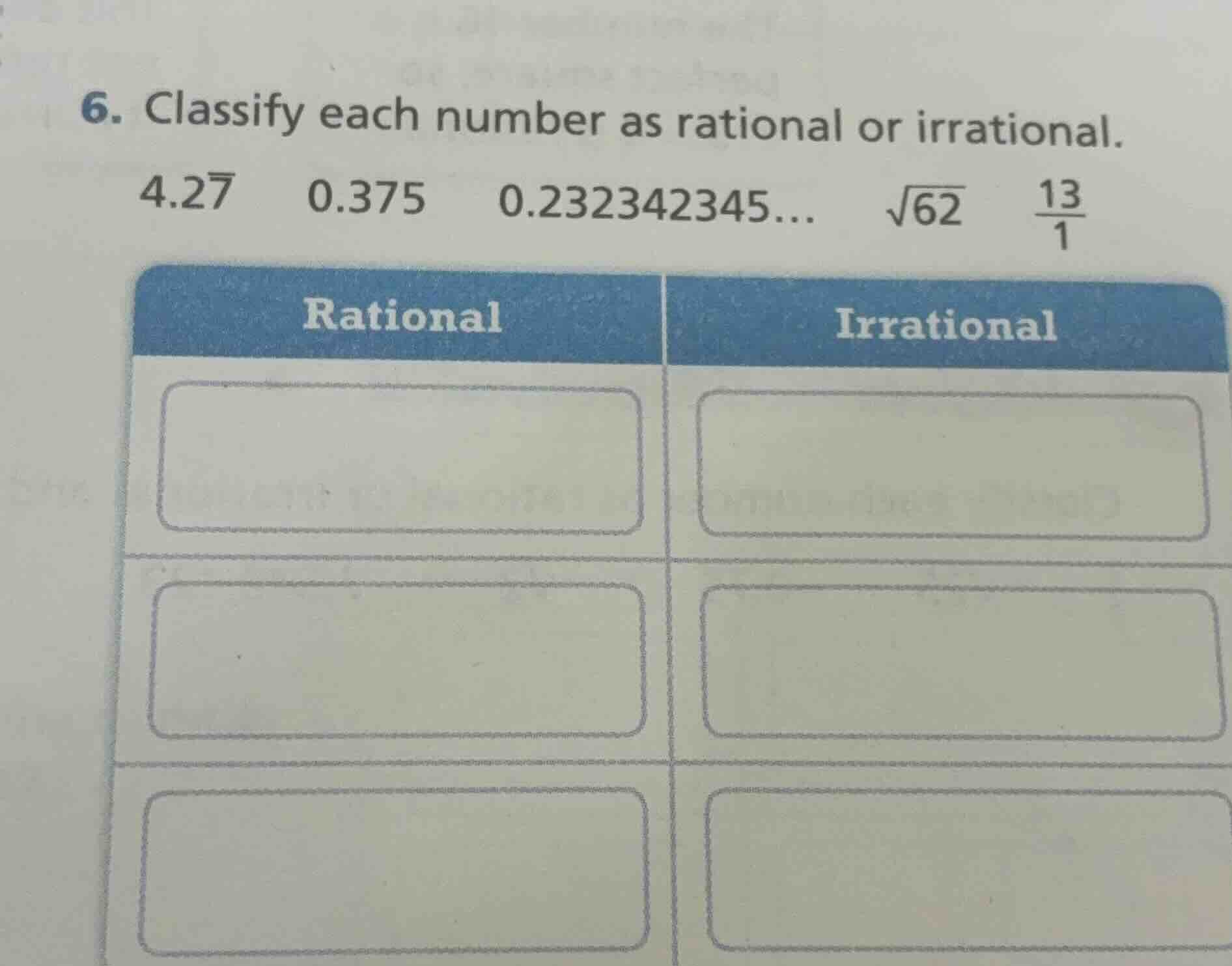
- classify each number as rational or irrational.
$4.2\overline{7}$ $0.375$ $0.232342345...$ $\sqrt{62}$ $\frac{13}{1}$
Step1: Recall definitions
A rational number can be expressed as a fraction $\frac{p}{q}$ where $p,q$ are integers and $q
eq0$. It includes terminating decimals, repeating decimals, and integers (since integers can be written as $\frac{\text{integer}}{1}$). An irrational number is a non - repeating, non - terminating decimal and cannot be expressed as a fraction of two integers.
Step2: Classify $4.2\overline{7}$
The number $4.2\overline{7}$ is a repeating decimal (the digit 7 repeats). Repeating decimals can be converted to fractions. Let $x = 4.2\overline{7}=4.2777\cdots$. Then $10x=42.777\cdots$ and $100x = 427.777\cdots$. Subtracting $10x$ from $100x$: $100x-10x=427.777\cdots - 42.777\cdots$, $90x = 385$, $x=\frac{385}{90}=\frac{77}{18}$. So it is rational.
Step3: Classify $0.375$
$0.375$ is a terminating decimal. A terminating decimal can be written as a fraction. $0.375=\frac{375}{1000}=\frac{3}{8}$ (by dividing numerator and denominator by 125). So it is rational.
Step4: Classify $0.232342345\cdots$
The decimal $0.232342345\cdots$ is non - repeating and non - terminating (the pattern does not repeat). So it cannot be written as a fraction of two integers. Thus, it is irrational.
Step5: Classify $\sqrt{62}$
We know that 62 is not a perfect square (since $7^2 = 49$ and $8^2=64$). The square root of a non - perfect square is a non - repeating, non - terminating decimal. So $\sqrt{62}$ is irrational.
Step6: Classify $\frac{13}{1}$
$\frac{13}{1}$ is a fraction of two integers (13 and 1, with $1
eq0$). So it is a rational number.

Snap & solve any problem in the app
Get step-by-step solutions on Sovi AI
Photo-based solutions with guided steps
Explore more problems and detailed explanations
Rational Numbers:
$4.2\overline{7}$, $0.375$, $\frac{13}{1}$
Irrational Numbers:
$0.232342345\cdots$, $\sqrt{62}$