QUESTION IMAGE
Question
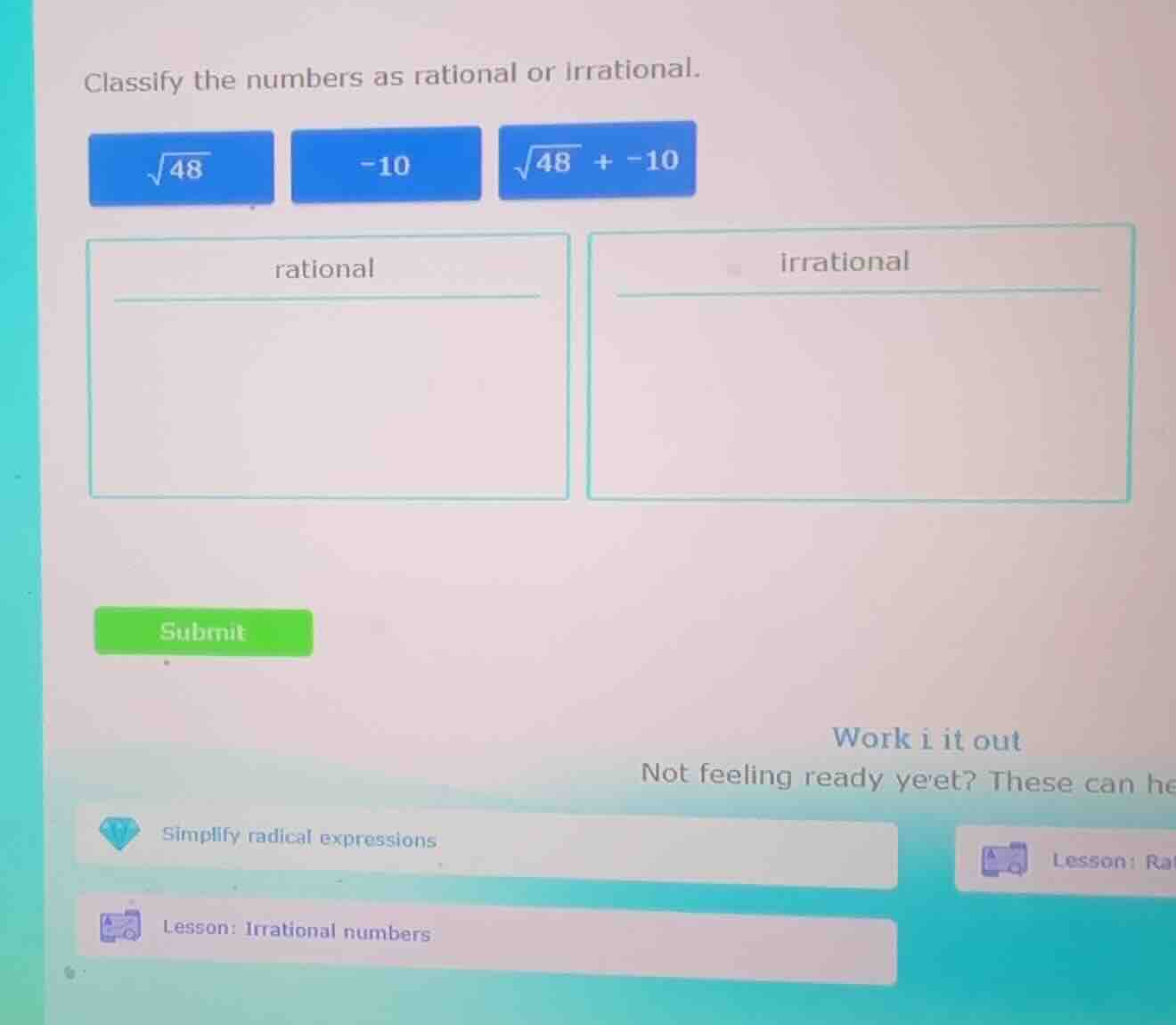
classify the numbers as rational or irrational.
\sqrt{48} -10 \sqrt{48} + -10
rational irrational
submit
work i it out
not feeling ready yet? these can he
simplify radical expressions
lesson: irrational numbers
Step1: Analyze \(\boldsymbol{\sqrt{48}}\)
A rational number can be expressed as a fraction \(\frac{p}{q}\) (where \(p,q\) are integers, \(q
eq0\)), or is a terminating/repeating decimal. An irrational number is a non - repeating, non - terminating decimal, often involving square roots of non - perfect squares.
Simplify \(\sqrt{48}\): \(\sqrt{48}=\sqrt{16\times3}=\sqrt{16}\times\sqrt{3} = 4\sqrt{3}\). Since \(\sqrt{3}\) is irrational (it cannot be expressed as a fraction of two integers and its decimal expansion is non - repeating and non - terminating), \(4\sqrt{3}\) is also irrational. So \(\sqrt{48}\) is irrational.
Step2: Analyze \(\boldsymbol{- 10}\)
\(-10\) can be written as \(\frac{-10}{1}\), where \(- 10\) and \(1\) are integers and \(1
eq0\). So \(-10\) is a rational number.
Step3: Analyze \(\boldsymbol{\sqrt{48}+(-10)}\)
We know that \(\sqrt{48}\) is irrational and \(-10\) is rational. The sum of a rational number and an irrational number is always irrational. Let's assume, for contradiction, that \(\sqrt{48}+(-10)=r\), where \(r\) is rational. Then \(\sqrt{48}=r + 10\). But the right - hand side \(r + 10\) is rational (since the sum of two rational numbers is rational) and the left - hand side \(\sqrt{48}\) is irrational, which is a contradiction. So \(\sqrt{48}+(-10)\) is irrational.

Snap & solve any problem in the app
Get step-by-step solutions on Sovi AI
Photo-based solutions with guided steps
Explore more problems and detailed explanations
rational: \(-10\)
irrational: \(\sqrt{48}\), \(\sqrt{48}+(-10)\)