QUESTION IMAGE
Question
close reading
government—we the people
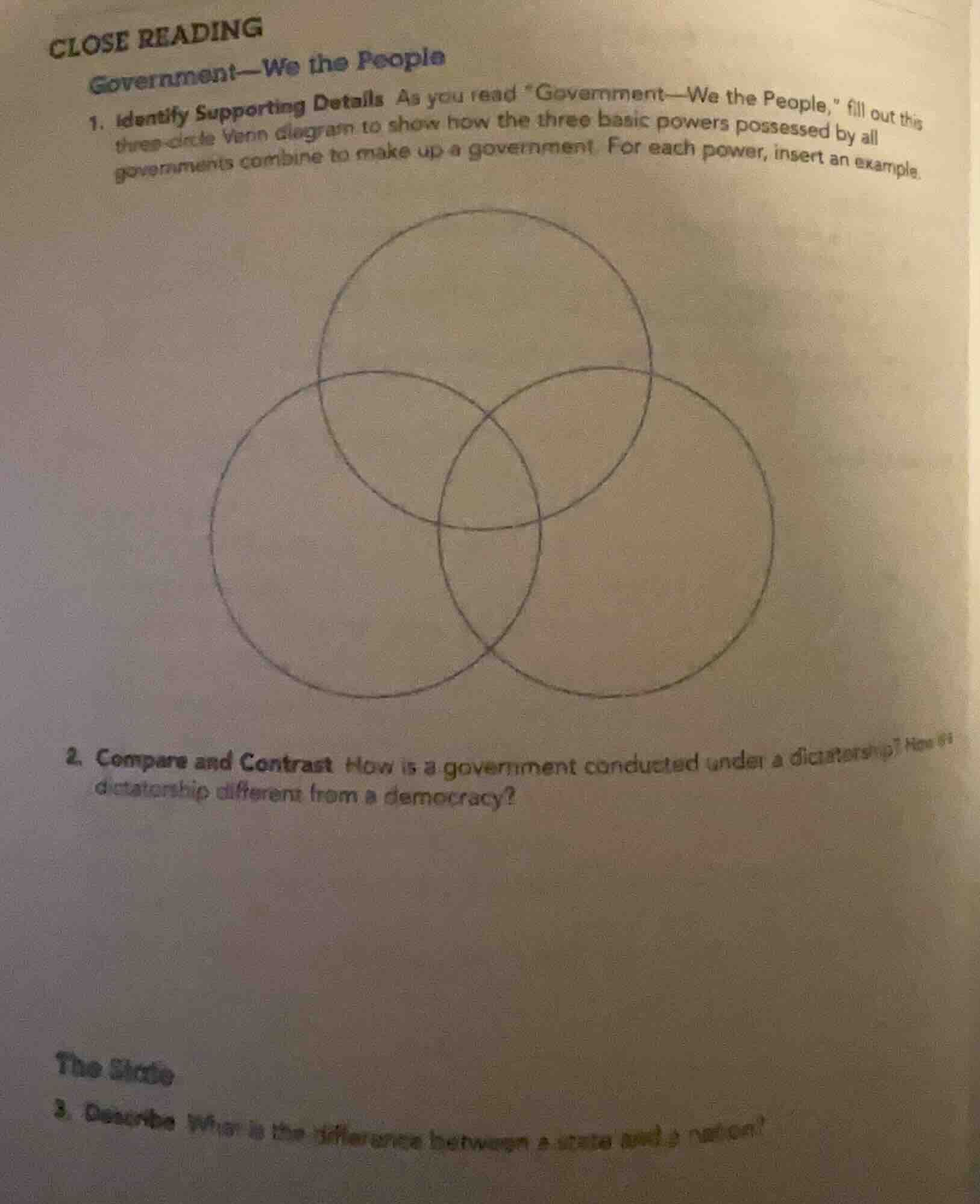
- identify supporting details as you read “government—we the people,” fill out this three - circle venn diagram to show how the three basic powers possessed by all governments combine to make up a government. for each power, insert an example.
- compare and contrast how is a government conducted under a dictatorship? how is a dictatorship different from a democracy?
the state
- describe what is the difference between a state and a nation?
Brief Explanations
- For the Venn diagram: The three core powers of all governments are legislative (make laws), executive (enforce laws), and judicial (interpret laws). Each circle represents one power, with overlapping areas showing how they interact (e.g., the executive enforcing laws written by the legislature).
- Legislative Power (Circle 1): Example - A parliament voting to pass a new environmental protection law.
- Executive Power (Circle 2): Example - A president signing an executive order to implement a public health policy.
- Judicial Power (Circle 3): Example - A supreme court ruling that a law violates the country's constitution.
- Overlap of all three: The system of checks and balances, where each branch limits the others (e.g., courts striking down executive actions that violate legislative rules).
- Dictatorship: Power is held by a single ruler or small group, with no meaningful input from the public. Leaders are not elected freely, and dissent is often suppressed. Democracy: Power rests with the people, who elect leaders through free, fair elections, and have rights to free speech and political participation.
- A state is a sovereign political entity with defined borders, a government, and the authority to rule its territory. A nation is a group of people bound by shared culture, history, language, or identity, which may or may not have its own sovereign state.

Snap & solve any problem in the app
Get step-by-step solutions on Sovi AI
Photo-based solutions with guided steps
Explore more problems and detailed explanations
- Venn Diagram Fill-In:
- Circle 1 (Legislative Power): Passing new tax laws
- Circle 2 (Executive Power): Deploying national guard during a crisis
- Circle 3 (Judicial Power): Sentencing someone for a criminal offense
- All three overlap: Checks and balances (e.g., courts reviewing laws passed by the legislature and signed by the executive)
- A dictatorship is run by an unelected, unaccountable ruler/group that controls all power and suppresses opposition. A democracy is run by leaders elected by the people, who are accountable to the public, with protections for individual rights and political dissent.
- A state is a sovereign, self-governing political unit with territory and a government. A nation is a community of people united by shared cultural, historical, or ethnic ties.