QUESTION IMAGE
Question
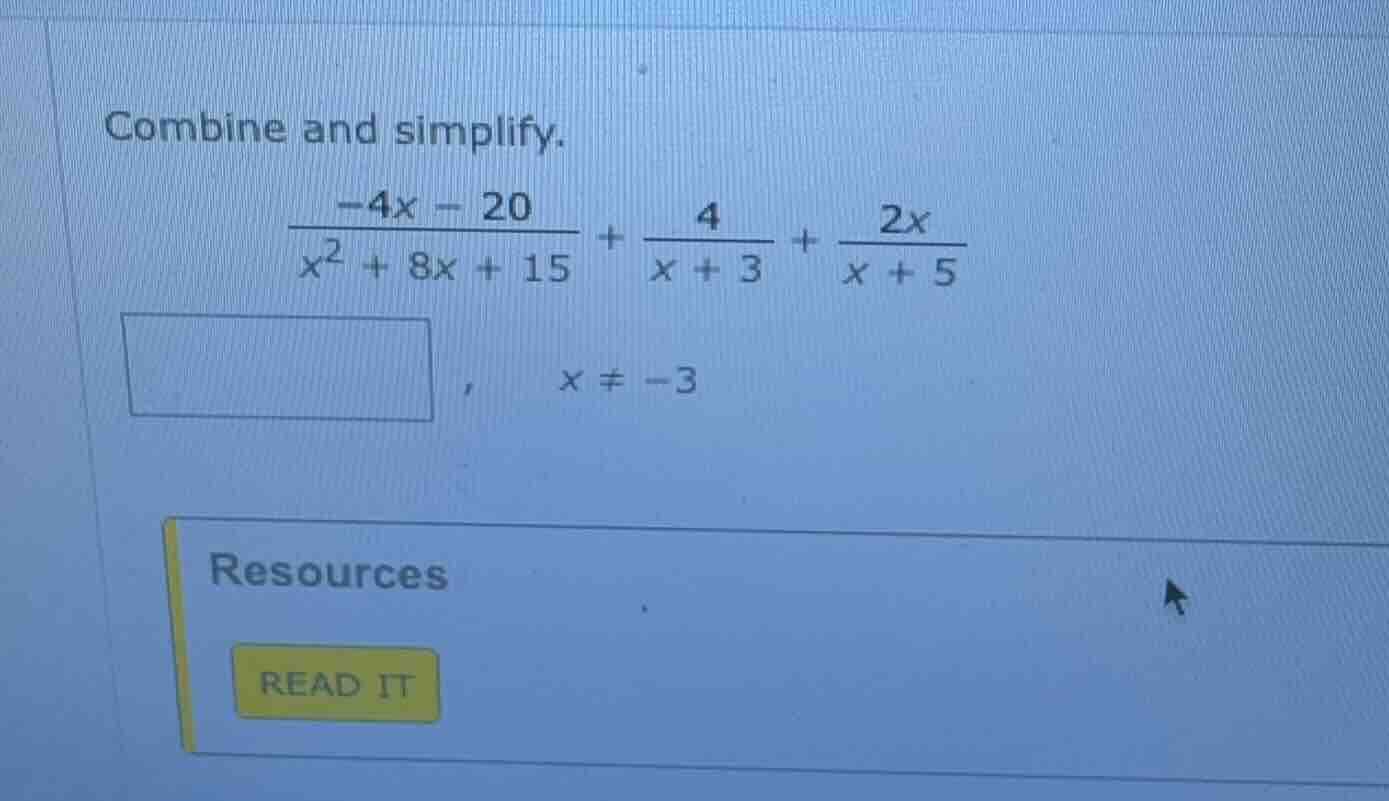
combine and simplify.\\(
\frac{-4x - 20}{x^2 + 8x + 15} + \frac{4}{x + 3} + \frac{2x}{x + 5}\\)
\\(\square\\), \\(x \
eq -3\\)
Step1: Factor the denominator
Factor \(x^{2}+8x + 15\). We need two numbers that multiply to \(15\) and add to \(8\), which are \(3\) and \(5\). So \(x^{2}+8x + 15=(x + 3)(x + 5)\).
The first fraction becomes \(\frac{-4x-20}{(x + 3)(x + 5)}\), and we can factor out \(-4\) from the numerator: \(\frac{-4(x + 5)}{(x + 3)(x + 5)}\). Then we can cancel out \((x + 5)\) (since \(x
eq - 5\) as well, from the domain, but given \(x
eq - 3\) here, and we assume \(x
eq - 5\) for the fraction to be defined), so the first fraction simplifies to \(\frac{-4}{x + 3}\).
Step2: Rewrite the fractions with common denominator
Now we have \(\frac{-4}{x + 3}+\frac{4}{x + 3}+\frac{2x}{x + 5}\). The first two fractions have the same denominator \((x + 3)\).
Step3: Combine the first two fractions
\(\frac{-4 + 4}{x + 3}+\frac{2x}{x + 5}=\frac{0}{x + 3}+\frac{2x}{x + 5}\). Since \(\frac{0}{x + 3}=0\) (for \(x
eq - 3\)), we are left with \(\frac{2x}{x + 5}\). Wait, no, wait, let's check again. Wait, maybe I made a mistake in simplifying the first fraction. Let's redo the first step.
Wait, the first fraction: \(\frac{-4x-20}{x^{2}+8x + 15}=\frac{-4(x + 5)}{(x + 3)(x + 5)}\), cancel \((x + 5)\) ( \(x
eq - 5\) ), so it's \(\frac{-4}{x + 3}\). Then the second fraction is \(\frac{4}{x + 3}\), third is \(\frac{2x}{x + 5}\). Now add the first two: \(\frac{-4+4}{x + 3}=\frac{0}{x + 3}=0\), then add the third: \(0+\frac{2x}{x + 5}=\frac{2x}{x + 5}\)? Wait, no, that can't be right. Wait, maybe I messed up the factoring or the simplification. Wait, let's start over.
Wait, original expression: \(\frac{-4x - 20}{x^{2}+8x + 15}+\frac{4}{x + 3}+\frac{2x}{x + 5}\)
Factor denominator of first term: \(x^{2}+8x + 15=(x + 3)(x + 5)\)
Factor numerator of first term: \(-4x-20=-4(x + 5)\)
So first term: \(\frac{-4(x + 5)}{(x + 3)(x + 5)}=\frac{-4}{x + 3}\) ( \(x
eq - 5\) )
Now the expression is \(\frac{-4}{x + 3}+\frac{4}{x + 3}+\frac{2x}{x + 5}\)
Combine the first two terms: \(\frac{-4 + 4}{x + 3}+\frac{2x}{x + 5}=\frac{0}{x + 3}+\frac{2x}{x + 5}\)
Since \(\frac{0}{x + 3}=0\) (for \(x
eq - 3\)), then the result is \(\frac{2x}{x + 5}\)? Wait, but let's check with another approach. Let's find a common denominator for all three fractions, which is \((x + 3)(x + 5)\).
First fraction: \(\frac{-4x-20}{(x + 3)(x + 5)}\)
Second fraction: \(\frac{4}{x + 3}=\frac{4(x + 5)}{(x + 3)(x + 5)}\)
Third fraction: \(\frac{2x}{x + 5}=\frac{2x(x + 3)}{(x + 3)(x + 5)}\)
Now add them up:
\[
\]
Now cancel out \((x + 3)\) (since \(x
eq - 3\)), we get \(\frac{2x}{x + 5}\). Ah, there we go, my first approach had a mistake in the middle, but the second approach with common denominator is correct. So let's do it step by step with common denominator:
Step1: Factor denominators and numerators
Factor \(x^{2}+8x + 15=(x + 3)(x + 5)\), factor \(-4x - 20=-4(x + 5)\). So first fraction: \(\frac{-4(x + 5)}{(x + 3)(x + 5)}\)
Step2: Find common denominator \((x + 3)(x + 5)\)
Rewrite each fraction:
- First fraction: \(\frac{-4(x + 5)}{(x + 3)(x + 5)}\) (already in common denominator)
- Second fraction: \(\frac{4}{x + 3}=\frac{4(x + 5)}{(x + 3)(x + 5)}\) (multiply numerator and denominator by \((x + 5)\))
- Third fraction: \(\frac{2x}{x + 5}=\frac{2x(x + 3)}{(x + 3)(x + 5)}\) (multiply numerator and denominator by \((x + 3)\))…

Snap & solve any problem in the app
Get step-by-step solutions on Sovi AI
Photo-based solutions with guided steps
Explore more problems and detailed explanations
\(\frac{2x}{x + 5}\)