QUESTION IMAGE
Question
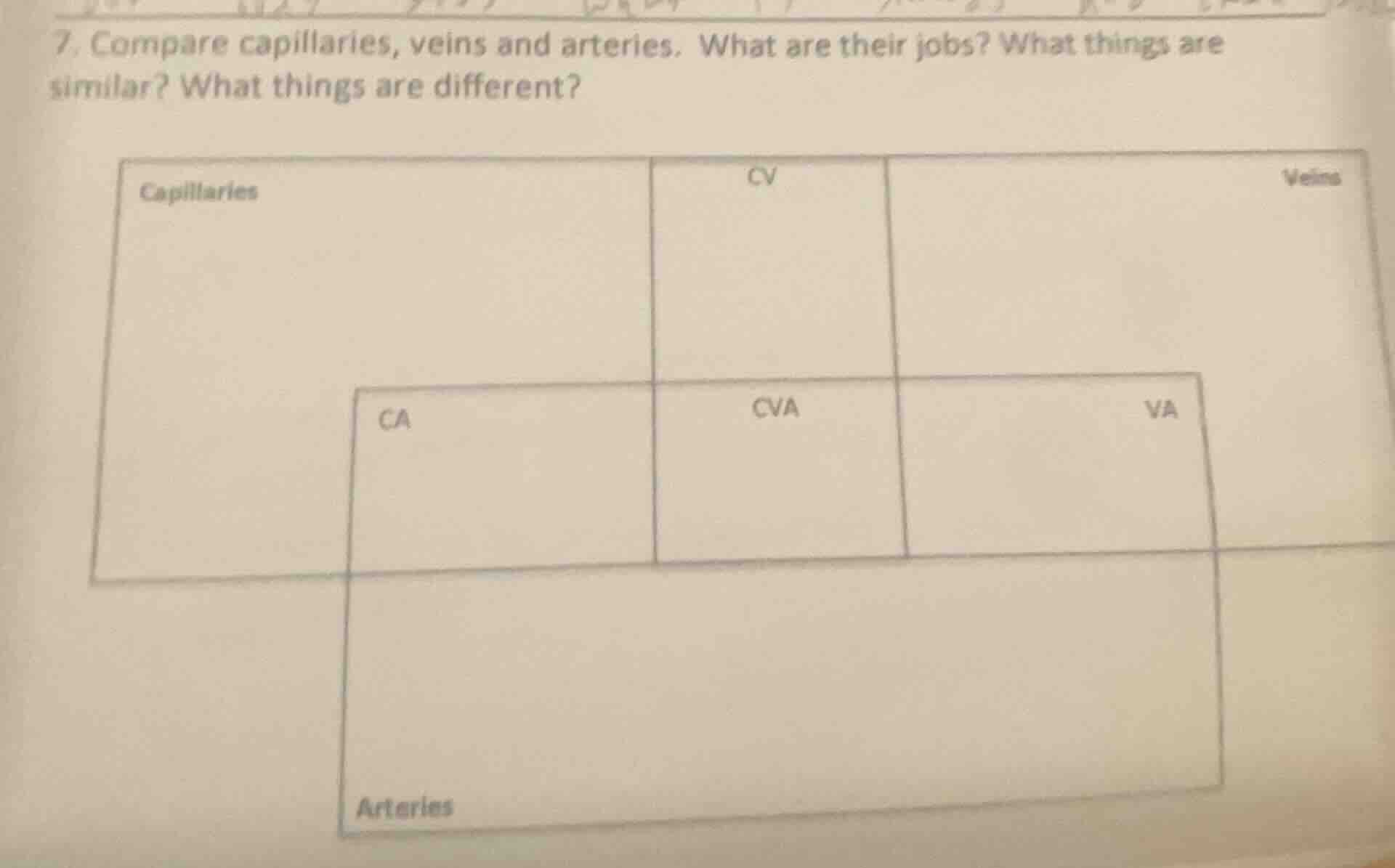
- compare capillaries, veins and arteries. what are their jobs? what things are similar? what things are different?
Brief Explanations
To compare capillaries, veins, and arteries, we analyze their functions (jobs), similarities, and differences:
Jobs:
- Capillaries: Facilitate the exchange of oxygen, nutrients, and waste products between blood and body tissues.
- Veins: Carry deoxygenated blood (except pulmonary veins) back to the heart from the body’s tissues.
- Arteries: Carry oxygenated blood (except pulmonary arteries) away from the heart to the body’s tissues.
Similarities (CVA: Capillaries, Veins, Arteries; CV: Capillaries & Veins; CA: Capillaries & Arteries; VA: Veins & Arteries):
- CVA: All are blood vessels, part of the circulatory system, and transport blood (or blood components, in capillaries’ case).
- CV: Both have thin endothelial linings (for smooth blood flow) and are involved in blood circulation (capillaries connect arteries and veins).
- CA: Both have muscular or elastic layers (to some extent) and transport blood under pressure (arteries with higher pressure, capillaries with lower, but still driven by arterial pressure).
- VA: Both have larger diameters than capillaries (veins often have valves, arteries have thicker walls, but both are “pipes” for blood transport).
Differences:
- Structure:
- Capillaries: Single endothelial cell layer, very thin (1 cell thick), no muscle/elastic tissue.
- Veins: Thin muscular/elastic layers, larger lumen, have valves (to prevent backflow).
- Arteries: Thick muscular/elastic layers, smaller lumen, no valves (except in heart).
- Blood Flow Direction:
- Capillaries: Connect arteries to veins (blood flows from arteries → capillaries → veins).
- Veins: Blood flows toward the heart.
- Arteries: Blood flows away from the heart.
- Blood Type (Oxygenation):
- Capillaries: Blood transitions from oxygenated (arterial end) to deoxygenated (venous end).
- Veins: Mostly deoxygenated blood (except pulmonary veins).
- Arteries: Mostly oxygenated blood (except pulmonary arteries).
To fill the table (labels: CV = Capillaries & Veins; CA = Capillaries & Arteries; CVA = All three; VA = Veins & Arteries):
| Capillaries | CV (Capillaries & Veins) | Veins | |
|---|---|---|---|
| CVA | All are blood vessels; transport blood | (Same as CVA row) | (Same as CVA row) |
| CA | Thin walls (1 cell thick); low pressure | Thin walls (capillaries: 1 cell; veins: thin muscle) | Thick elastic/muscular walls; high pressure |
| VA | No valves; single cell layer | Valves (veins); larger lumen (veins) | Valves; larger lumen; thin walls |
| Arteries | Connect to arteries (blood from arteries) | Thick elastic/muscular walls; no valves | Connect to veins (blood to veins) |
(Note: The table structure may vary, but the key is to organize the above info into the provided grid, focusing on jobs, similarities, and differences.)

Snap & solve any problem in the app
Get step-by-step solutions on Sovi AI
Photo-based solutions with guided steps
Explore more problems and detailed explanations
Jobs:
- Capillaries: Exchange O₂, nutrients, and waste with tissues.
- Veins: Carry deoxygenated blood to the heart.
- Arteries: Carry oxygenated blood away from the heart.
Similarities (Examples for each category):
- CVA: All are blood vessels (part of circulatory system) that transport blood.
- CV: Both have thin endothelial linings; capillaries connect arteries to veins.
- CA: Both transport blood under pressure (arteries > capillaries); have cell/muscle layers.
- VA: Both have larger diameters than capillaries; transport blood over long distances.
Differences (Examples):
- Structure: Capillaries (1 cell thick) < Veins (thin walls, valves) < Arteries (thick walls, no valves).
- Flow Direction: Arteries (away from heart) → Capillaries (between) → Veins (toward heart).
- Oxygenation: Arteries (mostly O₂-rich) → Capillaries (O₂ transitions) → Veins (mostly O₂-poor).
(For the table, summarize these points into the labeled sections: CVA = all three; CV = capillaries + veins; CA = capillaries + arteries; VA = veins + arteries.)