QUESTION IMAGE
Question
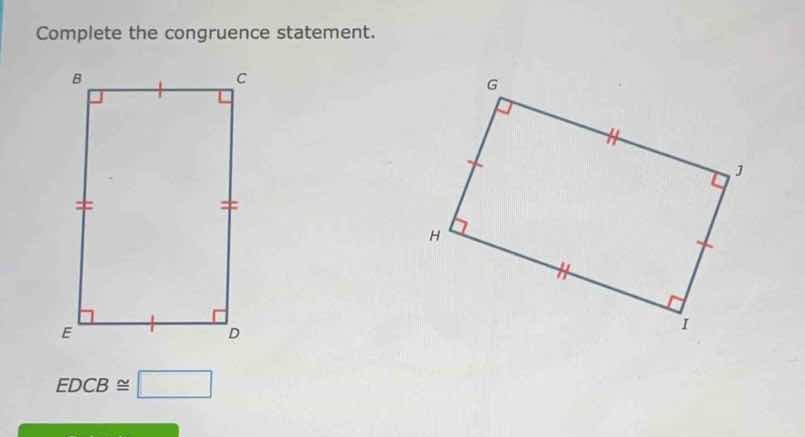
complete the congruence statement.
edcb ≅ \boxed{
Step1: Identify Corresponding Vertices
In congruent figures, corresponding vertices are determined by the order of the letters in the congruence statement and the markings (congruent sides, right angles). For rectangle \( EDCB \) and the other rectangle, we match the vertices based on the side and angle congruences.
- \( E \) (right angle, with side \( ED \) and \( EB \)) corresponds to \( I \) (right angle, with side \( IJ \) and \( IH \))? Wait, no, let's look at the order of \( EDCB \): \( E \to D \to C \to B \to E \).
- \( E \) has a right angle, \( D \) has a right angle, \( C \) has a right angle, \( B \) has a right angle.
- In the second rectangle, the vertices are \( I, J, G, H \)? Wait, no, the second rectangle has vertices \( I, J, G, H \) (wait, the figure is \( H, G, J, I \) with right angles at \( H, G, J, I \)). Wait, let's check the side markings:
- \( EDCB \): \( EB \) and \( DC \) have two marks (congruent), \( ED \) and \( BC \) have one mark (congruent).
- The other rectangle: \( HI \) and \( GJ \) have two marks, \( HG \) and \( IJ \) have one mark.
- So \( E \) (connected to \( D \) and \( B \)): \( E \) is at the bottom - left, \( D \) at bottom - right, \( C \) at top - right, \( B \) at top - left.
- The other rectangle: \( I \) is at bottom - right, \( J \) at top - right, \( G \) at top - left, \( H \) at bottom - left? Wait, no, let's list the order of \( EDCB \): \( E \) (bottom - left), \( D \) (bottom - right), \( C \) (top - right), \( B \) (top - left).
- The second rectangle: \( I \) (bottom - right), \( J \) (top - right), \( G \) (top - left), \( H \) (bottom - left)? Wait, no, the correct correspondence:
- \( E \) (bottom - left, right angle) corresponds to \( I \) (bottom - right? No, wait, let's do vertex matching by order.
- \( EDCB \): \( E \to D \to C \to B \). So \( E \) (first letter) should correspond to the first letter of the congruent figure, \( D \) to second, \( C \) to third, \( B \) to fourth.
- Looking at the second rectangle, the vertices in order should be \( IJGH \)? Wait, no, let's check the right angles. \( EDCB \) has right angles at \( E, D, C, B \). The other rectangle has right angles at \( I, J, G, H \)? Wait, no, the figure is \( H, G, J, I \) with right angles at \( H, G, J, I \). Wait, maybe I got the order wrong. Let's see:
- \( EDCB \): \( E \) (bottom), \( D \) (right - bottom), \( C \) (right - top), \( B \) (left - top).
- The other rectangle: \( I \) (bottom - right), \( J \) (top - right), \( G \) (top - left), \( H \) (bottom - left)? No, let's check the side markings again.
- \( EDCB \): sides \( EB \) and \( DC \) (two marks) are vertical, \( ED \) and \( BC \) (one mark) are horizontal.
- The other rectangle: sides \( HI \) and \( GJ \) (two marks) are vertical? Wait, no, the other rectangle is rotated. Wait, the order of \( EDCB \) is \( E \) (bottom - left), \( D \) (bottom - right), \( C \) (top - right), \( B \) (top - left). So the order is clockwise: \( E \to D \to C \to B \).
- The other rectangle, when we look at the vertices in clockwise order starting from the bottom - right? Wait, no, let's match the vertices:
- \( E \) (right angle, adjacent to \( ED \) (one mark) and \( EB \) (two marks)) corresponds to \( I \) (right angle, adjacent to \( IJ \) (one mark) and \( IH \) (two marks))? Wait, no, \( ED \) has one mark, \( BC \) has one mark (so \( ED \cong BC \)). \( EB \) has two marks, \( DC \) has two marks (so \( EB \cong DC \)).
- In the other rectangle, \( IJ \) has one mark, \( HG \) ha…

Snap & solve any problem in the app
Get step-by-step solutions on Sovi AI
Photo-based solutions with guided steps
Explore more problems and detailed explanations
\( IJGH \)