QUESTION IMAGE
Question
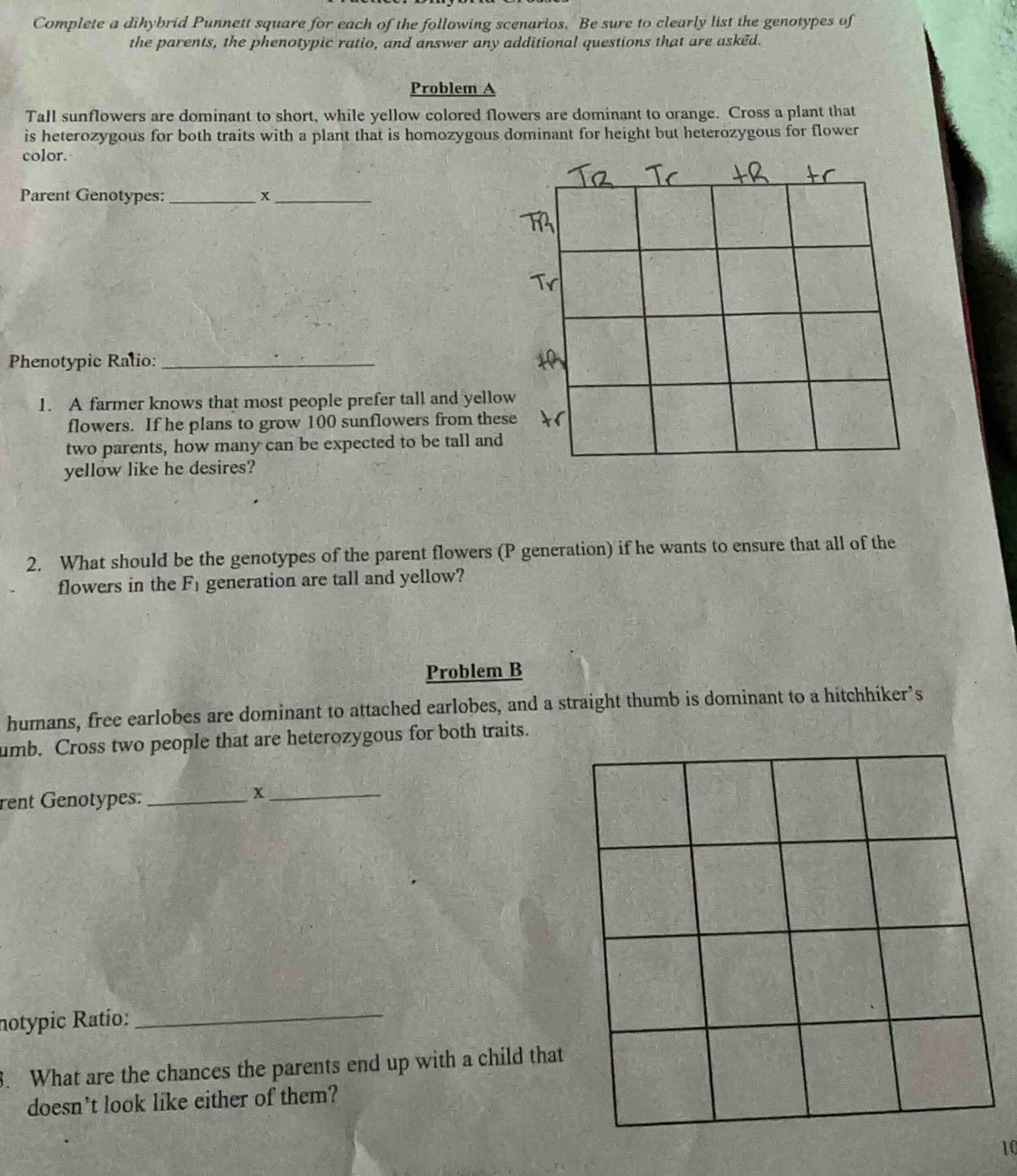
complete a dihybrid punnett square for each of the following scenarios. be sure to clearly list the genotypes of the parents, the phenotypic ratio, and answer any additional questions that are asked.
problem a
tall sunflowers are dominant to short, while yellow colored flowers are dominant to orange. cross a plant that is heterozygous for both traits with a plant that is homozygous dominant for height but heterozygous for flower color.
parent genotypes: ____ x ____
phenotypic ratio: ______
- a farmer knows that most people prefer tall and yellow flowers. if he plans to grow 100 sunflowers from these two parents, how many can be expected to be tall and yellow like he desires?
- what should be the genotypes of the parent flowers (p generation) if he wants to ensure that all of the flowers in the f₁ generation are tall and yellow?
problem b
humans, free earlobes are dominant to attached earlobes, and a straight thumb is dominant to a hitchhiker’s umb. cross two people that are heterozygous for both traits.
rent genotypes: ____ x ____
otypic ratio: ______
- what are the chances the parents end up with a child that doesn’t look like either of them?
Problem A
Parent Genotypes
Let's define the alleles:
- For height: \( T \) (tall, dominant), \( t \) (short, recessive)
- For flower color: \( Y \) (yellow, dominant), \( y \) (orange, recessive)
First parent: heterozygous for both traits → \( TtYy \)
Second parent: homozygous dominant for height (\( TT \)) and heterozygous for flower color (\( Yy \)) → \( TTYy \)
So parent genotypes: \( TtYy \times TTYy \)
Gametes Production
- From \( TtYy \): The possible gametes are formed by independent assortment of the two traits. For height (\( Tt \)): \( T \) or \( t \); for flower color (\( Yy \)): \( Y \) or \( y \). So the gametes are \( TY, Ty, tY, ty \)
- From \( TTYy \): For height (\( TT \)): only \( T \); for flower color (\( Yy \)): \( Y \) or \( y \). So the gametes are \( TY, TY, Ty, Ty \) (or simplified as \( TY, Ty \) since both \( T \) alleles are the same, so the gametes are \( TY \) and \( Ty \) each with 50% chance, but when listing all possible (even with duplicate \( T \) alleles), we can write \( TY, TY, Ty, Ty \))
Dihybrid Punnett Square
Let's set up the Punnett square with the gametes from each parent. The rows will be the gametes from \( TtYy \) (\( TY, Ty, tY, ty \)) and the columns will be the gametes from \( TTYy \) (\( TY, TY, Ty, Ty \))
| \( TY \) | \( TY \) | \( Ty \) | \( Ty \) | |
|---|---|---|---|---|
| \( Ty \) | \( TT Yy \) | \( TT Yy \) | \( TT yy \) | \( TT yy \) |
| \( tY \) | \( Tt YY \) | \( Tt YY \) | \( Tt Yy \) | \( Tt Yy \) |
| \( ty \) | \( Tt Yy \) | \( Tt Yy \) | \( Tt yy \) | \( Tt yy \) |
Now let's determine the phenotypes for each genotype:
- Tall ( \( T\_ \)) and Yellow ( \( Y\_ \)): Genotypes with \( T \) (any) and \( Y \) (any). Let's count the number of such cells:
- \( TTYY \): 2 cells (first two in first row)
- \( TT Yy \): 2 cells (third and fourth in first row) + 2 cells (first two in second row) = 4
- \( Tt YY \): 2 cells (first two in third row)
- \( Tt Yy \): 2 cells (third and fourth in third row) + 2 cells (first two in fourth row) = 4
- Total for Tall and Yellow: \( 2 + 4 + 2 + 4 = 12 \)
- Tall ( \( T\_ \)) and Orange ( \( yy \)): Genotypes with \( T \) (any) and \( yy \)
- \( TT yy \): 2 cells (third and fourth in second row)
- \( Tt yy \): 2 cells (third and fourth in fourth row)
- Total for Tall and Orange: \( 2 + 2 = 4 \)
- Short ( \( tt \)) and Yellow ( \( Y\_ \)): Genotypes with \( tt \) and \( Y \) (any). But in our cross, the second parent is \( TT \), so the offspring will have at least one \( T \) from the second parent. So \( tt \) is not possible here. So the number of short and yellow is 0.
- Short ( \( tt \)) and Orange ( \( yy \)): Also not possible, since we can't get \( tt \) from the cross (second parent is \( TT \)), so 0.
Wait, let's re - check the genotypes:
- All offspring will have \( T \) from the \( TTYy \) parent, so the height phenotype is always tall (since \( T \) is dominant). So we only need to consider the flower color and height is always tall.
- For flower color: \( Y\_ \) (yellow) or \( yy \) (orange)
- From the Punnett square:
- Genotypes with \( Y\_ \) (yellow): Let's count the number of cells with at least one \( Y \) allele.
- \( TTYY \): 2
- \( TT Yy \): 4
- \( Tt YY \): 2
- \( Tt Yy \): 4
- Total: \( 2 + 4+2 + 4=12 \)
- Genotypes with \( yy \) (orange):
- \( TT yy \): 2
- \( Tt yy \): 2
- Total: \( 2 + 2 = 4 \)
Since height is always tall (because one paren…

Snap & solve any problem in the app
Get step-by-step solutions on Sovi AI
Photo-based solutions with guided steps
Explore more problems and detailed explanations
Problem A
Parent Genotypes
Let's define the alleles:
- For height: \( T \) (tall, dominant), \( t \) (short, recessive)
- For flower color: \( Y \) (yellow, dominant), \( y \) (orange, recessive)
First parent: heterozygous for both traits → \( TtYy \)
Second parent: homozygous dominant for height (\( TT \)) and heterozygous for flower color (\( Yy \)) → \( TTYy \)
So parent genotypes: \( TtYy \times TTYy \)
Gametes Production
- From \( TtYy \): The possible gametes are formed by independent assortment of the two traits. For height (\( Tt \)): \( T \) or \( t \); for flower color (\( Yy \)): \( Y \) or \( y \). So the gametes are \( TY, Ty, tY, ty \)
- From \( TTYy \): For height (\( TT \)): only \( T \); for flower color (\( Yy \)): \( Y \) or \( y \). So the gametes are \( TY, TY, Ty, Ty \) (or simplified as \( TY, Ty \) since both \( T \) alleles are the same, so the gametes are \( TY \) and \( Ty \) each with 50% chance, but when listing all possible (even with duplicate \( T \) alleles), we can write \( TY, TY, Ty, Ty \))
Dihybrid Punnett Square
Let's set up the Punnett square with the gametes from each parent. The rows will be the gametes from \( TtYy \) (\( TY, Ty, tY, ty \)) and the columns will be the gametes from \( TTYy \) (\( TY, TY, Ty, Ty \))
| \( TY \) | \( TY \) | \( Ty \) | \( Ty \) | |
|---|---|---|---|---|
| \( Ty \) | \( TT Yy \) | \( TT Yy \) | \( TT yy \) | \( TT yy \) |
| \( tY \) | \( Tt YY \) | \( Tt YY \) | \( Tt Yy \) | \( Tt Yy \) |
| \( ty \) | \( Tt Yy \) | \( Tt Yy \) | \( Tt yy \) | \( Tt yy \) |
Now let's determine the phenotypes for each genotype:
- Tall ( \( T\_ \)) and Yellow ( \( Y\_ \)): Genotypes with \( T \) (any) and \( Y \) (any). Let's count the number of such cells:
- \( TTYY \): 2 cells (first two in first row)
- \( TT Yy \): 2 cells (third and fourth in first row) + 2 cells (first two in second row) = 4
- \( Tt YY \): 2 cells (first two in third row)
- \( Tt Yy \): 2 cells (third and fourth in third row) + 2 cells (first two in fourth row) = 4
- Total for Tall and Yellow: \( 2 + 4 + 2 + 4 = 12 \)
- Tall ( \( T\_ \)) and Orange ( \( yy \)): Genotypes with \( T \) (any) and \( yy \)
- \( TT yy \): 2 cells (third and fourth in second row)
- \( Tt yy \): 2 cells (third and fourth in fourth row)
- Total for Tall and Orange: \( 2 + 2 = 4 \)
- Short ( \( tt \)) and Yellow ( \( Y\_ \)): Genotypes with \( tt \) and \( Y \) (any). But in our cross, the second parent is \( TT \), so the offspring will have at least one \( T \) from the second parent. So \( tt \) is not possible here. So the number of short and yellow is 0.
- Short ( \( tt \)) and Orange ( \( yy \)): Also not possible, since we can't get \( tt \) from the cross (second parent is \( TT \)), so 0.
Wait, let's re - check the genotypes:
- All offspring will have \( T \) from the \( TTYy \) parent, so the height phenotype is always tall (since \( T \) is dominant). So we only need to consider the flower color and height is always tall.
- For flower color: \( Y\_ \) (yellow) or \( yy \) (orange)
- From the Punnett square:
- Genotypes with \( Y\_ \) (yellow): Let's count the number of cells with at least one \( Y \) allele.
- \( TTYY \): 2
- \( TT Yy \): 4
- \( Tt YY \): 2
- \( Tt Yy \): 4
- Total: \( 2 + 4+2 + 4=12 \)
- Genotypes with \( yy \) (orange):
- \( TT yy \): 2
- \( Tt yy \): 2
- Total: \( 2 + 2 = 4 \)
Since height is always tall (because one parent is \( TT \) and the other is \( Tt \), so all offspring have at least one \( T \) allele), the phenotypic ratio is based on flower color within the tall plants. So the phenotypic ratio of tall - yellow : tall - orange is \( 12:4 = 3:1 \) (simplified by dividing both by 4). Wait, but let's check the number of each phenotype:
- Tall and yellow: 12 out of 16 (since the Punnett square has 16 cells)
- Tall and orange: 4 out of 16
- Short and yellow: 0
- Short and orange: 0
So the phenotypic ratio is tall - yellow : tall - orange = \( 12:4=3:1 \) (or in the format of tall yellow : tall orange : short yellow : short orange = \( 12:4:0:0 \))
Question 1: Expected number of tall and yellow sunflowers out of 100
The proportion of tall and yellow sunflowers is \( \frac{12}{16}=\frac{3}{4} \)
To find the expected number out of 100, we calculate \( 100\times\frac{3}{4} = 75 \)
Question 2: Genotypes of parents to ensure all \( F_1 \) are tall and yellow
- For all \( F_1 \) to be tall ( \( T\_ \)) and yellow ( \( Y\_ \)):
- For height: We can have one parent as \( TT \) (homozygous dominant) and the other parent can be any genotype with \( T \) (but to ensure all are tall, at least one parent is \( TT \)). But to ensure all are yellow ( \( Y\_ \)), we need at least one parent to be homozygous dominant for flower color ( \( YY \)) or both parents with \( Y\_ \) such that no \( yy \) is produced. The best way is to have one parent as \( TTYY \) (homozygous dominant for both traits) and the other parent can be any genotype, but if we want to be sure, the cross \( TTYY\times\text{any with } T\_ \text{and } Y\_ \) will work. But the most straightforward is \( TTYY\times TTYY \) or \( TTYY\times TTYy \) or \( TTYY\times TtYY \) or \( TTYY\times TtYy \). But to ensure that all are tall (so at least one \( T \) allele from each parent, but if one parent is \( TTYY \), then regardless of the other parent (as long as it has \( T \) for height and \( Y \) for color), but to have all yellow, the other parent should have at least one \( Y \) allele. The simplest cross is \( TTYY\times TTYY \) (both homozygous dominant for both traits), but also a cross like \( TTYY\times TTYy \) will also result in all tall (since \( TT \) from one parent and \( T \) from the other) and all yellow (since \( YY \) from one parent and at least one \( Y \) from the other). But the most certain way is to have one parent as \( TTYY \) (homozygous dominant for both traits) and the other parent can be \( TTYY \), \( TTYy \), \( TtYY \), or \( TtYy \), but to ensure that there is no chance of getting \( yy \) or \( tt \), the cross \( TTYY\times TTYY \) will give all \( TTYY \) offspring, which are tall and yellow. Another option is \( TTYY\times TTYy \), but \( TTYY\times TTYY \) is a safer bet.
Problem B
Parent Genotypes
Let's define the alleles:
- For earlobes: \( F \) (free, dominant), \( f \) (attached, recessive)
- For thumb: \( S \) (straight, dominant), \( s \) (hitchhiker's, recessive)
Both parents are heterozygous for both traits, so the parent genotypes are \( FfSs\times FfSs \)
Gametes Production
- From each \( FfSs \) parent: By independent assortment, for earlobes (\( Ff \)): \( F \) or \( f \); for thumb (\( Ss \)): \( S \) or \( s \). So the possible gametes are \( FS, Fs, fS, fs \)
Dihybrid Punnett Square
We set up the Punnett square with the gametes from each parent. The rows and columns will be \( FS, Fs, fS, fs \)
| \( FS \) | \( Fs \) | \( fS \) | \( fs \) | |
|---|---|---|---|---|
| \( Fs \) | \( FFSs \) | \( FFss \) | \( FfSs \) | \( Ffss \) |
| \( fS \) | \( FfSS \) | \( FfSs \) | \( ffSS \) | \( ffSs \) |
| \( fs \) | \( FfSs \) | \( Ffss \) | \( ffSs \) | \( ffss \) |
Phenotype Determination
- Free earlobes ( \( F\_ \)) and straight thumb ( \( S\_ \)): Genotypes with \( F\_ \) and \( S\_ \)
- Count the cells: \( FFSS \) (1), \( FFSs \) (2), \( FfSS \) (2), \( FfSs \) (4) → Total: \( 1 + 2+2 + 4=9 \)
- Free earlobes ( \( F\_ \)) and hitchhiker's thumb ( \( ss \)): Genotypes with \( F\_ \) and \( ss \)
- Count the cells: \( FFss \) (1), \( Ffss \) (2) → Total: \( 1+2 = 3 \)
- Attached earlobes ( \( ff \)) and straight thumb ( \( S\_ \)): Genotypes with \( ff \) and \( S\_ \)
- Count the cells: \( ffSS \) (1), \( ffSs \) (2) → Total: \( 1 + 2=3 \)
- Attached earlobes ( \( ff \)) and hitchhiker's thumb ( \( ss \)): Genotype \( ffss \) → Count: 1
So the phenotypic ratio is free earlobes - straight thumb : free earlobes - hitchhiker's thumb : attached earlobes - straight thumb : attached earlobes - hitchhiker's thumb = \( 9:3:3:1 \)
Question 3: Chances of a child not looking like either parent
The parents have the phenotype free earlobes and straight thumb (since they are heterozygous for both traits, \( FfSs \), so phenotype is free earlobes and straight thumb). A child that doesn't look like either parent will have a different phenotype, i.e., either free earlobes - hitchhiker's thumb, attached earlobes - straight thumb, or attached earlobes - hitchhiker's thumb.
The total number of non - parental phenotype cells is \( 3 + 3+1=7 \)? Wait no, the parental phenotype is free earlobes and straight thumb (9 cells). The other phenotypes are \( 3 + 3+1 = 7 \)? Wait no, the total number of cells in the Punnett square is 16. The number of cells with non - parental phenotype is \( 16 - 9=7 \)? Wait no, let's re - check:
Parental phenotype: free earlobes ( \( F\_ \)) and straight thumb ( \( S\_ \)) → 9 cells.
Non - parental phenotypes:
- Free earlobes and hitchhiker's thumb: 3 cells
- Attached earlobes and straight thumb: 3 cells
- Attached earlobes and hitchhiker's thumb: 1 cell
Total non - parental: \( 3 + 3+1=7 \)? Wait, \( 3+3 + 1=7 \), and \( 9+7 = 16 \), which is correct. But wait, the chance is the number of non - parental phenotype cells divided by the total number of cells. So the probability is \( \frac{7}{16}\)? Wait no, wait the parental phenotype is \( F\_S\_ \) (9 cells), the other phenotypes are \( F\_ss \) (3), \( ffS\_ \) (3), \( ffss \) (1). So the number of children that don't look like the parents (who have \( F\_S\_ \)) is \( 3 + 3+1=7 \)? Wait, no, the parents have \( FfSs \), so their phenotype is free earlobes ( \( F\_ \)) and straight thumb ( \( S\_ \)). A child that doesn't look like them will have a different combination: either free earlobes and hitchhiker's thumb ( \( F\_ss \)), attached earlobes and straight thumb ( \( ffS\_ \)), or attached earlobes and hitchhiker's thumb ( \( ffss \)). The number of such children is \( 3+3 + 1=7 \) out of 16. So the probability is \( \frac{7}{16}\) or \( 43.75\% \)
Final Answers
Problem A
- Parent Genotypes: \( TtYy \times TTYy \)
- Phenotypic Ratio: Tall yellow : Tall orange : Short yellow : Short orange = \( 12:4:0:0 \) (or simplified as \( 3:1:0:0 \))
- 1. Expected number of tall and yellow sunflowers: \( 75 \)
- 2. One possible set of parent genotypes: \( TTYY\times TTYY \) (other valid answers include \( TTYY\times TTYy \), \( TTYY\times TtYY \), \( TTYY\times TtYy \))
Problem B
- Parent Genotypes: \( FfSs \times FfSs \)
- Phenotypic Ratio: Free earlobes - straight thumb : Free earlobes - hitchhiker's thumb : Attached earlobes - straight thumb : Attached earlobes - hitchhiker's thumb = \( 9:3:3:1 \)
- 3. The chance of a child not looking like either parent is \( \frac{7}{16}\) (or \( 43.75\% \))