QUESTION IMAGE
Question
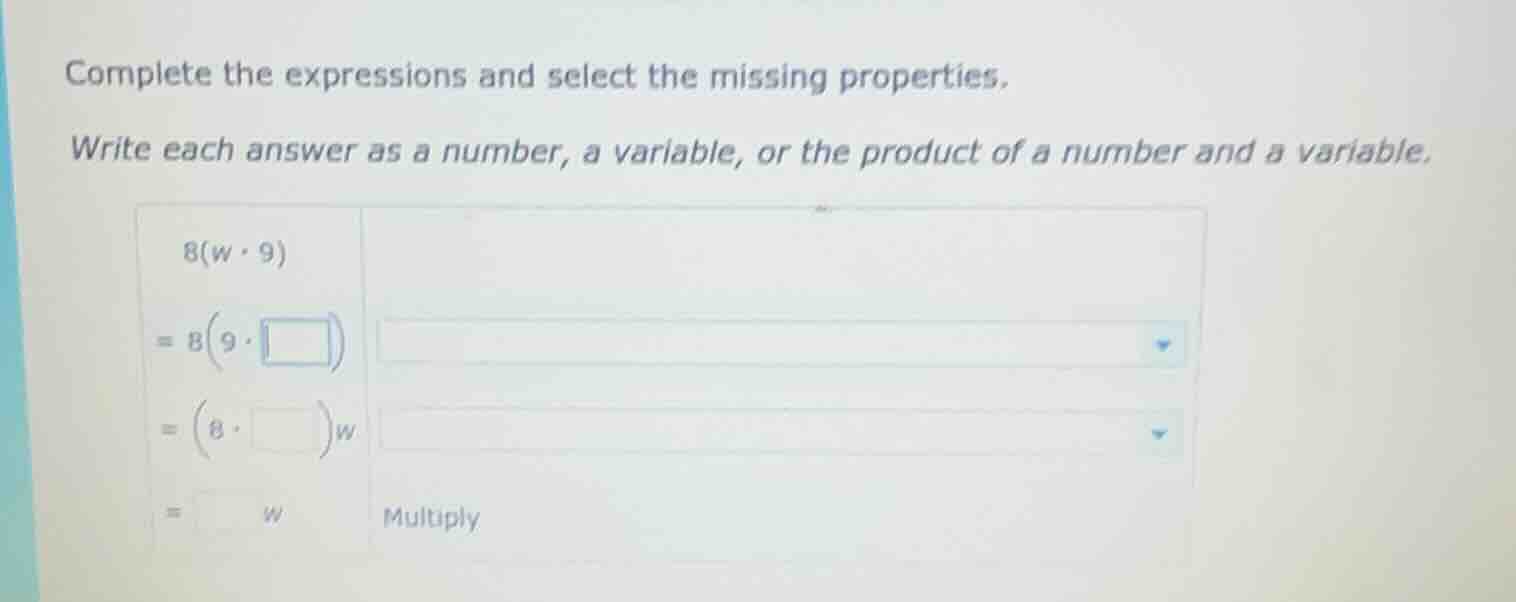
complete the expressions and select the missing properties. write each answer as a number, a variable, or the product of a number and a variable. 8(w·9) = 8(9·□) = (8·□)w = □w multiply
Step1: Apply Commutative Property of Multiplication
The commutative property of multiplication states that \(a \cdot b = b \cdot a\). So for \(8(w \cdot 9)\), we can rewrite \(w \cdot 9\) as \(9 \cdot w\). So the first blank is \(w\), and the property is the Commutative Property of Multiplication.
\[8(w \cdot 9)=8(9 \cdot w)\]
Step2: Apply Associative Property of Multiplication
The associative property of multiplication states that \((a \cdot b) \cdot c = a \cdot (b \cdot c)\). Here, we can group \(8\) and \(9\) together. So \(8(9 \cdot w)=(8 \cdot 9)w\). The second blank is \(9\), and the property is the Associative Property of Multiplication.
\[8(9 \cdot w)=(8 \cdot 9)w\]
Step3: Multiply 8 and 9
Calculate \(8 \cdot 9 = 72\). So the third blank is \(72\).
\[(8 \cdot 9)w = 72w\]

Snap & solve any problem in the app
Get step-by-step solutions on Sovi AI
Photo-based solutions with guided steps
Explore more problems and detailed explanations
First blank: \(w\) (Property: Commutative Property of Multiplication)
Second blank: \(9\) (Property: Associative Property of Multiplication)
Third blank: \(72\)