QUESTION IMAGE
Question
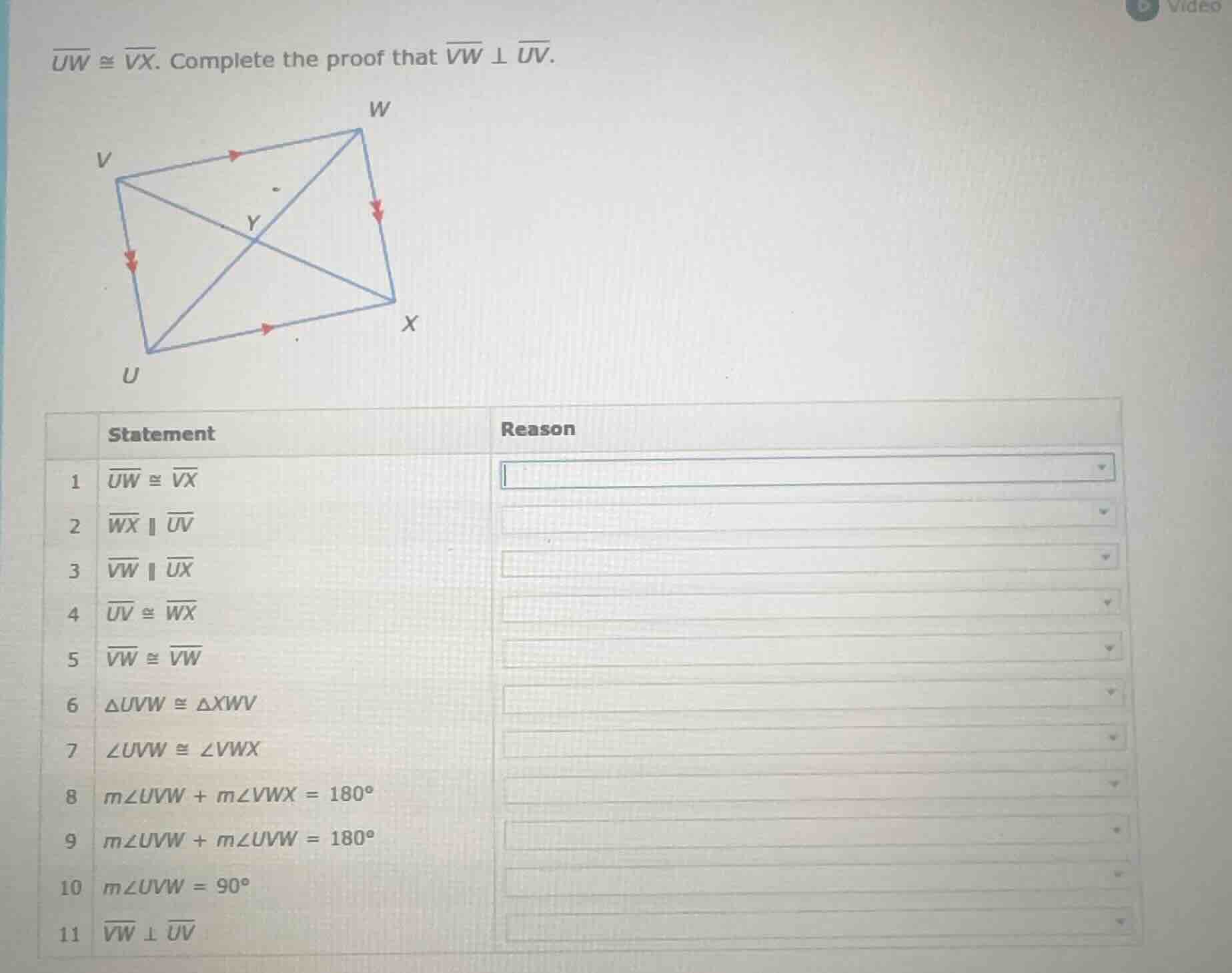
$\overline{uw} \cong \overline{vx}$. complete the proof that $\overline{vw} \perp \overline{uv}$.
- $\overline{uw} \cong \overline{vx}$
- $\overline{wx} \parallel \overline{uv}$
- $\overline{vw} \parallel \overline{ux}$
- $\overline{uv} \cong \overline{wx}$
- $\overline{vw} \cong \overline{vw}$
- $\triangle uvw \cong \triangle xwv$
- $\angle uvw \cong \angle vwx$
- $m\angle uvw + m\angle vwx = 180^\circ$
- $m\angle uvw + m\angle uvw = 180^\circ$
- $m\angle uvw = 90^\circ$
- $\overline{vw} \perp \overline{uv}$
Response
To complete the proof that \(\overline{VW} \perp \overline{UV}\), we analyze each statement and provide the corresponding reason:
Step 1: Statement \(\overline{UW} \cong \overline{VX}\)
- Reason: Given (as stated in the problem).
Step 2: Statement \(\overline{WX} \parallel \overline{UV}\)
- Reason: Opposite sides of a parallelogram are parallel (from the diagram, \(UVWX\) appears to be a parallelogram with marked parallel sides).
Step 3: Statement \(\overline{VW} \parallel \overline{UX}\)
- Reason: Opposite sides of a parallelogram are parallel (consistent with the parallelogram structure).
Step 4: Statement \(\overline{UV} \cong \overline{WX}\)
- Reason: Opposite sides of a parallelogram are congruent.
Step 5: Statement \(\overline{VW} \cong \overline{VW}\)
- Reason: Reflexive property of congruence (a segment is congruent to itself).
Step 6: Statement \(\triangle UVW \cong \triangle XWV\)
- Reason: SSS (Side - Side - Side) Congruence Postulate. We have \(\overline{UW} \cong \overline{VX}\) (Step 1), \(\overline{UV} \cong \overline{WX}\) (Step 4), and \(\overline{VW} \cong \overline{VW}\) (Step 5).
Step 7: Statement \(\angle UVW \cong \angle VWX\)
- Reason: Corresponding parts of congruent triangles are congruent (CPCTC). Since \(\triangle UVW \cong \triangle XWV\), their corresponding angles are congruent.
Step 8: Statement \(m\angle UVW + m\angle VWX = 180^\circ\)
- Reason: Consecutive interior angles are supplementary (because \(\overline{UV} \parallel \overline{WX}\) and \(\overline{VW}\) is a transversal).
Step 9: Statement \(m\angle UVW + m\angle UVW = 180^\circ\)
- Reason: Substitution (since \(\angle UVW \cong \angle VWX\), we can substitute \(m\angle VWX\) with \(m\angle UVW\)).
Step 10: Statement \(m\angle UVW = 90^\circ\)
- Reason: Solving the equation \(2m\angle UVW=180^\circ\) (from Step 9: \(m\angle UVW + m\angle UVW=180^\circ\) or \(2m\angle UVW = 180^\circ\)) gives \(m\angle UVW=\frac{180^\circ}{2} = 90^\circ\).
Step 11: Statement \(\overline{VW} \perp \overline{UV}\)
- Reason: If the measure of an angle between two segments is \(90^\circ\), then the segments are perpendicular. Since \(m\angle UVW = 90^\circ\), \(\overline{VW}\) and \(\overline{UV}\) form a right angle, so \(\overline{VW} \perp \overline{UV}\).
For the first statement (\(\overline{UW} \cong \overline{VX}\)) the reason is "Given".
If we are only asked for the reason of the first statement:
Brief Explanations
The statement \(\overline{UW} \cong \overline{VX}\) is given in the problem, so the reason is "Given".

Snap & solve any problem in the app
Get step-by-step solutions on Sovi AI
Photo-based solutions with guided steps
Explore more problems and detailed explanations
Given