QUESTION IMAGE
Question
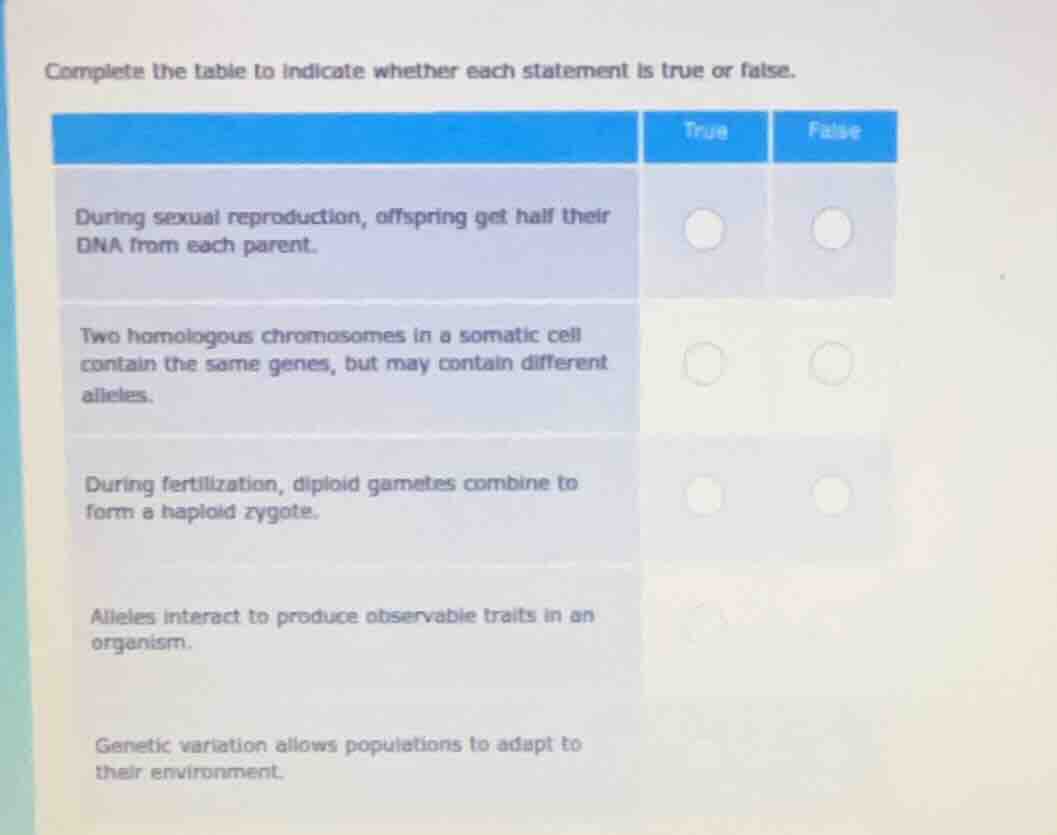
complete the table to indicate whether each statement is true or false.
during sexual reproduction, offspring get half their dna from each parent.
two homologous chromosomes in a somatic cell contain the same genes, but may contain different alleles.
during fertilization, diploid gametes combine to form a haploid zygote.
alleles interact to produce observable traits in an organism.
genetic variation allows populations to adapt to their environment.
Brief Explanations
- Sexual reproduction involves fusion of haploid gametes, each carrying half the parent's DNA, so offspring inherit 50% from each parent.
- Homologous chromosomes pair in somatic cells: they have the same gene loci, but can have different allele variants of those genes.
- Gametes are haploid (1 set of chromosomes), and fertilization combines two haploid gametes to form a diploid zygote, not the reverse.
- Alleles are variants of a gene; their combination (dominant/recessive, etc.) determines the observable phenotype (trait) of an organism.
- Genetic variation creates differences in traits within a population, which natural selection acts on to enable adaptation to environmental changes.

Snap & solve any problem in the app
Get step-by-step solutions on Sovi AI
Photo-based solutions with guided steps
Explore more problems and detailed explanations
| Statement | True | False |
|---|---|---|
| Two homologous chromosomes in a somatic cell contain the same genes, but may contain different alleles. | ✅ | |
| During fertilization, diploid gametes combine to form a haploid zygote. | ✅ | |
| Alleles interact to produce observable traits in an organism. | ✅ | |
| Genetic variation allows populations to adapt to their environment. | ✅ |