QUESTION IMAGE
Question
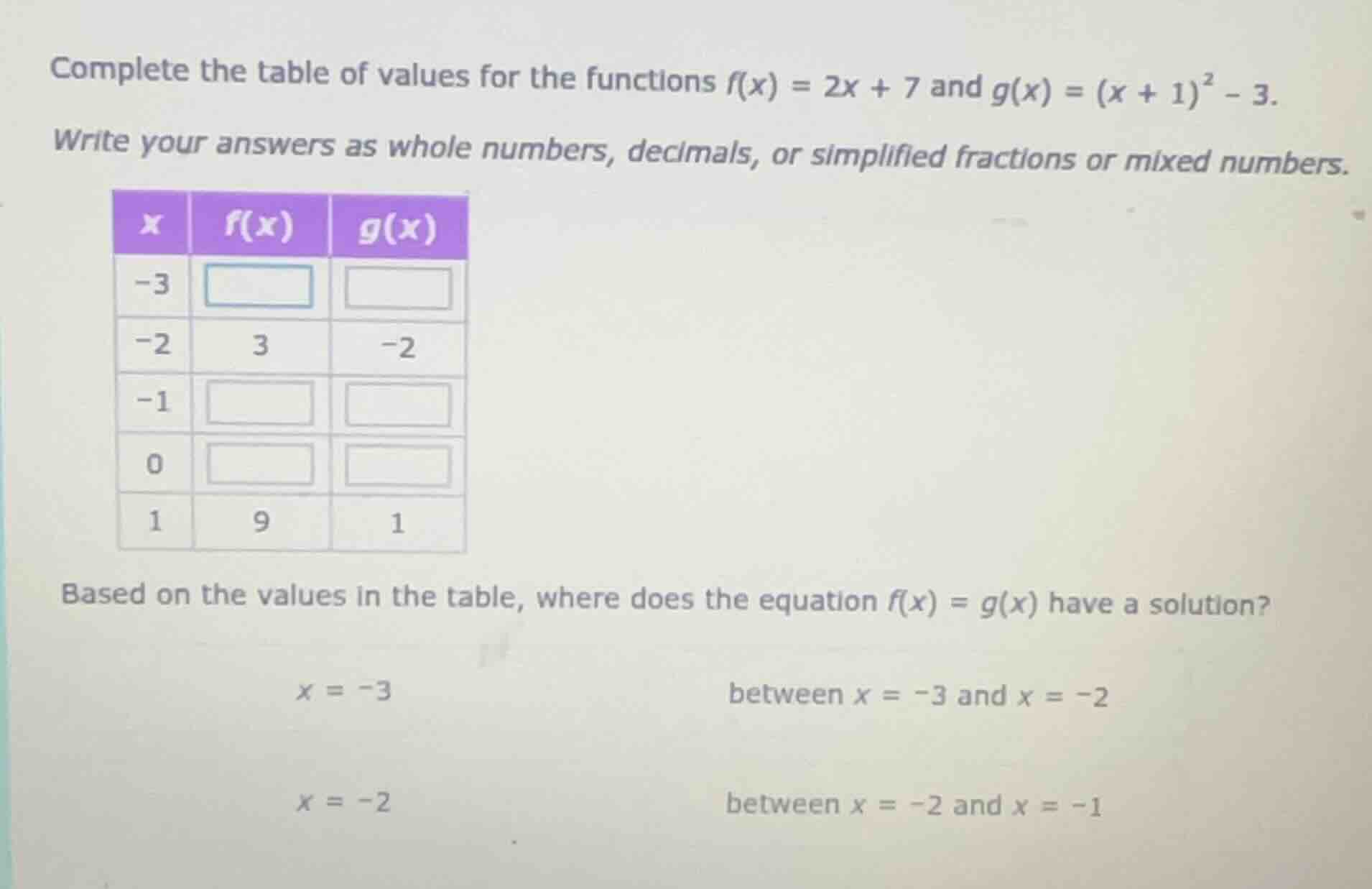
complete the table of values for the functions $f(x) = 2x + 7$ and $g(x) = (x + 1)^2 - 3$. write your answers as whole numbers, decimals, or simplified fractions or mixed numbers. \
based on the values in the table, where does the equation $f(x) = g(x)$ have a solution? $x = -3$; between $x = -3$ and $x = -2$; $x = -2$; between $x = -2$ and $x = -1$
Part 1: Completing the table for \( f(x) = 2x + 7 \) and \( g(x) = (x + 1)^2 - 3 \)
For \( x = -3 \):
- Step 1: Calculate \( f(-3) \)
Substitute \( x = -3 \) into \( f(x) = 2x + 7 \):
\( f(-3) = 2(-3) + 7 = -6 + 7 = 1 \)
- Step 2: Calculate \( g(-3) \)
Substitute \( x = -3 \) into \( g(x) = (x + 1)^2 - 3 \):
\( g(-3) = (-3 + 1)^2 - 3 = (-2)^2 - 3 = 4 - 3 = 1 \)
For \( x = -1 \):
- Step 1: Calculate \( f(-1) \)
Substitute \( x = -1 \) into \( f(x) = 2x + 7 \):
\( f(-1) = 2(-1) + 7 = -2 + 7 = 5 \)
- Step 2: Calculate \( g(-1) \)
Substitute \( x = -1 \) into \( g(x) = (x + 1)^2 - 3 \):
\( g(-1) = (-1 + 1)^2 - 3 = (0)^2 - 3 = 0 - 3 = -3 \)
For \( x = 0 \):
- Step 1: Calculate \( f(0) \)
Substitute \( x = 0 \) into \( f(x) = 2x + 7 \):
\( f(0) = 2(0) + 7 = 0 + 7 = 7 \)
- Step 2: Calculate \( g(0) \)
Substitute \( x = 0 \) into \( g(x) = (x + 1)^2 - 3 \):
\( g(0) = (0 + 1)^2 - 3 = (1)^2 - 3 = 1 - 3 = -2 \)
Updated Table:
| \( x \) | \( f(x) \) | \( g(x) \) |
|---|---|---|
| \( -2 \) | \( 3 \) | \( -2 \) |
| \( -1 \) | \( 5 \) | \( -3 \) |
| \( 0 \) | \( 7 \) | \( -2 \) |
| \( 1 \) | \( 9 \) | \( 1 \) |
Part 2: Solving \( f(x) = g(x) \)
To find where \( f(x) = g(x) \), we analyze the table:
- At \( x = -3 \): \( f(-3) = 1 \) and \( g(-3) = 1 \), so \( f(x) = g(x) \) here. Wait, but let’s check the options. Wait, the options include "between \( x = -2 \) and \( x = -1 \)"? Wait, no—wait, at \( x = -2 \): \( f(-2) = 3 \), \( g(-2) = -2 \) (so \( f > g \)). At \( x = -1 \): \( f(-1) = 5 \), \( g(-1) = -3 \) (still \( f > g \))? Wait, no—wait, earlier at \( x = -3 \), \( f(x) = g(x) = 1 \). But the options given are:
- \( x = -3 \)
- between \( x = -3 \) and \( x = -2 \)
- \( x = -2 \)
- between \( x = -2 \) and \( x = -1 \)
Wait, but at \( x = -3 \), \( f(x) = g(x) \), so the solution is \( x = -3 \)? Wait, but let’s recheck:
At \( x = -3 \): \( f(-3) = 2(-3) + 7 = 1 \), \( g(-3) = (-3 + 1)^2 - 3 = 4 - 3 = 1 \). So \( f(-3) = g(-3) \), so \( x = -3 \) is a solution.
Final Answers:
Table Completion:
- \( x = -3 \): \( f(x) = 1 \), \( g(x) = 1 \)
- \( x = -1 \): \( f(x) = 5 \), \( g(x) = -3 \)
- \( x = 0 \): \( f(x) = 7 \), \( g(x) = -2 \)
Solution to \( f(x) = g(x) \):
\( x = -3 \) (since \( f(-3) = g(-3) = 1 \)).
Final Answer (Table Values):
For \( x = -3 \): \( f(x) = \boldsymbol{1} \), \( g(x) = \boldsymbol{1} \)
For \( x = -1 \): \( f(x) = \boldsymbol{5} \), \( g(x) = \boldsymbol{-3} \)
For \( x = 0 \): \( f(x) = \boldsymbol{7} \), \( g(x) = \boldsymbol{-2} \)
Solution to \( f(x) = g(x) \):
\( \boldsymbol{x = -3} \) (or check the options—if \( x = -3 \) is an option, that’s the answer).
(Note: If the problem expects the "between" option, there might be a miscalculation. Wait, no—at \( x = -3 \), they are equal. So the solution is \( x = -3 \).)

Snap & solve any problem in the app
Get step-by-step solutions on Sovi AI
Photo-based solutions with guided steps
Explore more problems and detailed explanations
Part 1: Completing the table for \( f(x) = 2x + 7 \) and \( g(x) = (x + 1)^2 - 3 \)
For \( x = -3 \):
- Step 1: Calculate \( f(-3) \)
Substitute \( x = -3 \) into \( f(x) = 2x + 7 \):
\( f(-3) = 2(-3) + 7 = -6 + 7 = 1 \)
- Step 2: Calculate \( g(-3) \)
Substitute \( x = -3 \) into \( g(x) = (x + 1)^2 - 3 \):
\( g(-3) = (-3 + 1)^2 - 3 = (-2)^2 - 3 = 4 - 3 = 1 \)
For \( x = -1 \):
- Step 1: Calculate \( f(-1) \)
Substitute \( x = -1 \) into \( f(x) = 2x + 7 \):
\( f(-1) = 2(-1) + 7 = -2 + 7 = 5 \)
- Step 2: Calculate \( g(-1) \)
Substitute \( x = -1 \) into \( g(x) = (x + 1)^2 - 3 \):
\( g(-1) = (-1 + 1)^2 - 3 = (0)^2 - 3 = 0 - 3 = -3 \)
For \( x = 0 \):
- Step 1: Calculate \( f(0) \)
Substitute \( x = 0 \) into \( f(x) = 2x + 7 \):
\( f(0) = 2(0) + 7 = 0 + 7 = 7 \)
- Step 2: Calculate \( g(0) \)
Substitute \( x = 0 \) into \( g(x) = (x + 1)^2 - 3 \):
\( g(0) = (0 + 1)^2 - 3 = (1)^2 - 3 = 1 - 3 = -2 \)
Updated Table:
| \( x \) | \( f(x) \) | \( g(x) \) |
|---|---|---|
| \( -2 \) | \( 3 \) | \( -2 \) |
| \( -1 \) | \( 5 \) | \( -3 \) |
| \( 0 \) | \( 7 \) | \( -2 \) |
| \( 1 \) | \( 9 \) | \( 1 \) |
Part 2: Solving \( f(x) = g(x) \)
To find where \( f(x) = g(x) \), we analyze the table:
- At \( x = -3 \): \( f(-3) = 1 \) and \( g(-3) = 1 \), so \( f(x) = g(x) \) here. Wait, but let’s check the options. Wait, the options include "between \( x = -2 \) and \( x = -1 \)"? Wait, no—wait, at \( x = -2 \): \( f(-2) = 3 \), \( g(-2) = -2 \) (so \( f > g \)). At \( x = -1 \): \( f(-1) = 5 \), \( g(-1) = -3 \) (still \( f > g \))? Wait, no—wait, earlier at \( x = -3 \), \( f(x) = g(x) = 1 \). But the options given are:
- \( x = -3 \)
- between \( x = -3 \) and \( x = -2 \)
- \( x = -2 \)
- between \( x = -2 \) and \( x = -1 \)
Wait, but at \( x = -3 \), \( f(x) = g(x) \), so the solution is \( x = -3 \)? Wait, but let’s recheck:
At \( x = -3 \): \( f(-3) = 2(-3) + 7 = 1 \), \( g(-3) = (-3 + 1)^2 - 3 = 4 - 3 = 1 \). So \( f(-3) = g(-3) \), so \( x = -3 \) is a solution.
Final Answers:
Table Completion:
- \( x = -3 \): \( f(x) = 1 \), \( g(x) = 1 \)
- \( x = -1 \): \( f(x) = 5 \), \( g(x) = -3 \)
- \( x = 0 \): \( f(x) = 7 \), \( g(x) = -2 \)
Solution to \( f(x) = g(x) \):
\( x = -3 \) (since \( f(-3) = g(-3) = 1 \)).
Final Answer (Table Values):
For \( x = -3 \): \( f(x) = \boldsymbol{1} \), \( g(x) = \boldsymbol{1} \)
For \( x = -1 \): \( f(x) = \boldsymbol{5} \), \( g(x) = \boldsymbol{-3} \)
For \( x = 0 \): \( f(x) = \boldsymbol{7} \), \( g(x) = \boldsymbol{-2} \)
Solution to \( f(x) = g(x) \):
\( \boldsymbol{x = -3} \) (or check the options—if \( x = -3 \) is an option, that’s the answer).
(Note: If the problem expects the "between" option, there might be a miscalculation. Wait, no—at \( x = -3 \), they are equal. So the solution is \( x = -3 \).)