QUESTION IMAGE
Question
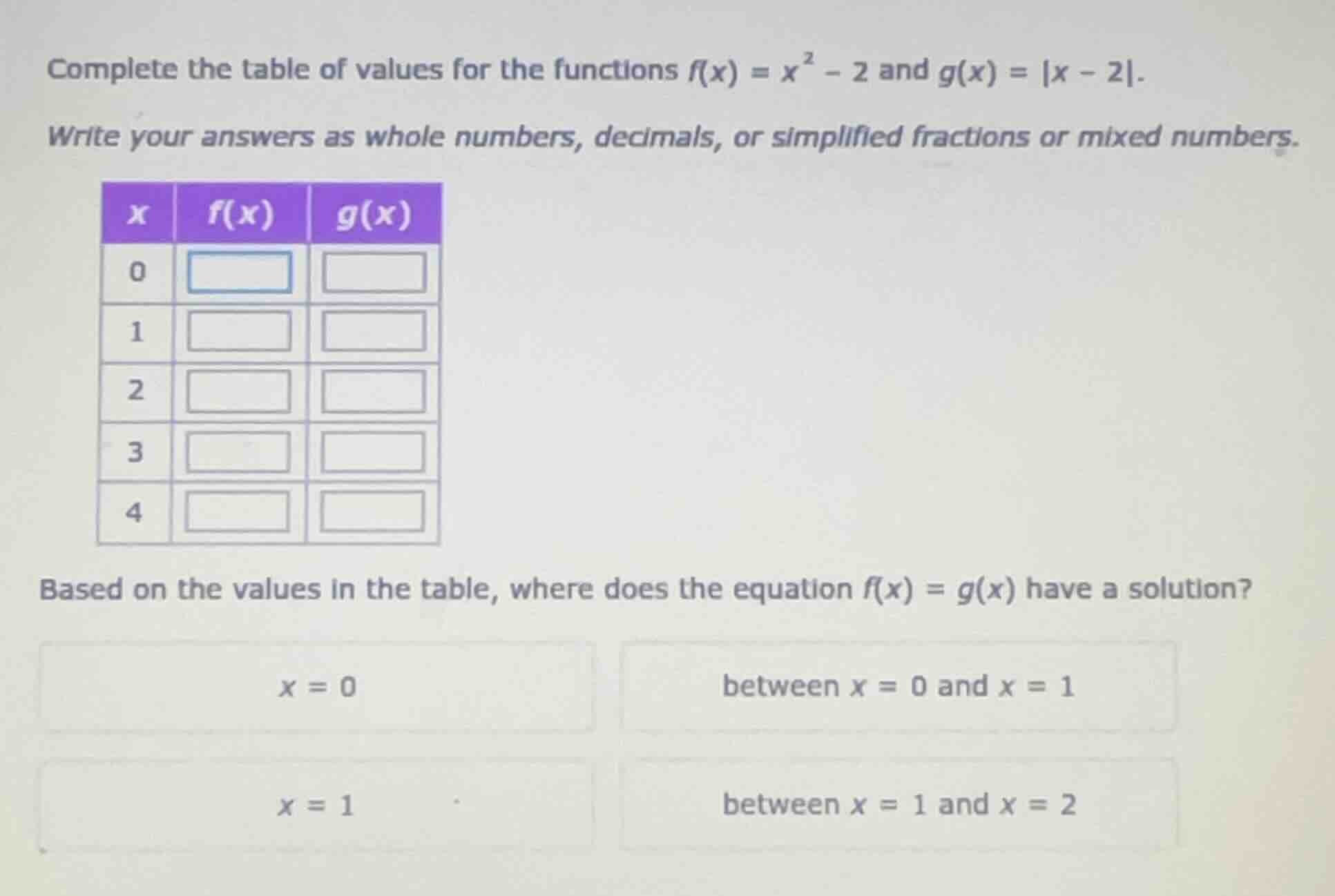
complete the table of values for the functions $f(x) = x^2 - 2$ and $g(x) = |x - 2|$. write your answers as whole numbers, decimals, or simplified fractions or mixed numbers. \
based on the values in the table, where does the equation $f(x) = g(x)$ have a solution? \\( x = 0 \\) \\( x = 1 \\) between $x = 0$ and $x = 1$ between $x = 1$ and $x = 2$
Part 1: Complete the table for \( f(x) = x^2 - 2 \) and \( g(x) = |x - 2| \)
For \( x = 0 \):
- \( f(0) = 0^2 - 2 = -2 \)
- \( g(0) = |0 - 2| = 2 \)
For \( x = 1 \):
- \( f(1) = 1^2 - 2 = -1 \)
- \( g(1) = |1 - 2| = 1 \)
For \( x = 2 \):
- \( f(2) = 2^2 - 2 = 2 \)
- \( g(2) = |2 - 2| = 0 \)
For \( x = 3 \):
- \( f(3) = 3^2 - 2 = 7 \)
- \( g(3) = |3 - 2| = 1 \)
For \( x = 4 \):
- \( f(4) = 4^2 - 2 = 14 \)
- \( g(4) = |4 - 2| = 2 \)
The completed table is:
| \( x \) | \( f(x) \) | \( g(x) \) |
|---|---|---|
| 1 | -1 | 1 |
| 2 | 2 | 0 |
| 3 | 7 | 1 |
| 4 | 14 | 2 |
Part 2: Find where \( f(x) = g(x) \)
We analyze the values of \( f(x) \) and \( g(x) \) at each \( x \):
- At \( x = 0 \): \( f(0) = -2 \), \( g(0) = 2 \) ( \( f(x) < g(x) \) )
- At \( x = 1 \): \( f(1) = -1 \), \( g(1) = 1 \) ( \( f(x) < g(x) \) )
- At \( x = 2 \): \( f(2) = 2 \), \( g(2) = 0 \) ( \( f(x) > g(x) \) )
Since \( f(x) \) is increasing (quadratic) and \( g(x) \) is decreasing then increasing (absolute value), we check the intervals:
- Between \( x = 1 \) and \( x = 2 \): At \( x = 1 \), \( f(x) = -1 \), \( g(x) = 1 \) ( \( f < g \) ). At \( x = 2 \), \( f(x) = 2 \), \( g(x) = 0 \) ( \( f > g \) ). By the Intermediate Value Theorem, \( f(x) = g(x) \) has a solution between \( x = 1 \) and \( x = 2 \).
Final Answers
Table:
| \( x \) | \( f(x) \) | \( g(x) \) |
|---|---|---|
| 1 | -1 | 1 |
| 2 | 2 | 0 |
| 3 | 7 | 1 |
| 4 | 14 | 2 |
Solution to \( f(x) = g(x) \):
The equation \( f(x) = g(x) \) has a solution between \( x = 1 \) and \( x = 2 \).

Snap & solve any problem in the app
Get step-by-step solutions on Sovi AI
Photo-based solutions with guided steps
Explore more problems and detailed explanations
Part 1: Complete the table for \( f(x) = x^2 - 2 \) and \( g(x) = |x - 2| \)
For \( x = 0 \):
- \( f(0) = 0^2 - 2 = -2 \)
- \( g(0) = |0 - 2| = 2 \)
For \( x = 1 \):
- \( f(1) = 1^2 - 2 = -1 \)
- \( g(1) = |1 - 2| = 1 \)
For \( x = 2 \):
- \( f(2) = 2^2 - 2 = 2 \)
- \( g(2) = |2 - 2| = 0 \)
For \( x = 3 \):
- \( f(3) = 3^2 - 2 = 7 \)
- \( g(3) = |3 - 2| = 1 \)
For \( x = 4 \):
- \( f(4) = 4^2 - 2 = 14 \)
- \( g(4) = |4 - 2| = 2 \)
The completed table is:
| \( x \) | \( f(x) \) | \( g(x) \) |
|---|---|---|
| 1 | -1 | 1 |
| 2 | 2 | 0 |
| 3 | 7 | 1 |
| 4 | 14 | 2 |
Part 2: Find where \( f(x) = g(x) \)
We analyze the values of \( f(x) \) and \( g(x) \) at each \( x \):
- At \( x = 0 \): \( f(0) = -2 \), \( g(0) = 2 \) ( \( f(x) < g(x) \) )
- At \( x = 1 \): \( f(1) = -1 \), \( g(1) = 1 \) ( \( f(x) < g(x) \) )
- At \( x = 2 \): \( f(2) = 2 \), \( g(2) = 0 \) ( \( f(x) > g(x) \) )
Since \( f(x) \) is increasing (quadratic) and \( g(x) \) is decreasing then increasing (absolute value), we check the intervals:
- Between \( x = 1 \) and \( x = 2 \): At \( x = 1 \), \( f(x) = -1 \), \( g(x) = 1 \) ( \( f < g \) ). At \( x = 2 \), \( f(x) = 2 \), \( g(x) = 0 \) ( \( f > g \) ). By the Intermediate Value Theorem, \( f(x) = g(x) \) has a solution between \( x = 1 \) and \( x = 2 \).
Final Answers
Table:
| \( x \) | \( f(x) \) | \( g(x) \) |
|---|---|---|
| 1 | -1 | 1 |
| 2 | 2 | 0 |
| 3 | 7 | 1 |
| 4 | 14 | 2 |
Solution to \( f(x) = g(x) \):
The equation \( f(x) = g(x) \) has a solution between \( x = 1 \) and \( x = 2 \).