QUESTION IMAGE
Question
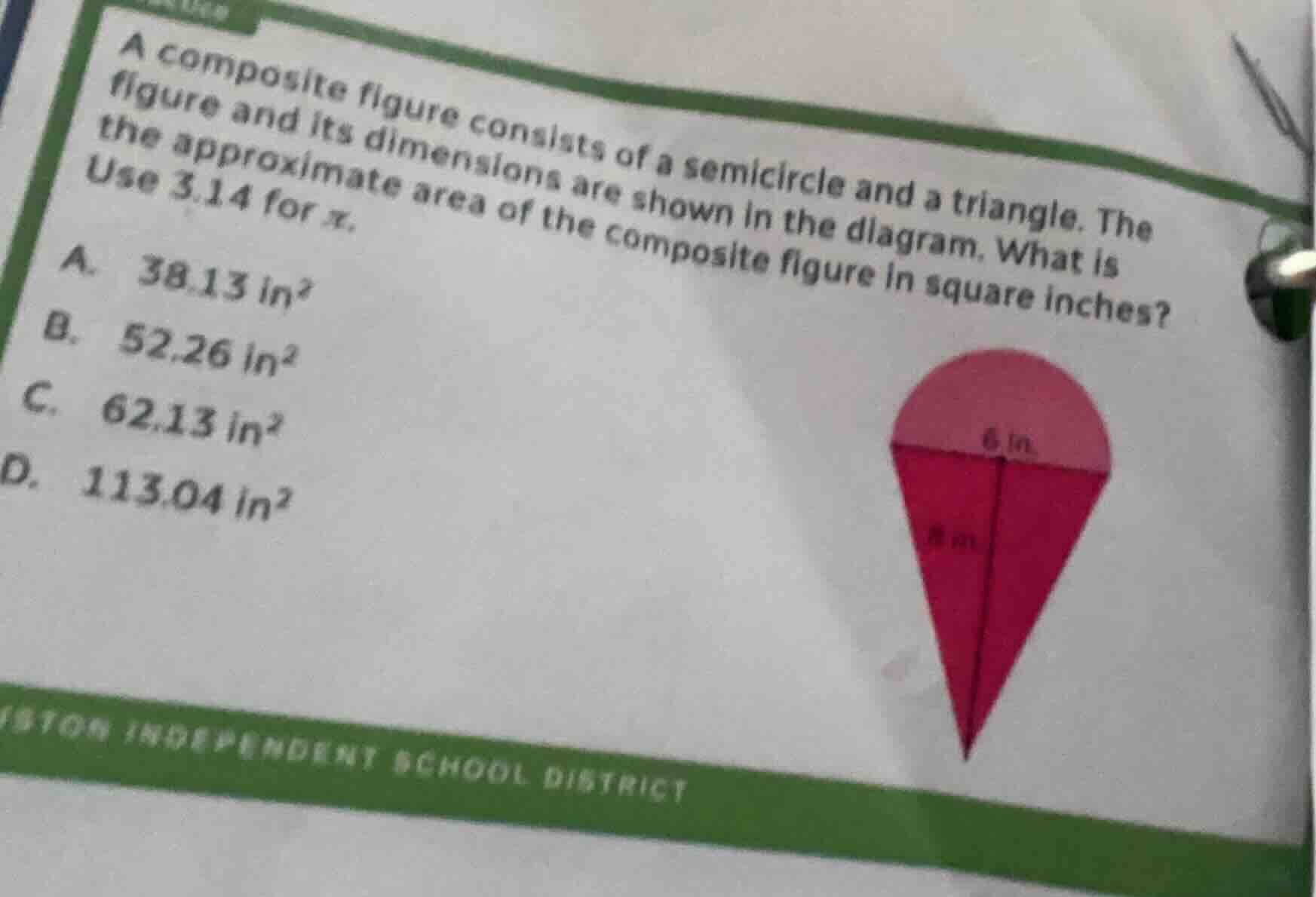
a composite figure consists of a semicircle and a triangle. the figure and its dimensions are shown in the diagram. what is the approximate area of the composite figure in square inches? use 3.14 for π. a. 38.13 in² b. 52.26 in² c. 62.13 in² d. 113.04 in² (diagram of a semicircle with diameter 6 in on top of a triangle with height 8 in)
Step1: Find the area of the semicircle
The diameter of the semicircle is 6 in, so the radius \( r=\frac{6}{2} = 3 \) in. The formula for the area of a full circle is \( A=\pi r^{2} \), so the area of a semicircle is \( \frac{1}{2}\pi r^{2} \). Substituting \( \pi = 3.14 \) and \( r = 3 \):
\( \frac{1}{2}\times3.14\times3^{2}=\frac{1}{2}\times3.14\times9 = 14.13 \) \( \text{in}^2 \)
Step2: Find the area of the triangle
The base of the triangle is 6 in and the height is 8 in. The formula for the area of a triangle is \( A=\frac{1}{2}\times\text{base}\times\text{height} \). Substituting the values:
\( \frac{1}{2}\times6\times8=24 \) \( \text{in}^2 \) Wait, no, wait. Wait, the triangle here: Wait, looking at the diagram, the triangle's base is 6 and height is 8? Wait, no, maybe I miscalculated. Wait, no, let's recheck. Wait, the composite figure is a semicircle on top of a triangle. Wait, the triangle: base is 6 in, height is 8 in? Wait, no, wait, the area of the triangle: \( \frac{1}{2}\times6\times8 = 24 \)? Wait, no, that can't be. Wait, no, maybe the height is 8? Wait, no, wait the answer options. Wait, maybe I made a mistake. Wait, no, let's recalculate the triangle area. Wait, the triangle: base is 6, height is 8? Wait, no, the area of the triangle should be \( \frac{1}{2}\times6\times8 = 24 \)? But then adding to the semicircle 14.13 gives 38.13, but that's option A. But wait, maybe the triangle is different. Wait, no, wait the diagram: the triangle is below the semicircle, with base 6 and height 8? Wait, no, maybe I misread the height. Wait, no, let's check the options. Wait, option C is 62.13. Wait, maybe the triangle's height is 8? Wait, no, maybe I messed up the triangle area. Wait, no, wait: Wait, the triangle: base 6, height 8. Wait, \( \frac{1}{2}\times6\times8 = 24 \). Semicircle area 14.13. Total would be 24 + 14.13 = 38.13? But that's option A. But wait, maybe the triangle is not that. Wait, no, maybe the height is 8? Wait, no, maybe the diagram has the triangle with base 6 and height 8? Wait, no, maybe I made a mistake. Wait, wait the answer options: C is 62.13. Wait, maybe the triangle's height is 8, but wait, no, let's recalculate. Wait, no, maybe the triangle is actually with base 6 and height 8? Wait, no, 24 +14.13 is 38.13 (option A). But that seems low. Wait, maybe the triangle's height is 8, but wait, no, maybe I misread the triangle. Wait, no, the diagram: the triangle is a larger triangle? Wait, no, the composite figure: semicircle (diameter 6) and triangle (base 6, height 8). Wait, but 24 +14.13 is 38.13, which is option A. But wait, maybe I made a mistake in the triangle area. Wait, no, let's check again. Wait, the formula for the triangle: \( \frac{1}{2} \times base \times height \). Base is 6, height is 8. So \( \frac{1}{2} \times6\times8 = 24 \). Semicircle: \( \frac{1}{2} \times3.14\times3^2 = 14.13 \). Total area: 24 +14.13 = 38.13 \( \text{in}^2 \), which is option A. Wait, but that's what the calculation shows.
Wait, but wait, maybe the triangle is not with height 8? Wait, no, the diagram shows the triangle with height 8. So the total area is semicircle area plus triangle area. So 14.13 +24 = 38.13. So the answer should be A.
Wait, but let's check the options again. Option A is 38.13 \( \text{in}^2 \), which matches our calculation.

Snap & solve any problem in the app
Get step-by-step solutions on Sovi AI
Photo-based solutions with guided steps
Explore more problems and detailed explanations
A. 38.13 \( \text{in}^2 \)