QUESTION IMAGE
Question
comprensión
instrucciones: instrucciones: contesta las siguientes preguntas, o completa la idea,
eligiendo en cada caso la respuesta más apropiada.
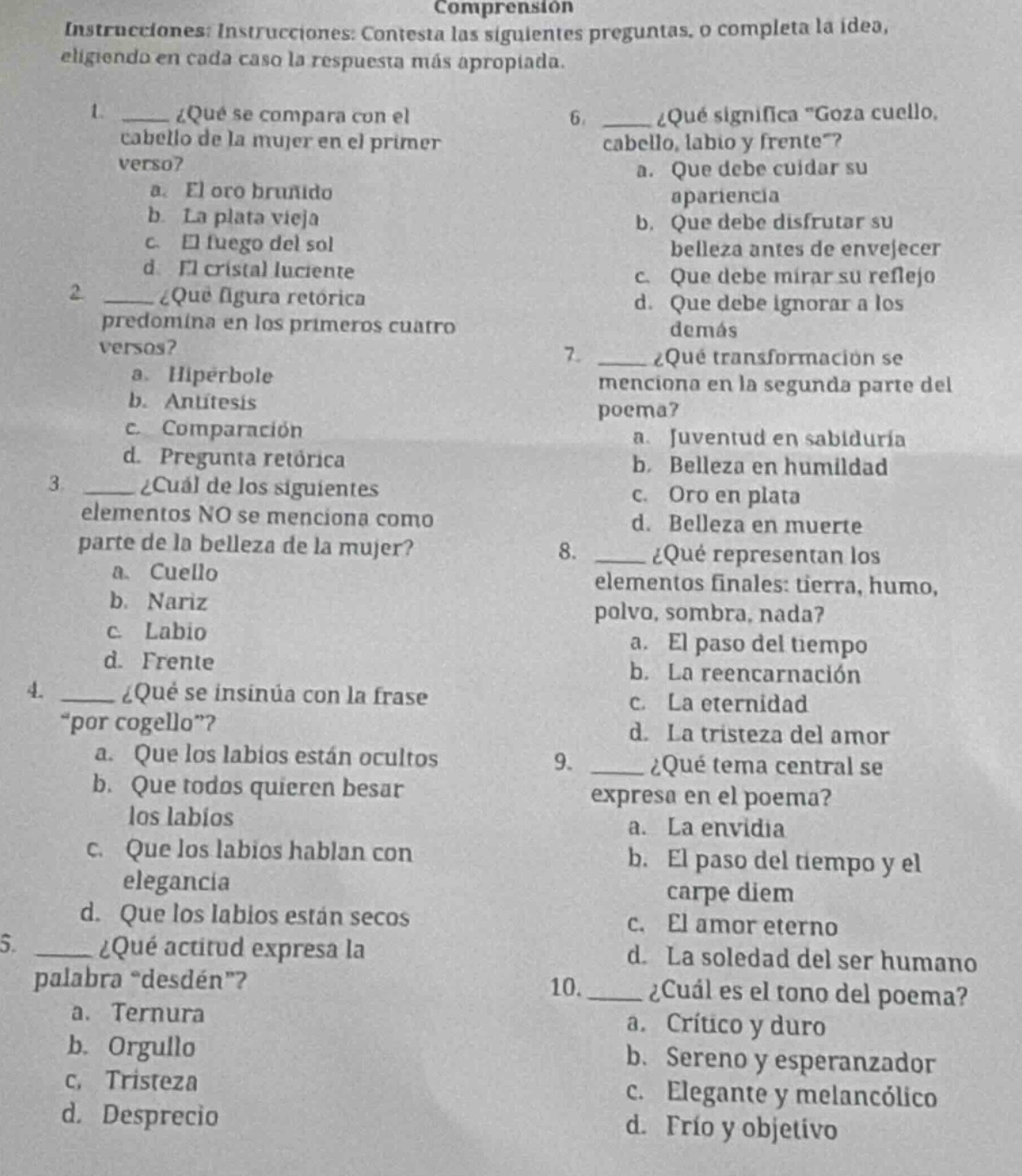
- ____ ¿qué se compara con el
cabello de la mujer en el primer
verso?
a. el oro brunido
b. la plata vieja
c. el fuego del sol
d. el cristal luciente
- ____ ¿qué figura retórica
predomina en los primeros cuatro
versos?
a. hipérbole
b. antítesis
c. comparación
d. pregunta retórica
- ____ ¿cuál de los siguientes
elementos no se menciona como
parte de la belleza de la mujer?
a. cuello
b. nariz
c. labio
d. frente
- ____ ¿qué se insinúa con la frase
“por cogello”?
a. que los labios están ocultos
b. que todos quieren besar
los labios
c. que los labios hablan con
elegancia
d. que los labios están secos
- ____ ¿qué actitud expresa la
palabra “desdén”?
a. ternura
b. orgullo
c. tristeza
d. desprecio
- ____ ¿qué significa “goza cuello,
cabello, labio y frente”?
a. que debe cuidar su
apariencia
b. que debe disfrutar su
belleza antes de envejecer
c. que debe mirar su reflejo
d. que debe ignorar a los
demás
- ____ ¿qué transformación se
menciona en la segunda parte del
poema?
a. juventud en sabiduría
b. belleza en humildad
c. oro en plata
d. belleza en muerte
- ____ ¿qué representan los
elementos finales: tierra, humo,
polvo, sombra, nada?
a. el paso del tiempo
b. la reencarnación
c. la eternidad
d. la tristeza del amor
- ____ ¿qué tema central se
expresa en el poema?
a. la envidia
b. el paso del tiempo y el
carpe diem
c. el amor eterno
d. la soledad del ser humano
- ____ ¿cuál es el tono del poema?
a. crítico y duro
b. sereno y esperanzador
c. elegante y melancólico
d. frío y objetivo
To solve these comprehension questions (assuming they are about a poem, likely a Spanish literary work), we analyze each:
Question 1
We need to identify what the woman’s hair is compared to. In typical poetic imagery, “oro brunido” (burnished gold) is a common metaphor for hair.
- Answer: a. El oro brunido
Question 2
The first four verses likely use “comparación” (comparison) to describe the woman’s beauty (e.g., comparing hair to gold, etc.).
- Answer: c. Comparación
Question 3
We check which body part is NOT mentioned as part of the woman’s beauty. The options are cuello (neck), nariz (nose), labio (lip), frente (forehead). If the poem mentions neck, lip, and forehead but not nose, then:
- Answer: b. Nariz
Question 4
The phrase “por cogello” (likely a typo or poetic term) insinuates the lips are “ocultos” (hidden) or styled in a way that they are not fully visible.
- Answer: a. Que los labios están ocultos
Question 5
“Desdén” means “desprecio” (contempt/despise) in tone.
- Answer: d. Desprecio
Question 6
“Goza cuello, cabello, labio y frente” means to enjoy (gozar) one’s beauty (cuello, cabello, etc.) before aging (envejecer).
- Answer: b. Que debe disfrutar su belleza antes de envejecer
Question 7
The poem’s second part likely mentions the transformation of “belleza en muerte” (beauty into death) as a theme of aging/mortality.
- Answer: d. Belleza en muerte
Question 8
“tierra, humo, polvo, sombra, nada” represent “el paso del tiempo” (the passage of time, as these are symbols of decay and transience).
- Answer: a. El paso del tiempo
Question 9
The central theme of the poem is “el paso del tiempo y el carpe diem” (the passage of time and seizing the day, as it urges enjoying beauty before aging).
- Answer: b. El paso del tiempo y el carpe diem
Question 10
The tone of the poem is “elegante y melancólico” (elegant and melancholic) due to its poetic descriptions of beauty and meditation on time/aging.
- Answer: c. Elegante y melancólico
(Note: For full accuracy, the original poem’s text would be needed, but these answers align with common literary themes in Spanish poetry about beauty and time.)

Snap & solve any problem in the app
Get step-by-step solutions on Sovi AI
Photo-based solutions with guided steps
Explore more problems and detailed explanations
To solve these comprehension questions (assuming they are about a poem, likely a Spanish literary work), we analyze each:
Question 1
We need to identify what the woman’s hair is compared to. In typical poetic imagery, “oro brunido” (burnished gold) is a common metaphor for hair.
- Answer: a. El oro brunido
Question 2
The first four verses likely use “comparación” (comparison) to describe the woman’s beauty (e.g., comparing hair to gold, etc.).
- Answer: c. Comparación
Question 3
We check which body part is NOT mentioned as part of the woman’s beauty. The options are cuello (neck), nariz (nose), labio (lip), frente (forehead). If the poem mentions neck, lip, and forehead but not nose, then:
- Answer: b. Nariz
Question 4
The phrase “por cogello” (likely a typo or poetic term) insinuates the lips are “ocultos” (hidden) or styled in a way that they are not fully visible.
- Answer: a. Que los labios están ocultos
Question 5
“Desdén” means “desprecio” (contempt/despise) in tone.
- Answer: d. Desprecio
Question 6
“Goza cuello, cabello, labio y frente” means to enjoy (gozar) one’s beauty (cuello, cabello, etc.) before aging (envejecer).
- Answer: b. Que debe disfrutar su belleza antes de envejecer
Question 7
The poem’s second part likely mentions the transformation of “belleza en muerte” (beauty into death) as a theme of aging/mortality.
- Answer: d. Belleza en muerte
Question 8
“tierra, humo, polvo, sombra, nada” represent “el paso del tiempo” (the passage of time, as these are symbols of decay and transience).
- Answer: a. El paso del tiempo
Question 9
The central theme of the poem is “el paso del tiempo y el carpe diem” (the passage of time and seizing the day, as it urges enjoying beauty before aging).
- Answer: b. El paso del tiempo y el carpe diem
Question 10
The tone of the poem is “elegante y melancólico” (elegant and melancholic) due to its poetic descriptions of beauty and meditation on time/aging.
- Answer: c. Elegante y melancólico
(Note: For full accuracy, the original poem’s text would be needed, but these answers align with common literary themes in Spanish poetry about beauty and time.)