QUESTION IMAGE
Question
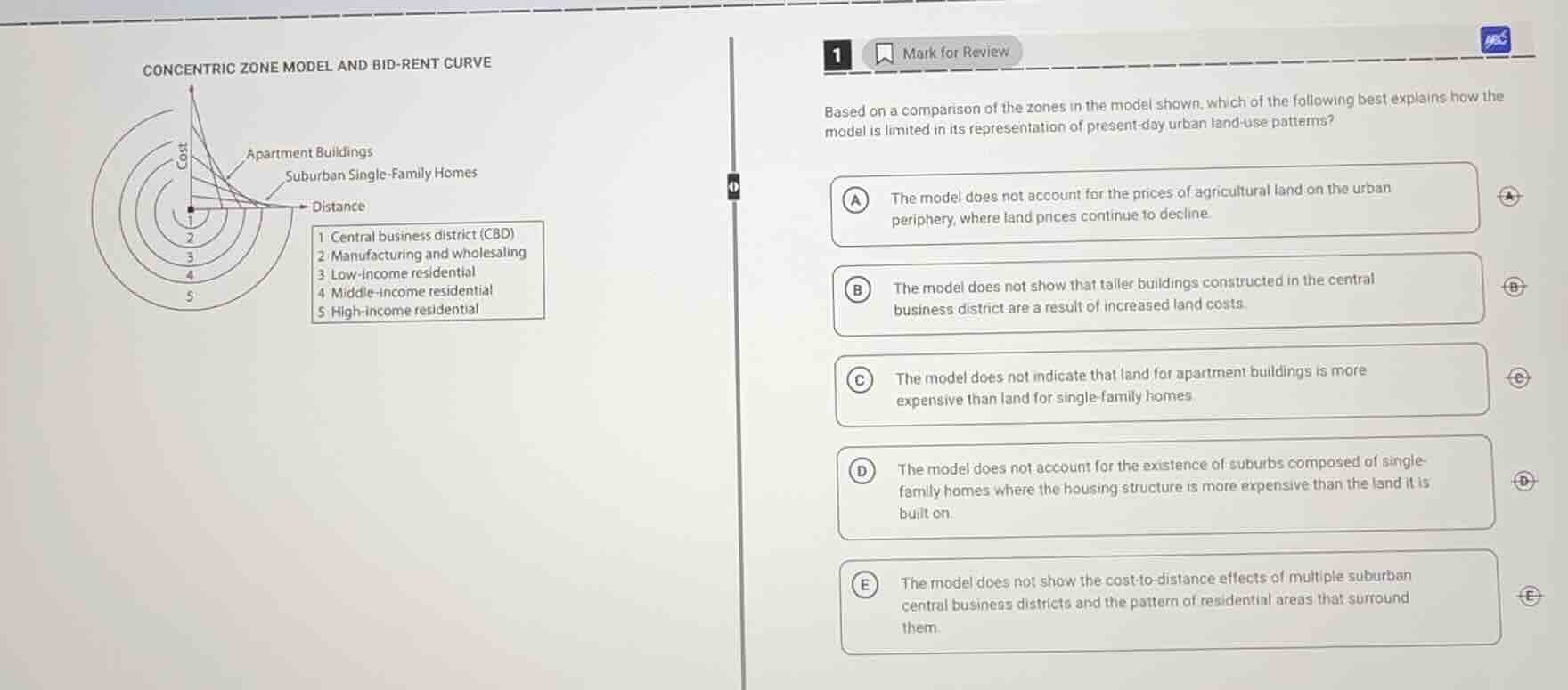
concentric zone model and bid - rent curve
cost
apartment buildings
suburban single - family homes
distance
1 central business district (cbd)
2 manufacturing and wholesaling
3 low - income residential
4 middle - income residential
5 high - income residential
1 mark for review
based on a comparison of the zones in the model shown, which of the following best explains how the model is limited in its representation of present - day urban land - use patterns?
a the model does not account for the prices of agricultural land on the urban periphery, where land prices continue to decline.
b the model does not show that taller buildings constructed in the central business district are a result of increased land costs.
c the model does not indicate that land for apartment buildings is more expensive than land for single - family homes
d the model does not account for the existence of suburbs composed of single - family homes where the housing structure is more expensive than the land it is built on.
e the model does not show the cost - to - distance effects of multiple suburban central business districts and the pattern of residential areas that surround them.
The Concentric Zone Model (and bid - rent curve here) is a traditional urban land - use model. In present - day urban areas, there are often multiple suburban central business districts (edge cities) and residential patterns around them. The original concentric model is centered around one central business district (CBD) and has a concentric zone structure. Option A: The model's focus is on urban land use, and agricultural land on the urban periphery is not a main limitation in terms of representing present - day urban land - use patterns. Option B: The bid - rent curve (shown with cost and distance) and the model can imply that taller buildings in CBD are due to high land costs (as land cost is high near CBD, so building up is a way to maximize land use), so this is not a limitation. Option C: The bid - rent curve for apartment buildings (closer to CBD) and single - family homes (farther) shows that apartment building land is more expensive, so the model does indicate this. Option D: The model has high - income residential (which can include single - family homes in suburbs) and the cost - distance relationship, and the idea of housing structure cost vs land cost is not a main limitation of the model's representation of urban land - use patterns. Option E: Present - day cities often have multiple sub - CBDs (suburban central business districts) and residential areas around them, while the concentric model is based on one CBD. So this is a key limitation.

Snap & solve any problem in the app
Get step-by-step solutions on Sovi AI
Photo-based solutions with guided steps
Explore more problems and detailed explanations
E. The model does not show the cost - to - distance effects of multiple suburban central business districts and the pattern of residential areas that surround them.