QUESTION IMAGE
Question
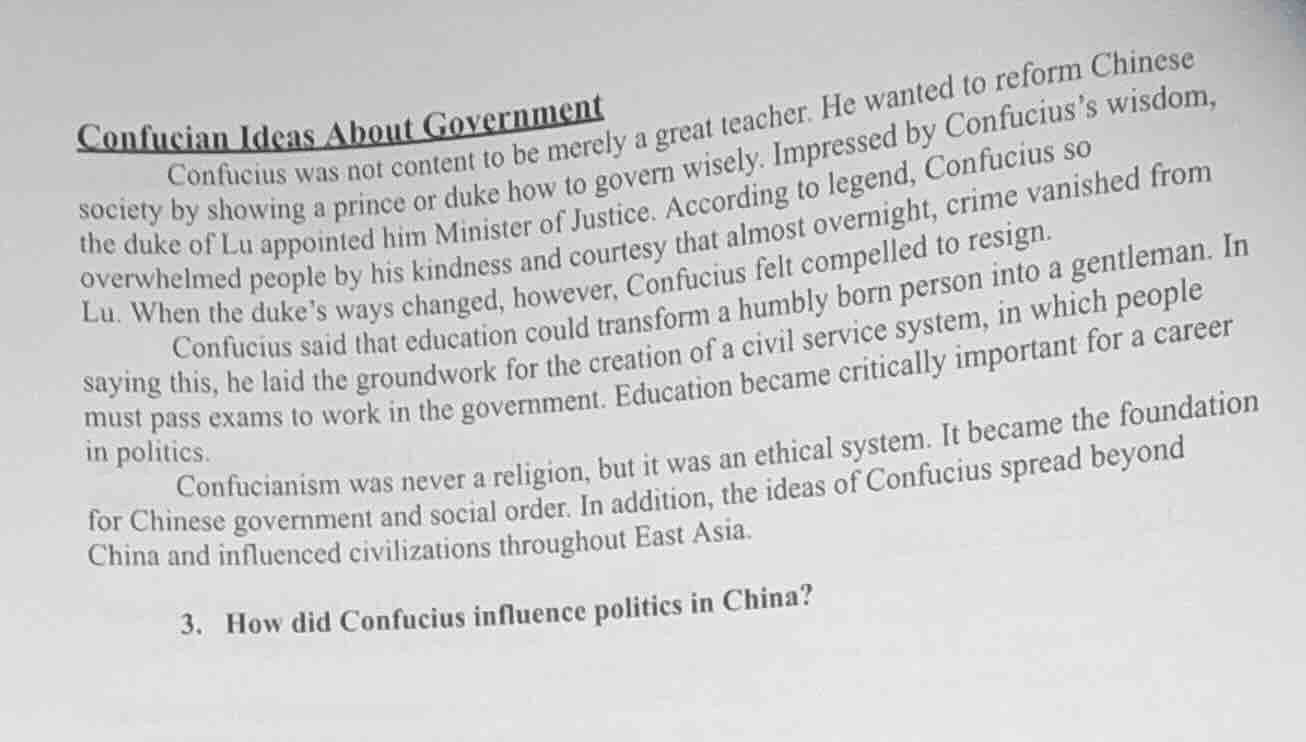
confucian ideas about government
confucius was not content to be merely a great teacher. he wanted to reform chinese
society by showing a prince or duke how to govern wisely. impressed by confucius’s wisdom,
the duke of lu appointed him minister of justice. according to legend, confucius so
overwhelmed people by his kindness and courtesy that almost overnight, crime vanished from
lu. when the duke’s ways changed, however, confucius felt compelled to resign.
confucius said that education could transform a humbly born person into a gentleman. in
saying this, he laid the groundwork for the creation of a civil service system, in which people
must pass exams to work in the government. education became critically important for a career
in politics.
confucianism was never a religion, but it was an ethical system. it became the foundation
for chinese government and social order. in addition, the ideas of confucius spread beyond
china and influenced civilizations throughout east asia.
- how did confucius influence politics in china?
- First, Confucius directly advised rulers (like the duke of Lu) on wise governance, and briefly served as Minister of Justice, demonstrating ethical, kind governance that reduced crime.
- Second, he laid the groundwork for a civil service system by arguing education could turn anyone into a gentleman, leading to a system where people needed to pass exams for government work, making education critical for political careers.
- Third, his ethical system became the foundation for Chinese government and social order, shaping long-standing political norms.

Snap & solve any problem in the app
Get step-by-step solutions on Sovi AI
Photo-based solutions with guided steps
Explore more problems and detailed explanations
Confucius influenced Chinese politics in three key ways:
- He advised rulers (such as the duke of Lu) on wise, ethical governance, and briefly served as Minister of Justice, where his kind, courteous approach reduced crime in Lu.
- He laid the groundwork for China's civil service system by asserting education could transform people into qualified leaders, leading to a system where individuals had to pass exams to work in government, making education essential for political careers.
- His ethical system became the foundational framework for Chinese government and social order, establishing long-lasting political norms, and his ideas also spread to influence East Asian civilizations beyond China.