QUESTION IMAGE
Question
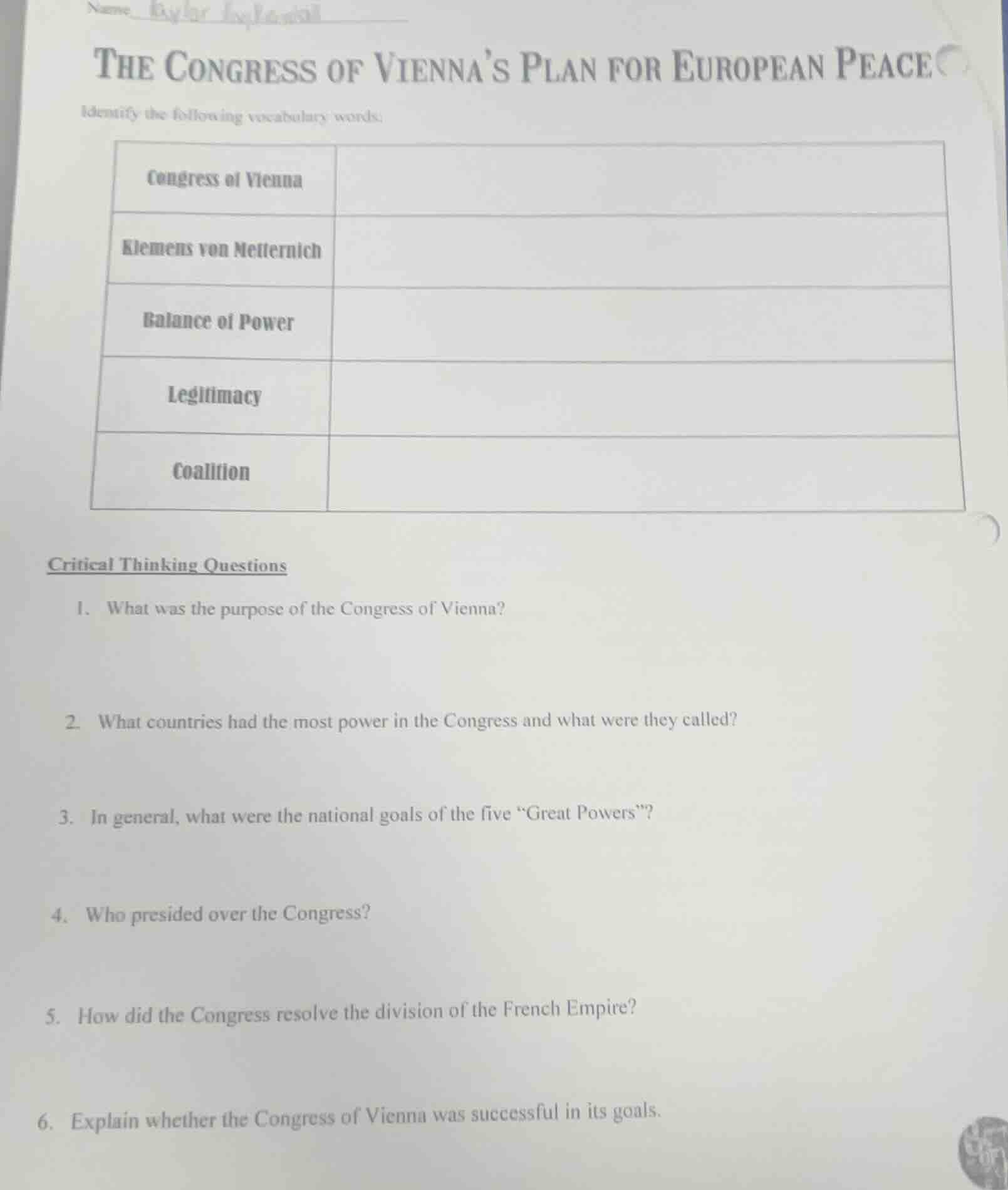
the congress of viennas plan for european peaceidentify the following vocabulary words:congress of viennaklemens von metternichbalance of powerlegitimacycoalitioncritical thinking questions1. what was the purpose of the congress of vienna?2. what countries had the most power in the congress and what were they called?3. in general, what were the national goals of the five \great powers\?4. who presided over the congress?5. how did the congress resolve the division of the french empire?6. explain whether the congress of vienna was successful in its goals.
Brief Explanations
Vocabulary Definitions:
- Congress of Vienna: A diplomatic conference of European powers held 1814-1815, post-Napoleonic Wars, to restructure Europe.
- Klemens von Metternich: Austrian statesman who led the Congress of Vienna, advocating for conservatism and balance of power.
- Balance of Power: A strategy to prevent one nation from dominating Europe by equalizing military/political strength of states.
- Legitimacy: The principle of restoring pre-Napoleonic monarchs to their thrones to reestablish stable, traditional rule.
- Coalition: An alliance of European nations (Britain, Austria, Prussia, Russia, later France) that defeated Napoleon and led the Congress.
Critical Thinking Answers:
- The Congress aimed to restructure Europe after Napoleon's wars, restore stability, prevent future French aggression, and reestablish conservative rule.
- The most powerful countries were Britain, Austria, Prussia, Russia, and later France; they were called the "Great Powers".
- Their core goals were to maintain a balance of power to avoid future wars, restore legitimate monarchies, protect their own territorial and imperial interests, and suppress revolutionary movements across Europe.
- Klemens von Metternich, Austria's foreign minister, presided over the Congress.
- France was reduced to its 1792 pre-war borders, lost all conquered territories, and had to pay war indemnities; surrounding states were given new territories to act as a buffer against future French expansion.
- The Congress was partially successful: it prevented a major European war for nearly 100 years (until World War I) and restored stable monarchies. However, it ignored rising nationalist and liberal movements, which eventually led to widespread revolts and changes to the established order in the 19th century.

Snap & solve any problem in the app
Get step-by-step solutions on Sovi AI
Photo-based solutions with guided steps
Explore more problems and detailed explanations
Vocabulary Identifications:
- Congress of Vienna: 1814-1815 European diplomatic conference to restructure post-Napoleonic Europe
- Klemens von Metternich: Austrian statesman who led the Congress of Vienna
- Balance of Power: Equalizing European state strength to prevent domination
- Legitimacy: Restoring pre-Napoleonic monarchs to power
- Coalition: Alliance of nations that defeated Napoleon and led the Congress
Critical Thinking Questions:
- To restructure Europe post-Napoleon, restore stability, and prevent French aggression.
- Britain, Austria, Prussia, Russia, and later France; they were called the "Great Powers".
- Maintain balance of power, restore legitimate monarchies, protect territorial interests, suppress revolution.
- Klemens von Metternich
- France was returned to its 1792 borders, lost all conquered lands, and buffer states were created around it.
- Partially successful: it prevented large-scale European war for ~100 years, but failed to address nationalist/liberal demands, leading to later 19th-century upheaval.