QUESTION IMAGE
Question
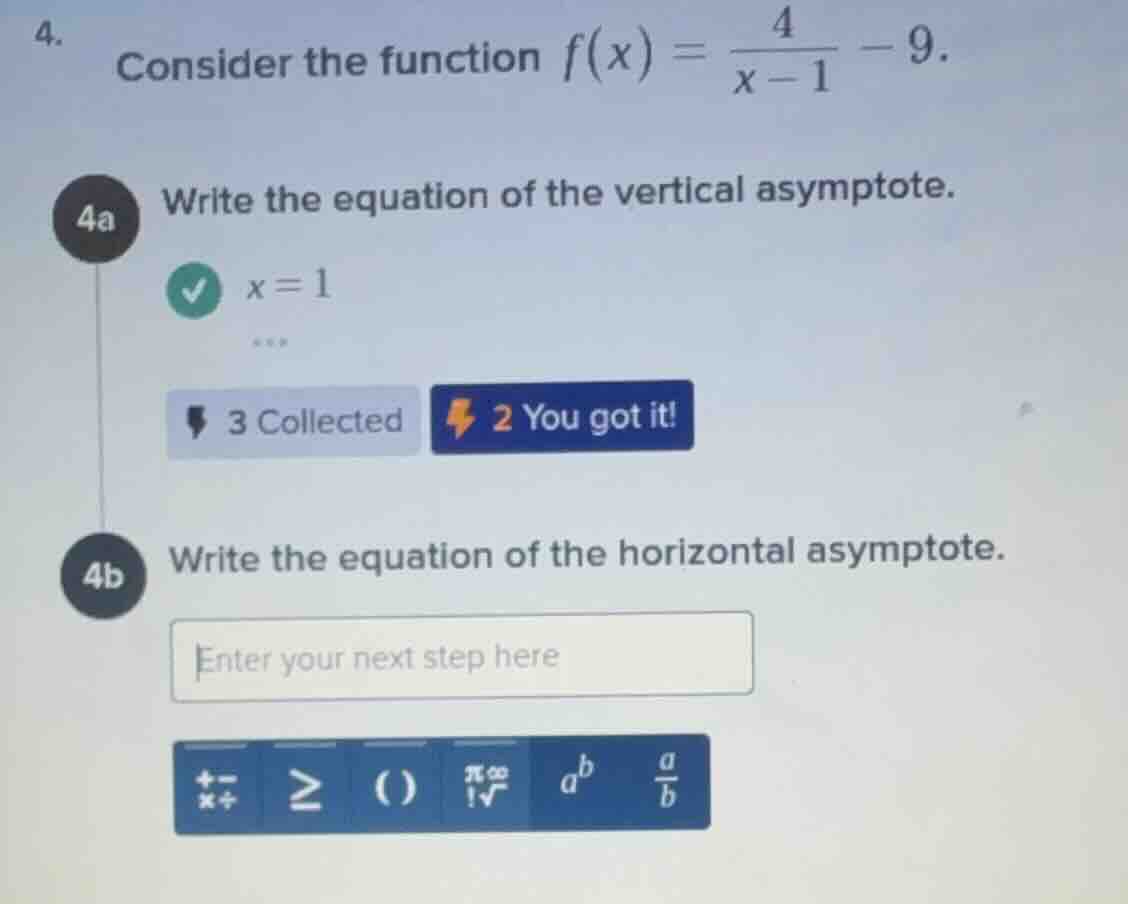
- consider the function $f(x) = \frac{4}{x - 1} - 9$. 4a write the equation of the vertical asymptote. \\(x = 1\\) 3 collected 2 you got it! 4b write the equation of the horizontal asymptote. enter your next step here
Step1: Analyze the function type
The function \( f(x)=\frac{4}{x - 1}-9 \) can be rewritten as \( f(x)=\frac{4-9(x - 1)}{x - 1}=\frac{4-9x + 9}{x - 1}=\frac{-9x+13}{x - 1} \). For a rational function of the form \( \frac{ax + b}{cx + d} \) (where \( a,b,c,d \) are constants), if the degrees of the numerator and the denominator are equal (both degree 1 here, since the highest power of \( x \) in numerator is 1 and in denominator is 1), the horizontal asymptote is the ratio of the leading coefficients.
Step2: Identify leading coefficients
In the numerator \( -9x + 13 \), the leading coefficient (coefficient of \( x \)) is \( -9 \). In the denominator \( x - 1 \), the leading coefficient (coefficient of \( x \)) is \( 1 \). But also, we can think about the limit as \( x\to\pm\infty \). For \( f(x)=\frac{4}{x - 1}-9 \), as \( x\to\pm\infty \), \( \frac{4}{x - 1}\to0 \) (because the denominator grows without bound, so the fraction approaches 0). Then \( f(x)\to0 - 9=-9 \). So the horizontal asymptote is \( y = - 9 \).

Snap & solve any problem in the app
Get step-by-step solutions on Sovi AI
Photo-based solutions with guided steps
Explore more problems and detailed explanations
\( y=-9 \)