QUESTION IMAGE
Question
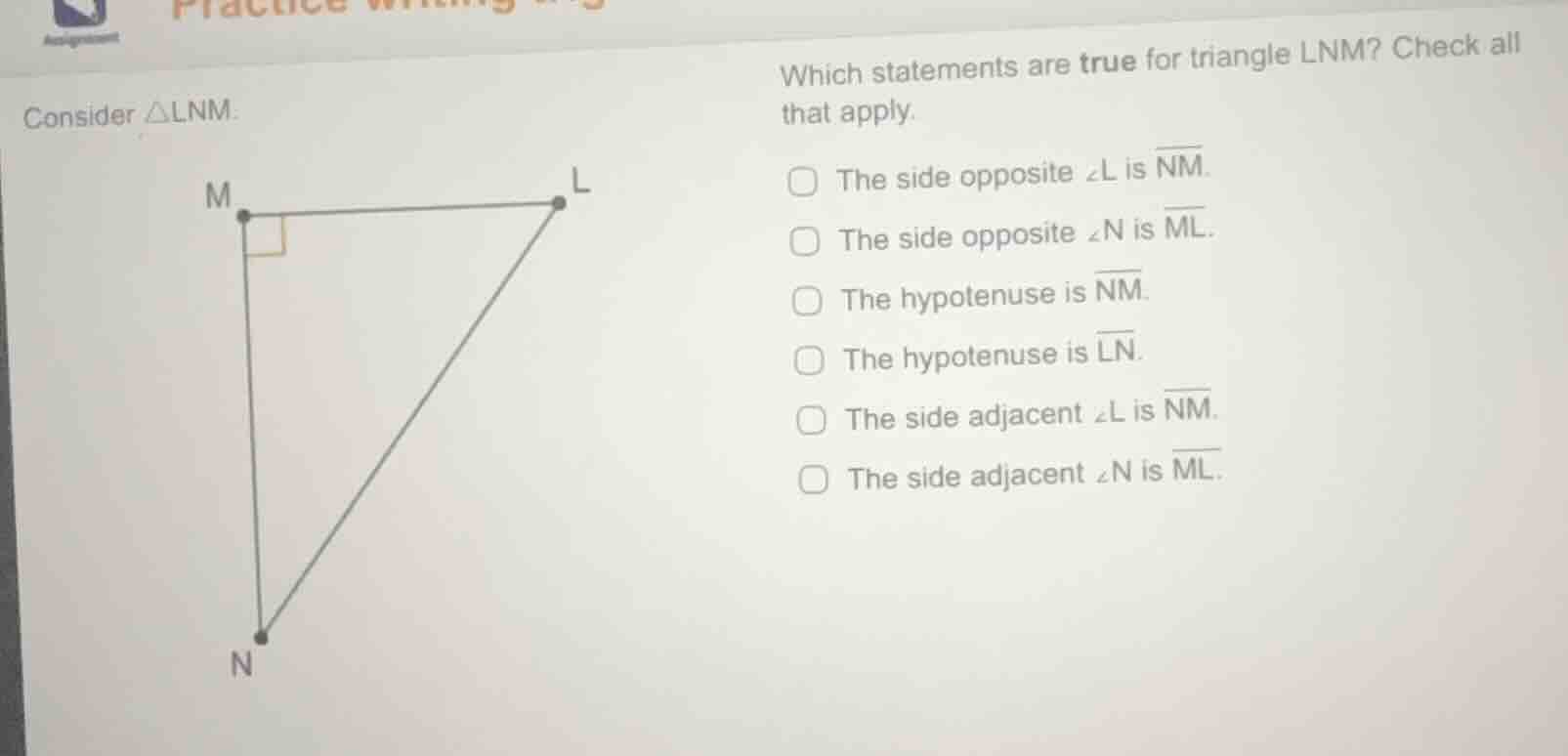
consider $\triangle$lnm. which statements are true for triangle lnm? check all that apply. the side opposite $\angle$l is $\overline{nm}$. the side opposite $\angle$n is $\overline{ml}$. the hypotenuse is $\overline{nm}$. the hypotenuse is $\overline{ln}$. the side adjacent $\angle$l is $\overline{nm}$. the side adjacent $\angle$n is $\overline{ml}$.
Brief Explanations
- For "The side opposite ∠L is \(\overline{NM}\)": In a triangle, the side opposite an angle is the one not connected to the angle's vertex. ∠L is at vertex L, so the side opposite is \(\overline{NM}\) (connects M and N, not L) – true.
- For "The side opposite ∠N is \(\overline{ML}\)": ∠N is at vertex N, so the side opposite is \(\overline{ML}\) (connects M and L, not N) – true.
- For "The hypotenuse is \(\overline{NM}\)": In a right triangle, the hypotenuse is the side opposite the right angle. The right angle is at M, so the hypotenuse should be opposite (∠M), which is \(\overline{LN}\), not \(\overline{NM}\) – false.
- For "The hypotenuse is \(\overline{LN}\)": As the right angle is at M, the hypotenuse is the side opposite (∠M), which is \(\overline{LN}\) (the longest side in a right triangle, opposite the right angle) – true.
- For "The side adjacent ∠L is \(\overline{NM}\)": Adjacent sides form the angle with the angle's vertex. ∠L is at L, with sides \(\overline{ML}\) and \(\overline{LN}\). Wait, no – in right triangle at M, ∠L is at L, so adjacent sides to ∠L are \(\overline{ML}\) (one leg) and \(\overline{LN}\) is hypotenuse? Wait, no, correction: In right triangle \( \triangle LNM \) with right angle at M, ∠L is at L, so the sides forming ∠L are \(\overline{ML}\) (horizontal leg) and \(\overline{LN}\) (hypotenuse)? Wait, no, adjacent side to ∠L: adjacent sides are the two sides that meet at ∠L. ∠L is at L, so sides \(\overline{ML}\) (from M to L) and \(\overline{LN}\) (from L to N). Wait, but the option says \(\overline{NM}\) – no, \(\overline{NM}\) is from N to M. Wait, maybe I messed up. Wait, the triangle: vertices L, N, M, right angle at M. So sides: \( \overline{ML} \) (horizontal, M to L), \( \overline{NM} \) (vertical, N to M), \( \overline{LN} \) (hypotenuse, L to N). So ∠L is at L, between \( \overline{ML} \) (M to L) and \( \overline{LN} \) (L to N). So the adjacent side to ∠L would be \( \overline{ML} \)? Wait, no, the other adjacent side? Wait, no, in trigonometry, for an acute angle in a right triangle, the adjacent side is the leg that is part of the angle (not the hypotenuse). Wait, ∠L is acute (since right angle at M). So for ∠L, the adjacent side is the leg that is adjacent (forms the angle with ∠L), which is \( \overline{ML} \), and the opposite side is \( \overline{NM} \). Wait, but the option says "The side adjacent ∠L is \(\overline{NM}\)" – that would be false? Wait, no, maybe I made a mistake. Wait, let's re-express:
- ∠L: vertex L, sides: \( \overline{ML} \) (from M to L) and \( \overline{LN} \) (from L to N). So the sides adjacent to ∠L are \( \overline{ML} \) (one leg) and \( \overline{LN} \) is hypotenuse? No, adjacent sides are the two sides that meet at the angle. So ∠L is formed by \( \overline{ML} \) (M-L) and \( \overline{LN} \) (L-N). So the adjacent side (other than hypotenuse) would be \( \overline{ML} \), but the option says \( \overline{NM} \). Wait, \( \overline{NM} \) is from N to M, which is vertical leg. So maybe the option is wrong? Wait, no, maybe I mislabeled the triangle. Wait, the triangle has right angle at M, so M is the right angle, so sides: \( \overline{ML} \) (horizontal, M to L), \( \overline{NM} \) (vertical, N to M), \( \overline{LN} \) (hypotenuse, L to N). So ∠L is at L, between \( \overline{ML} \) (M to L) and \( \overline{LN} \) (L to N). So the adjacent side to ∠L is \( \overline{ML} \) (the leg that is part of ∠L, not the hypotenuse), and the opposite side is \( \overline{NM} \) (the leg not part of ∠L). Wait, but the option says "The sid…

Snap & solve any problem in the app
Get step-by-step solutions on Sovi AI
Photo-based solutions with guided steps
Explore more problems and detailed explanations
- The side opposite \( \angle L \) is \( \overline{NM} \).
- The side opposite \( \angle N \) is \( \overline{ML} \).
- The hypotenuse is \( \overline{LN} \).