QUESTION IMAGE
Question
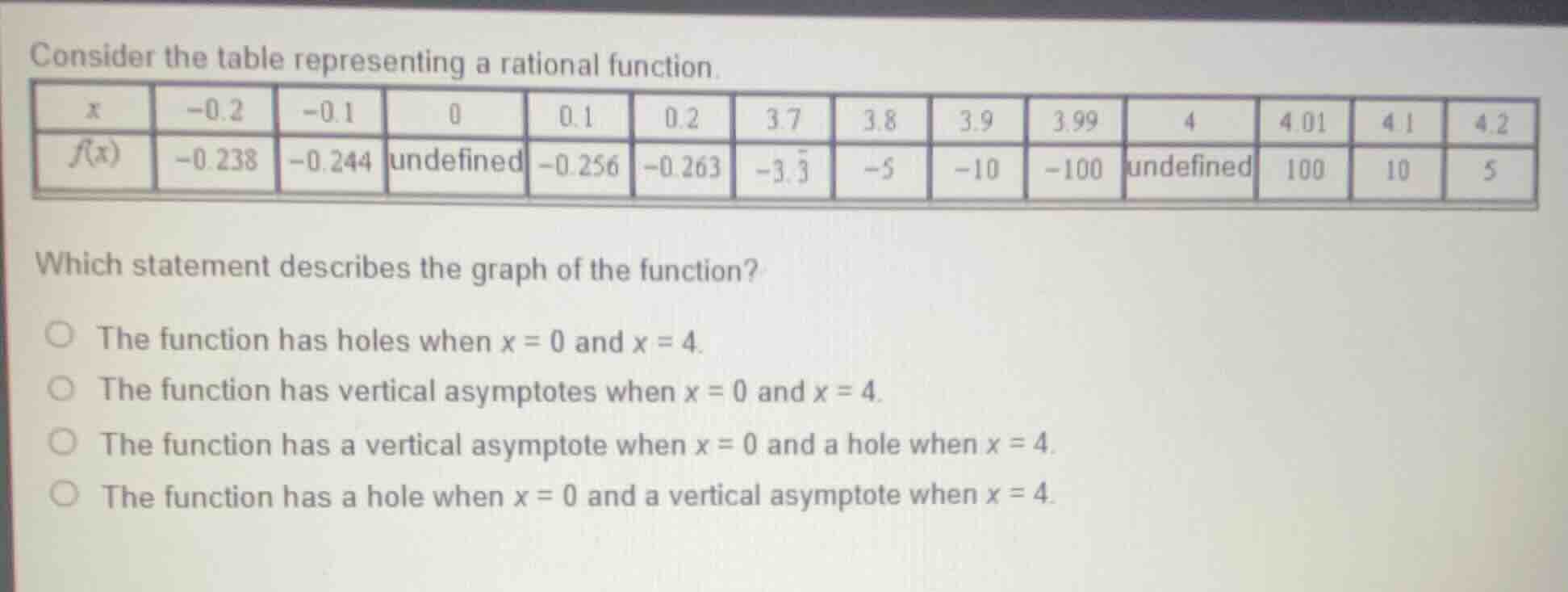
consider the table representing a rational function.
| x | -0.2 | -0.1 | 0 | 0.1 | 0.2 | 3.7 | 3.8 | 3.9 | 3.99 | 4 | 4.01 | 4.1 | 4.2 |
| f(x) | -0.238 | -0.244 | undefined | -0.256 | -0.263 | -3.\overline{3} | -5 | -10 | -100 | undefined | 100 | 10 | 5 |
which statement describes the graph of the function?
\bigcirc the function has holes when x = 0 and x = 4.
\bigcirc the function has vertical asymptotes when x = 0 and x = 4.
\bigcirc the function has a vertical asymptote when x = 0 and a hole when x = 4.
\bigcirc the function has a hole when x = 0 and a vertical asymptote when x = 4.
Brief Explanations
- For \(x=0\): The function is undefined here, but the values of \(f(x)\) approach a consistent finite value (\(\approx -0.25\)) as \(x\) approaches 0 from both the left and right. This matches the behavior of a hole (removable discontinuity).
- For \(x=4\): The function is undefined here, and the values of \(f(x)\) grow without bound (approach \(-\infty\) from the left, \(+\infty\) from the right) as \(x\) approaches 4. This matches the behavior of a vertical asymptote.

Snap & solve any problem in the app
Get step-by-step solutions on Sovi AI
Photo-based solutions with guided steps
Explore more problems and detailed explanations
The function has a hole when \(x = 0\) and a vertical asymptote when \(x = 4\).