QUESTION IMAGE
Question
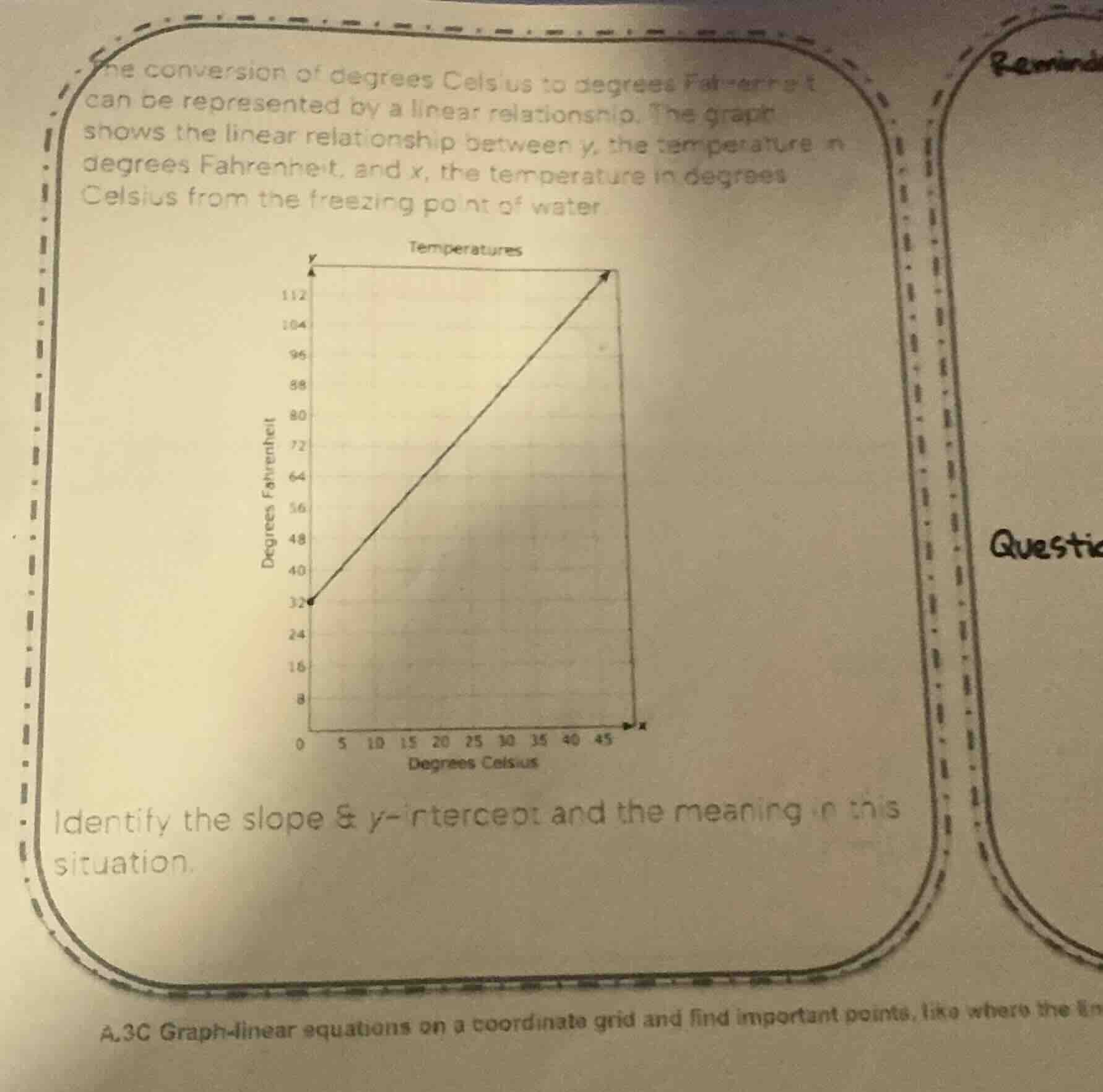
the conversion of degrees celsius to degrees fahrenheit can be represented by a linear relationship. the graph shows the linear relationship between y, the temperature in degrees fahrenheit, and x, the temperature in degrees celsius from the freezing point of water. identify the slope & y - intercept and the meaning in this situation.
Step1: Identify two points on the line
From the graph, we can see that the line passes through \((0, 32)\) (when \(x = 0\), \(y = 32\)) and let's take another point, say when \(x = 45\), \(y = 113\) (wait, actually, the freezing point of water is \(0^\circ\)C which is \(32^\circ\)F, and the boiling point is \(100^\circ\)C which is \(212^\circ\)F, but from the graph, let's use the given points. Wait, the y-intercept is at \(x = 0\), \(y = 32\), and let's take another point. Let's check the slope formula \(m=\frac{y_2 - y_1}{x_2 - x_1}\). Let's use \((0, 32)\) and \((45, 113)\)? Wait, no, maybe the correct points: the standard conversion is \(y=\frac{9}{5}x + 32\). Wait, from the graph, when \(x = 0\), \(y = 32\), and when \(x = 40\), let's see the y-value. Wait, the graph: x-axis is degrees Celsius, y-axis is degrees Fahrenheit. Let's take two points: \((0, 32)\) and \((45, 113)\)? No, wait, the standard slope for Celsius to Fahrenheit is \(\frac{9}{5}\) or \(1.8\). Let's calculate the slope using the two points. Let's take \((0, 32)\) (y-intercept) and another point. Let's see, when \(x = 10\), what's \(y\)? From the graph, the line goes from \((0, 32)\) upwards. Let's use the formula for slope: \(m=\frac{y_2 - y_1}{x_2 - x_1}\). Let's take \((0, 32)\) and \((45, 113)\) – no, wait, the correct slope is \(\frac{9}{5}=1.8\). Let's verify: when \(x = 0\), \(y = 32\) (y-intercept, \(b = 32\)). Then, for \(x = 10\), \(y = 32 + 1.8\times10 = 50\)? Wait, no, the standard formula is \(F=\frac{9}{5}C + 32\). So slope \(m=\frac{9}{5}=1.8\) (or \(\frac{9}{5}\)) and y-intercept \(b = 32\).
Step2: Interpret the slope and y-intercept
- Y-intercept (\(b\)): The y-intercept is the value of \(y\) when \(x = 0\). Here, when \(x = 0\) (0 degrees Celsius, the freezing point of water), \(y = 32\) degrees Fahrenheit. So the y-intercept is 32, which represents the temperature in Fahrenheit when the temperature in Celsius is 0 (the freezing point of water).
- Slope (\(m\)): The slope is the rate of change of \(y\) with respect to \(x\). The formula for slope is \(m=\frac{\Delta y}{\Delta x}\). In the context of temperature conversion, the slope \(\frac{9}{5}\) (or 1.8) means that for every 1 degree increase in Celsius, the temperature in Fahrenheit increases by \(\frac{9}{5}\) degrees (or 1.8 degrees).
So, to calculate the slope using two points: let's take \((0, 32)\) and \((5, 41)\) (since \(32 + 1.8\times5 = 32 + 9 = 41\)). Then \(m=\frac{41 - 32}{5 - 0}=\frac{9}{5}=1.8\).

Snap & solve any problem in the app
Get step-by-step solutions on Sovi AI
Photo-based solutions with guided steps
Explore more problems and detailed explanations
- Slope (\(m\)): \(\frac{9}{5}\) (or \(1.8\)) – this means that for each 1 - degree increase in Celsius, the temperature in Fahrenheit increases by \(\frac{9}{5}\) (or \(1.8\)) degrees.
- Y - intercept (\(b\)): \(32\) – this represents the temperature in Fahrenheit when the temperature in Celsius is \(0^\circ\)C (the freezing point of water).