QUESTION IMAGE
Question
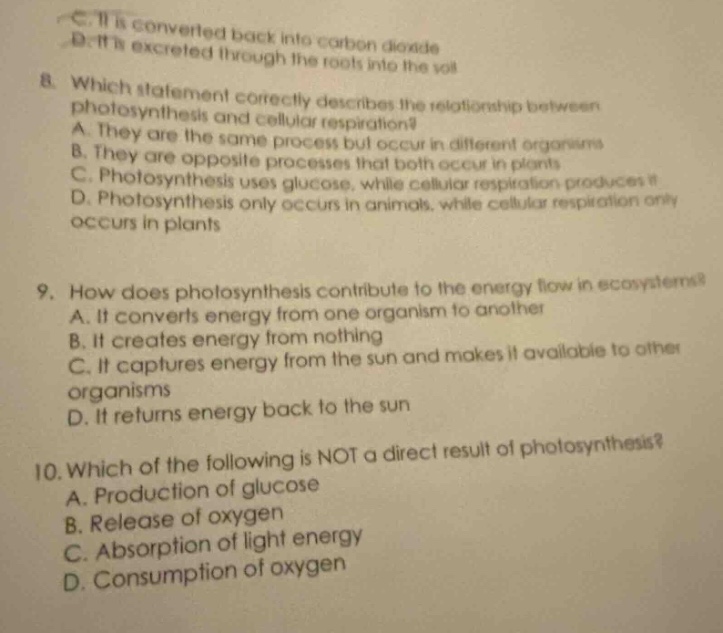
c. it is converted back into carbon dioxide
d. it is excreted through the roots into the soil
- which statement correctly describes the relationship between
photosynthesis and cellular respiration?
a. they are the same process but occur in different organisms
b. they are opposite processes that both occur in plants
c. photosynthesis uses glucose, while cellular respiration produces it
d. photosynthesis only occurs in animals, while cellular respiration only
occurs in plants
- how does photosynthesis contribute to the energy flow in ecosystems?
a. it converts energy from one organism to another
b. it creates energy from nothing
c. it captures energy from the sun and makes it available to other
organisms
d. it returns energy back to the sun
- which of the following is not a direct result of photosynthesis?
a. production of glucose
b. release of oxygen
c. absorption of light energy
d. consumption of oxygen
Question 8
- Option A: Photosynthesis and cellular respiration are different processes (photosynthesis makes glucose, respiration breaks it), so A is wrong.
- Option B: Photosynthesis (in plants, algae, some bacteria) and cellular respiration (in all living cells including plants) are opposite in terms of reactants/products and both occur in plants, so B is correct.
- Option C: Photosynthesis produces glucose, cellular respiration uses it, so C is wrong.
- Option D: Photosynthesis occurs in producers (plants, etc.), cellular respiration in all organisms, so D is wrong.
- Option A: Photosynthesis captures solar energy, not transfer between organisms directly, so A is wrong.
- Option B: Energy can't be created from nothing (violates conservation), so B is wrong.
- Option C: Photosynthesis uses sunlight to make glucose (stored energy), which is available to other organisms (e.g., when plants are eaten), so C is correct.
- Option D: Energy isn't returned to the sun; it's used in the ecosystem, so D is wrong.
- Option A: Photosynthesis produces glucose (from \( \ce{CO_2} \) and \( \ce{H_2O} \)), so A is a result.
- Option B: Photosynthesis releases \( \ce{O_2} \) as a byproduct, so B is a result.
- Option C: Photosynthesis absorbs light energy (by chlorophyll) to drive the process, so C is a direct part.
- Option D: Photosynthesis produces \( \ce{O_2} \), it does not consume \( \ce{O_2} \) (cellular respiration consumes \( \ce{O_2} \)), so D is NOT a direct result.

Snap & solve any problem in the app
Get step-by-step solutions on Sovi AI
Photo-based solutions with guided steps
Explore more problems and detailed explanations
B. They are opposite processes that both occur in plants