QUESTION IMAGE
Question
5.1 cool down
question 1:
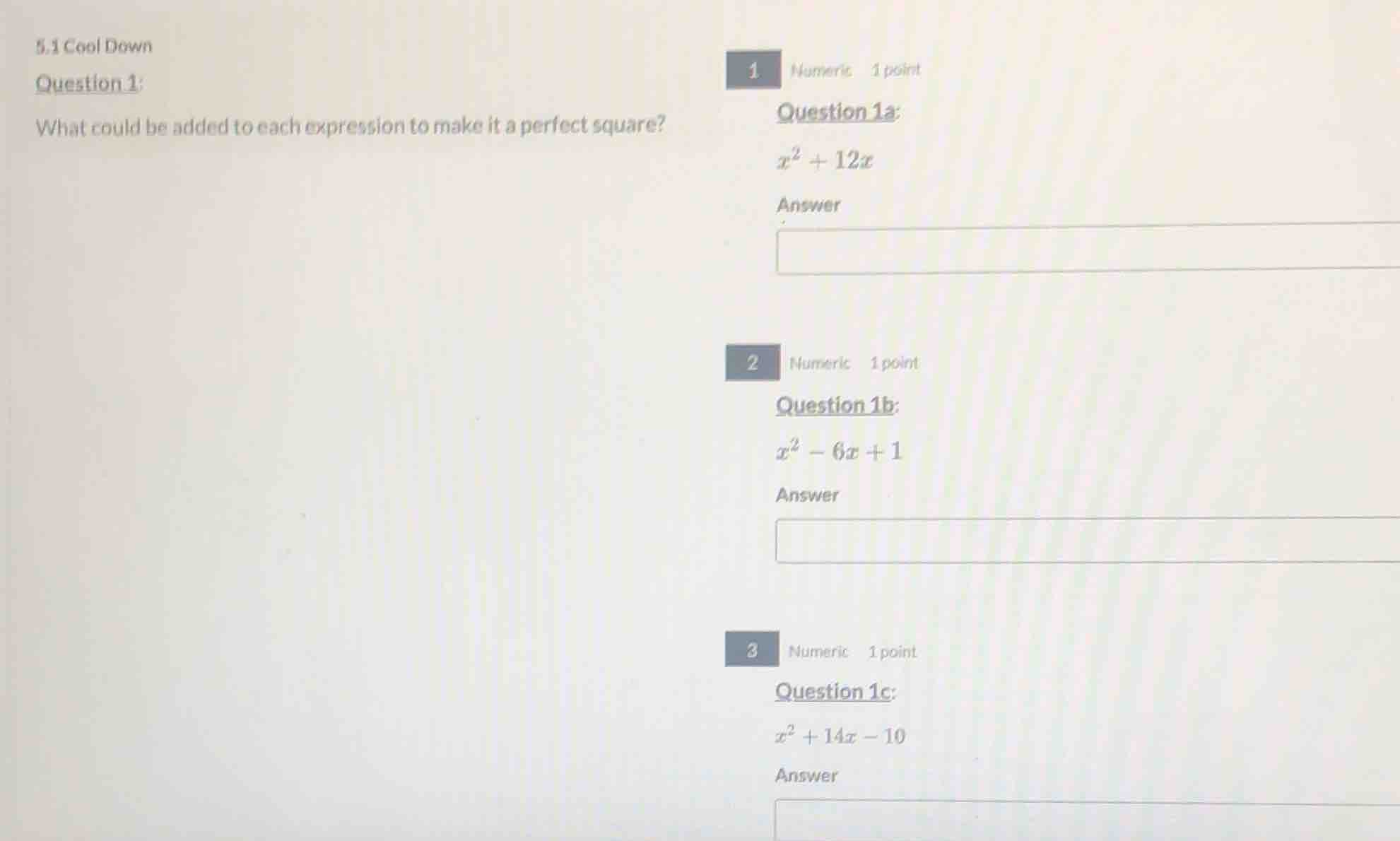
what could be added to each expression to make it a perfect square?
1 numeric 1 point
question 1a:
$x^2 + 12x$
answer
2 numeric 1 point
question 1b:
$x^2 - 6x + 1$
answer
3 numeric 1 point
question 1c:
$x^2 + 14x - 10$
answer
Question 1a:
Step1: Recall perfect square formula
A perfect square trinomial is of the form \((x + a)^2 = x^2 + 2ax + a^2\). For the expression \(x^2 + 12x\), we compare with \(x^2 + 2ax\). So, \(2a = 12\).
Step2: Solve for \(a\)
From \(2a = 12\), we get \(a=\frac{12}{2}=6\).
Step3: Find the constant term
The constant term of the perfect square is \(a^2\). Substituting \(a = 6\), we get \(a^2=6^2 = 36\). So we add 36.
Step1: Recall perfect square formula
For the quadratic part \(x^2-6x\) (ignoring the +1 for now), use \((x - a)^2=x^2-2ax + a^2\). Compare with \(x^2-6x\), so \(2a = 6\).
Step2: Solve for \(a\)
\(a=\frac{6}{2}=3\).
Step3: Find the constant term for the quadratic part
The constant term for \(x^2-6x\) to be a perfect square is \(a^2 = 3^2=9\). But our expression is \(x^2-6x + 1\), so we need to find what to add to make the entire expression a perfect square. Let the expression after adding \(k\) be \((x - 3)^2\). \((x - 3)^2=x^2-6x + 9\). Our original expression is \(x^2-6x + 1\). So we need to add \(9 - 1=8\) (because \(x^2-6x + 1+k=x^2-6x + 9\) implies \(k = 9 - 1\)).
Step1: Recall perfect square formula
For the quadratic part \(x^2 + 14x\) (ignoring the -10 for now), use \((x + a)^2=x^2+2ax + a^2\). Compare with \(x^2 + 14x\), so \(2a = 14\).
Step2: Solve for \(a\)
\(a=\frac{14}{2}=7\).
Step3: Find the constant term for the quadratic part
The constant term for \(x^2 + 14x\) to be a perfect square is \(a^2=7^2 = 49\). Our expression is \(x^2+14x-10\). Let the expression after adding \(k\) be \((x + 7)^2\). \((x + 7)^2=x^2+14x + 49\). So we need to add \(49-(- 10)=59\)? Wait, no. Wait, the expression is \(x^2+14x-10\). We want \(x^2+14x-10 + k=(x + 7)^2=x^2+14x + 49\). So \(k=49+10 = 59\)? Wait, no. Wait, \(x^2+14x-10 + k=x^2+14x + 49\) implies \(k=49 + 10=59\)? Wait, no. Wait, transpose: \(k=49-(- 10)\)? No, \(x^2+14x-10 + k=x^2+14x + 49\). Subtract \(x^2+14x\) from both sides: \(-10 + k=49\), so \(k = 49 + 10=59\). Wait, no, that's wrong. Wait, the original expression is \(x^2+14x-10\). We need to make it a perfect square. Let's consider the quadratic and linear terms: \(x^2+14x\). To make \(x^2+14x\) a perfect square, we add 49 (as above). But our expression has \(-10\), so to make the entire expression \(x^2+14x-10 + k\) a perfect square (which is \((x + 7)^2=x^2+14x + 49\)), we set \(x^2+14x-10 + k=x^2+14x + 49\). So \(k=49 + 10=59\). Wait, no, solving for \(k\): \(-10 + k=49\) => \(k=49 + 10 = 59\). Yes.

Snap & solve any problem in the app
Get step-by-step solutions on Sovi AI
Photo-based solutions with guided steps
Explore more problems and detailed explanations
36