QUESTION IMAGE
Question
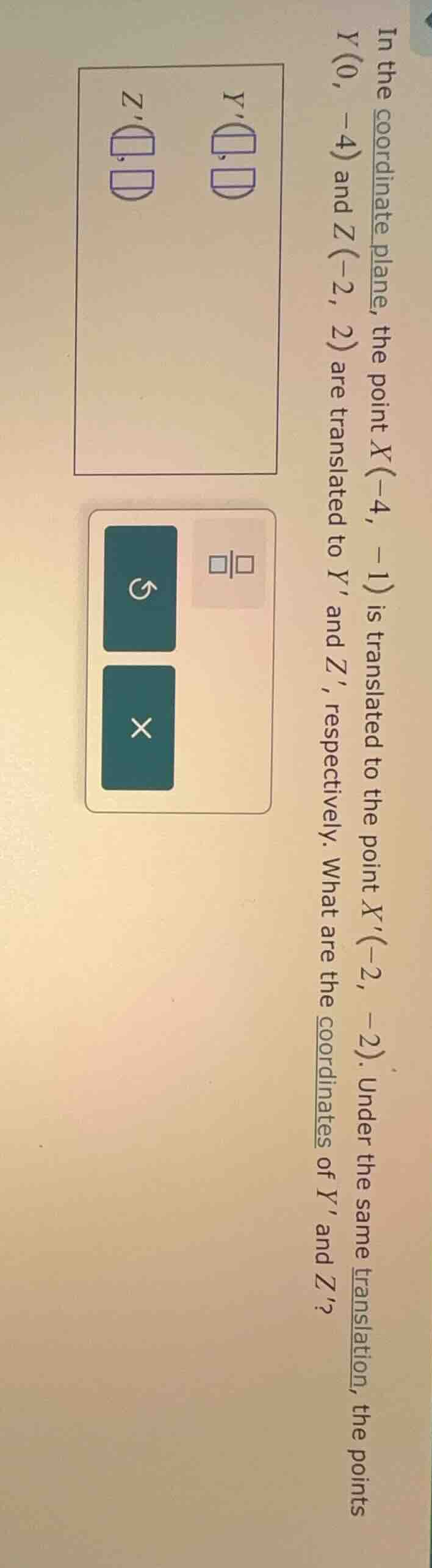
in the coordinate plane, the point ( x(-4, -1) ) is translated to the point ( x(-2, -2) ). under the same translation, the points ( y(0, -4) ) and ( z(-2, 2) ) are translated to ( y ) and ( z ), respectively. what are the coordinates of ( y ) and ( z )?
Step1: Find the translation vector
First, we find the translation vector by comparing the coordinates of \( X(-4, -1) \) and \( X'(-2, -2) \). The change in the \( x \)-coordinate is \( -2 - (-4) = 2 \), and the change in the \( y \)-coordinate is \( -2 - (-1) = -1 \). So the translation vector is \( (2, -1) \).
Step2: Translate point \( Y(0, -4) \)
To find \( Y' \), we add the translation vector to the coordinates of \( Y \). For the \( x \)-coordinate: \( 0 + 2 = 2 \). For the \( y \)-coordinate: \( -4 + (-1) = -5 \). So \( Y' \) is \( (2, -5) \).
Step3: Translate point \( Z(-2, 2) \)
To find \( Z' \), we add the translation vector to the coordinates of \( Z \). For the \( x \)-coordinate: \( -2 + 2 = 0 \). For the \( y \)-coordinate: \( 2 + (-1) = 1 \). So \( Z' \) is \( (0, 1) \).

Snap & solve any problem in the app
Get step-by-step solutions on Sovi AI
Photo-based solutions with guided steps
Explore more problems and detailed explanations
\( Y'(2, -5) \), \( Z'(0, 1) \)