QUESTION IMAGE
Question
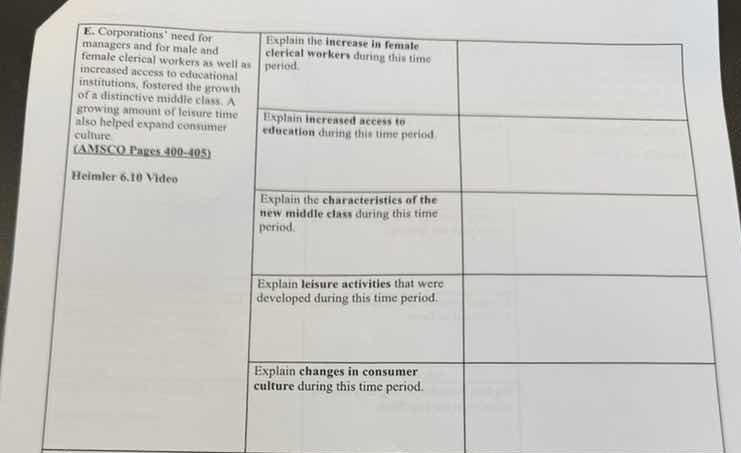
e. corporations’ need for managers and for male and female clerical workers as well as increased access to educational institutions fostered the growth of a distinct new middle class. a growing sense of leisure time also helped expand consumer culture. (amsco pages 400 - 405)
heimler 6.10 video
| explain the increase in female clerical workers during this time period. |
| explain increased access to education during this time period |
| explain the characteristics of the new middle class during this time period. |
| explain leisure activities that were developed during this time period. |
| explain changes in consumer culture during this time period. |
All answers reference the late 19th to early 20th century (Gilded Age/Progressive Era) U.S. context, aligned with the provided textbook and video references. Each explanation addresses the specific prompt by linking historical economic, social, and technological shifts to the topic in question, focusing on key, defining changes and trends of the period.

Snap & solve any problem in the app
Get step-by-step solutions on Sovi AI
Photo-based solutions with guided steps
Explore more problems and detailed explanations
- Explain the increase in female clerical workers during this time period:
- As large corporations expanded in the late 19th/early 20th century, there was a growing need for office staff to handle administrative tasks like record-keeping, typing, and telephony. Women were hired for these roles because employers paid them lower wages than men for similar work, and they were seen as suited for "detail-oriented, routine" office work. The rise of typewriters and other office technology also created these new clerical positions that became a major path for women's entry into the white-collar workforce.
- Explain increased access to education during this time period:
- In the late 19th and early 20th centuries, public high school enrollment surged in the U.S. as states implemented compulsory education laws. Additionally, more colleges and universities began admitting women, and new institutions like land-grant colleges (created under the Morrill Acts) expanded access to higher education for middle- and working-class students, not just the elite. These changes were driven by industrialization's demand for a more educated workforce and reform movements pushing for greater educational equity.
- Explain the characteristics of the new middle class during this time period:
- The new middle class (late 19th/early 20th century) included white-collar workers like managers, teachers, nurses, and office clerks. They were distinct from the working class (manual laborers) and the wealthy elite: they typically held salaried, non-manual jobs, valued upward mobility, education, and respectability, and often lived in emerging suburban areas. They embraced consumer culture and focused on maintaining a stable, comfortable household.
- Explain leisure activities that were developed during this time period:
- New leisure activities included spectator sports like professional baseball (the National League was founded in 1876) and college football. Amusement parks (e.g., Coney Island) became popular, as did vaudeville shows, nickelodeons (early movie theaters), and bicycling (made accessible by the safety bicycle). These activities were enabled by shorter work hours for some workers and the rise of disposable income among the middle class.
- Explain changes in consumer culture during this time period:
- Industrial mass production created a surplus of affordable goods (e.g., ready-to-wear clothing, household appliances). Advertising (via newspapers, billboards, and catalogs like Sears, Roebuck & Co.) encouraged people to buy these new products. The rise of department stores provided a central, appealing space for shopping, and credit systems allowed consumers to purchase goods on installment. Consumer culture shifted from buying only necessities to purchasing items for comfort, status, and leisure, tied to ideas of modernity and upward mobility.