QUESTION IMAGE
Question
cphs : advanced algebra: concepts and connections - block (27.0831030)
rational equations
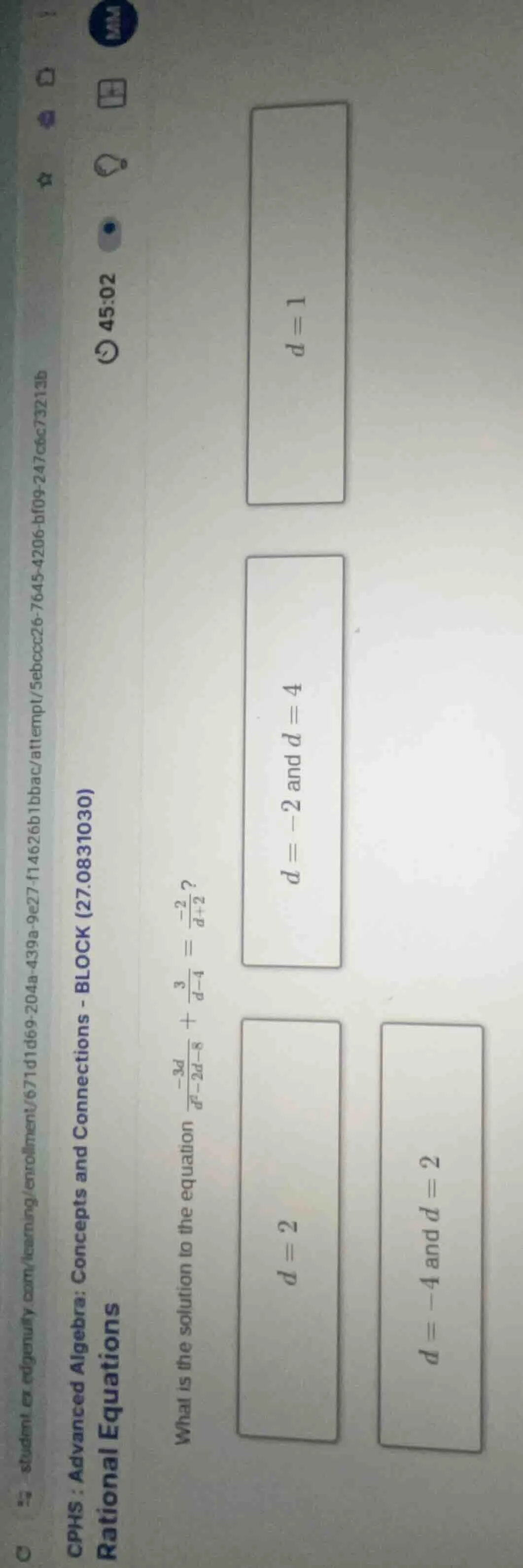
what is the solution to the equation \\(\frac{-3d}{d - 2d - 8}+\frac{3}{d - 4}=\frac{-2}{d + 2}\\)?
\\(d = 2\\)
\\(d = -2\\) and \\(d = 4\\)
\\(d = 1\\)
\\(d = -4\\) and \\(d = 2\\)
Step1: Simplify the denominator
First, factor the denominator \(d^2 - 2d - 8\). We need two numbers that multiply to \(-8\) and add to \(-2\). Those numbers are \(-4\) and \(2\), so \(d^2 - 2d - 8=(d - 4)(d + 2)\). The equation becomes \(\frac{-3d}{(d - 4)(d + 2)}+\frac{3}{d - 4}=\frac{-2}{d + 2}\).
Step2: Multiply through by the LCD
The least common denominator (LCD) of \((d - 4)(d + 2)\), \(d - 4\), and \(d + 2\) is \((d - 4)(d + 2)\). Multiply each term by \((d - 4)(d + 2)\) to eliminate the fractions:
\[
\]
Step3: Solve for \(d\)
Subtract \(8\) from both sides: \(6 - 8=-2d\), so \(-2=-2d\). Divide both sides by \(-2\): \(d = 1\). Wait, but we need to check for extraneous solutions. The original denominators are \(d^2 - 2d - 8\), \(d - 4\), and \(d + 2\). So \(d
eq4\) and \(d
eq - 2\). Wait, maybe I made a mistake in the first step. Let's re - do the equation. Wait, the original equation is \(\frac{-3d}{d^2-2d - 8}+\frac{3}{d - 4}=\frac{-2}{d + 2}\). Let's substitute \(d = 1\): denominators are \(1 - 2 - 8=-9
eq0\), \(1 - 4=-3
eq0\), \(1+2 = 3
eq0\). Wait, but let's check the calculation again.
Wait, when we multiply \(\frac{3}{d - 4}\) by \((d - 4)(d + 2)\), we get \(3(d + 2)\), and \(\frac{-2}{d + 2}\) times \((d - 4)(d + 2)\) is \(-2(d - 4)\). Then \(-3d+3d + 6=-2d + 8\), \(6=-2d + 8\), \(-2d=6 - 8=-2\), so \(d = 1\). Wait, but let's check the answer options. Wait, maybe I misread the equation. Let me re - examine the equation. The original equation is \(\frac{-3d}{d^2-2d - 8}+\frac{3}{d - 4}=\frac{-2}{d + 2}\). Wait, maybe the first term is \(\frac{-3d}{d^2-2d - 8}\), second is \(\frac{3}{d - 4}\), third is \(\frac{-2}{d + 2}\). Let's check \(d = 1\):
Left - hand side (LHS): \(\frac{-3(1)}{1 - 2 - 8}+\frac{3}{1 - 4}=\frac{-3}{-9}+\frac{3}{-3}=\frac{1}{3}-1=-\frac{2}{3}\)
Right - hand side (RHS): \(\frac{-2}{1 + 2}=-\frac{2}{3}\). So it works. But wait, the options include \(d=-2\) and \(d = 4\) which are excluded. Wait, maybe the equation was written differently. Wait, maybe the original equation is \(\frac{-3d}{d^2-2d - 8}+\frac{3}{d - 4}=\frac{-2}{d + 2}\). Wait, let's check the answer options again. The options are \(d = 2\), \(d=-2\) and \(d = 4\), \(d = 1\), \(d=-4\) and \(d = 2\). Wait, maybe I made a mistake in factoring. Wait, \(d^2-2d - 8=(d - 4)(d + 2)\) is correct. Wait, let's try \(d = 1\) which is an option. So the solution is \(d = 1\).

Snap & solve any problem in the app
Get step-by-step solutions on Sovi AI
Photo-based solutions with guided steps
Explore more problems and detailed explanations
\(d = 1\)