QUESTION IMAGE
Question
cphs : advanced algebra: concepts and connections - block (27.0831030)
radical equations and extraneous roots
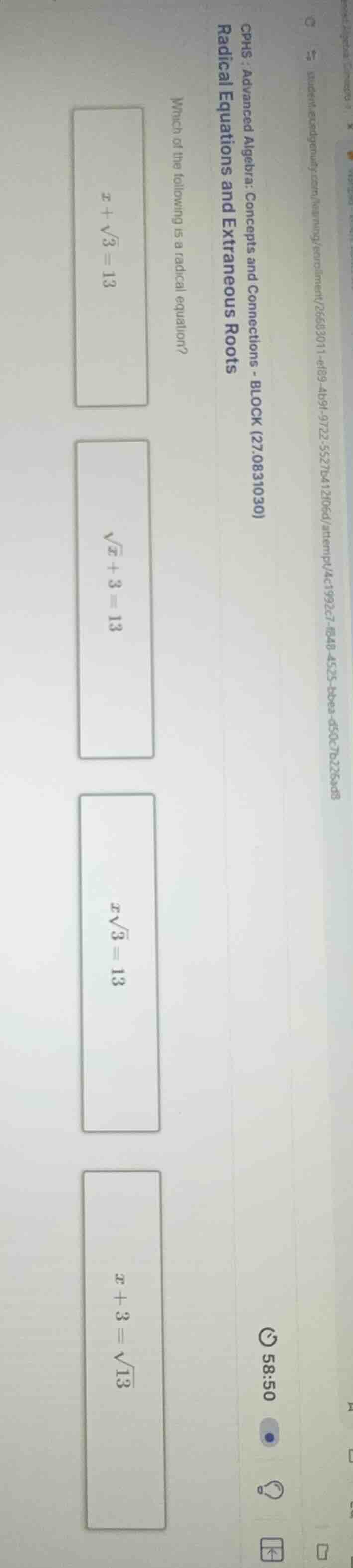
which of the following is a radical equation?
$x + \sqrt{3} = 13$
$\sqrt{x} + 3 = 13$
$x\sqrt{3} = 13$
$x + 3 = \sqrt{13}$
Brief Explanations
A radical equation is an equation that contains a variable within a radical (usually a square root, cube root, etc.). Let's analyze each option:
- For \( x + \sqrt{3}=13 \), \( \sqrt{3} \) is a constant radical (no variable inside the radical), so this is not a radical equation with a variable in the radical.
- For \( \sqrt{x}+3 = 13 \), the variable \( x \) is inside the square root (radical), so this fits the definition of a radical equation.
- For \( x\sqrt{3}=13 \), \( \sqrt{3} \) is a constant multiplier, and there's no variable inside a radical, so it's not a radical equation.
- For \( x + 3=\sqrt{13} \), \( \sqrt{13} \) is a constant radical (no variable inside), so it's not a radical equation.

Snap & solve any problem in the app
Get step-by-step solutions on Sovi AI
Photo-based solutions with guided steps
Explore more problems and detailed explanations
\(\boldsymbol{\sqrt{x}+3 = 13}\) (the second option in the list of equations provided)