QUESTION IMAGE
Question
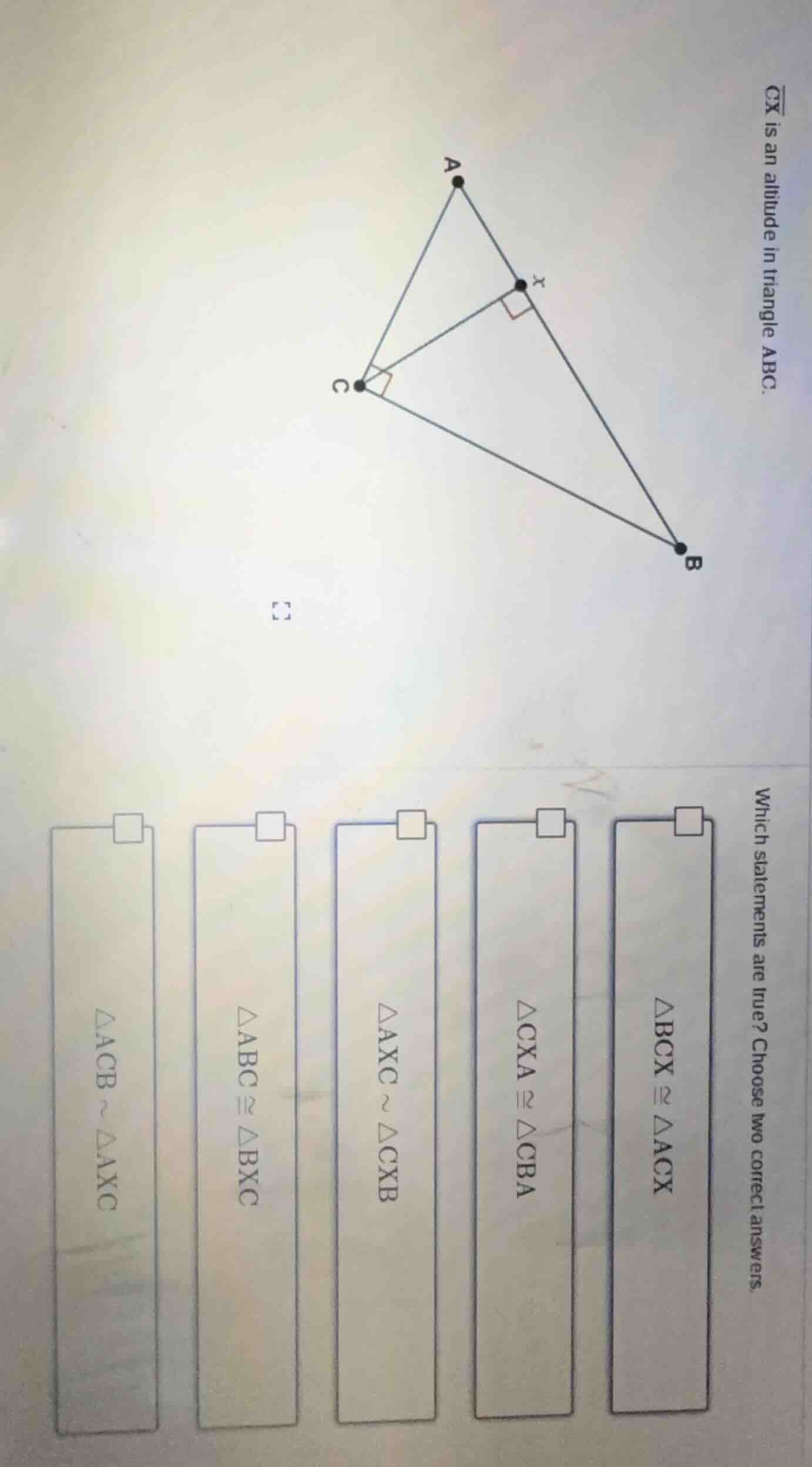
cx is an altitude in triangle abc. which statements are true? choose two correct answers. \\(\triangle bcx \cong \triangle acx\\) \\(\triangle cxa \cong \triangle cba\\) \\(\triangle axc \sim \triangle cxb\\) \\(\triangle abc \cong \triangle bxc\\) \\(\triangle acb \sim \triangle axc\\)
Brief Explanations
- For \(\triangle ACB \sim \triangle AXC\):
- In \(\triangle ACB\) and \(\triangle AXC\), \(\angle ACB=\angle AXC = 90^{\circ}\) (since \(CX\) is an altitude, \(\angle AXC = 90^{\circ}\) and \(\angle ACB\) is given as a right angle? Wait, looking at the diagram, \(\angle ACB\) is a right angle? Wait, the diagram shows \(\angle ACB\) with a right - angle mark and \(CX\perp AB\) (since \(CX\) is an altitude). Also, \(\angle A\) is common to both \(\triangle ACB\) and \(\triangle AXC\). By the AA (Angle - Angle) similarity criterion, if two angles of one triangle are equal to two angles of another triangle, the triangles are similar. \(\angle A=\angle A\) and \(\angle ACB=\angle AXC = 90^{\circ}\), so \(\triangle ACB\sim\triangle AXC\).
- For \(\triangle AXC\sim\triangle CXB\):
- \(\angle AXC=\angle CXB = 90^{\circ}\) (since \(CX\) is an altitude). Also, \(\angle ACX+\angle B=\angle ACX+\angle ACX = 90^{\circ}\) (because in right - triangle \(ACB\), \(\angle A+\angle B = 90^{\circ}\) and in right - triangle \(AXC\), \(\angle A+\angle ACX=90^{\circ}\), so \(\angle ACX=\angle B\)). So in \(\triangle AXC\) and \(\triangle CXB\), \(\angle AXC=\angle CXB = 90^{\circ}\) and \(\angle ACX=\angle B\). By AA similarity criterion, \(\triangle AXC\sim\triangle CXB\).
- Let's check the other options:
- For \(\triangle BCX\cong\triangle ACX\): There is no information to suggest that the corresponding sides are equal. Just because they are right - triangles does not mean they are congruent.
- For \(\triangle CXA\cong\triangle CBA\): The triangles have different side lengths (e.g., \(CX\) is an altitude, much shorter than \(BC\) or \(AC\) in general), so they are not congruent.
- For \(\triangle ABC\cong\triangle BXC\): The triangles have different shapes and side lengths, so they are not congruent.

Snap & solve any problem in the app
Get step-by-step solutions on Sovi AI
Photo-based solutions with guided steps
Explore more problems and detailed explanations
\(\triangle ACB \sim \triangle AXC\), \(\triangle AXC\sim\triangle CXB\)