QUESTION IMAGE
Question
date:
describe π as ratio of \\(\frac{c}{d}\\)
skills practice
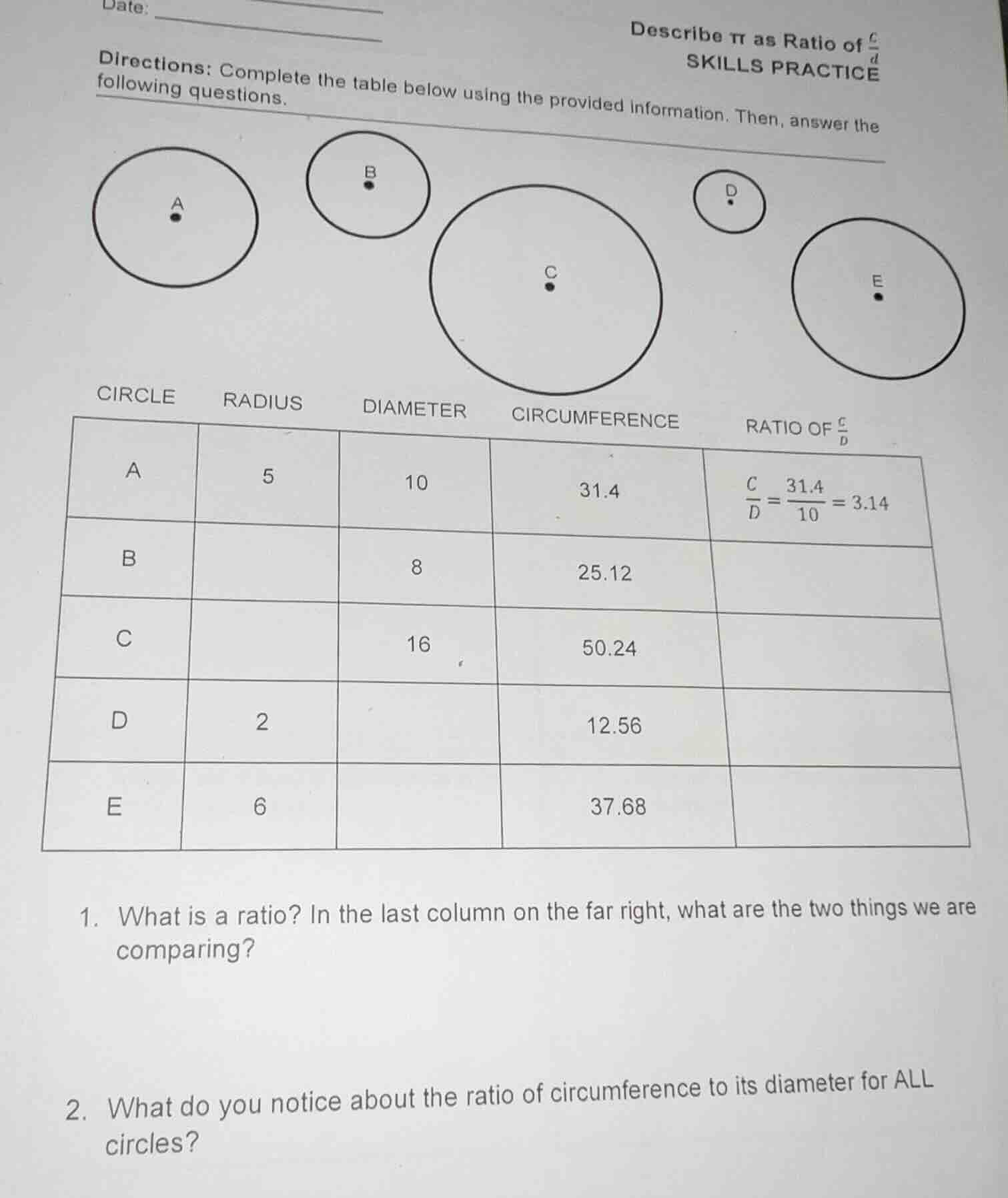
directions: complete the table below using the provided information. then, answer the following questions.
circle\tradius\tdiameter\tcircumference\tratio of \\(\frac{c}{d}\\)
a\t5\t10\t31.4\t\\(\frac{c}{d}=\frac{31.4}{10}=3.14\\)
b\t\t8\t25.12\t
c\t\t16\t50.24\t
d\t2\t\t12.56\t
e\t6\t\t37.68\t
- what is a ratio? in the last column on the far right, what are the two things we are comparing?
- what do you notice about the ratio of circumference to its diameter for all circles?
For Circle B:
Step 1: Find Radius
The radius \( r \) is half of the diameter \( d \). Given \( d = 8 \), so \( r=\frac{d}{2}=\frac{8}{2} = 4 \).
Step 2: Find Ratio \( \frac{C}{D} \)
Using the formula \( \frac{C}{D}=\frac{25.12}{8}=3.14 \).
For Circle C:
Step 1: Find Radius
Given \( d = 16 \), so \( r=\frac{d}{2}=\frac{16}{2}=8 \).
Step 2: Find Ratio \( \frac{C}{D} \)
Using the formula \( \frac{C}{D}=\frac{50.24}{16}=3.14 \).
For Circle D:
Step 1: Find Diameter
The diameter \( d = 2r \). Given \( r = 2 \), so \( d=2\times2 = 4 \).
Step 2: Find Ratio \( \frac{C}{D} \)
Using the formula \( \frac{C}{D}=\frac{12.56}{4}=3.14 \).
For Circle E:
Step 1: Find Diameter
The diameter \( d = 2r \). Given \( r = 6 \), so \( d=2\times6=12 \).
Step 2: Find Ratio \( \frac{C}{D} \)
Using the formula \( \frac{C}{D}=\frac{37.68}{12}=3.14 \).
Filling the table:
| CIRCLE | RADIUS | DIAMETER | CIRCUMFERENCE | RATIO OF \( \frac{C}{D} \) |
|---|---|---|---|---|
| B | 4 | 8 | 25.12 | \( \frac{25.12}{8}=3.14 \) |
| C | 8 | 16 | 50.24 | \( \frac{50.24}{16}=3.14 \) |
| D | 2 | 4 | 12.56 | \( \frac{12.56}{4}=3.14 \) |
| E | 6 | 12 | 37.68 | \( \frac{37.68}{12}=3.14 \) |

Snap & solve any problem in the app
Get step-by-step solutions on Sovi AI
Photo-based solutions with guided steps
Explore more problems and detailed explanations
ing the questions:
1.
- A ratio is a comparison of two quantities by division. In the last column, we are comparing the circumference (\( C \)) of the circle to its diameter (\( D \)).
2.
The ratio of the circumference to the diameter (\( \frac{C}{D} \)) is approximately \( 3.14 \) (which is the value of \( \pi \)) for all circles. This shows that the ratio of the circumference of a circle to its diameter is a constant ( \( \pi \) ), regardless of the size of the circle.