QUESTION IMAGE
Question
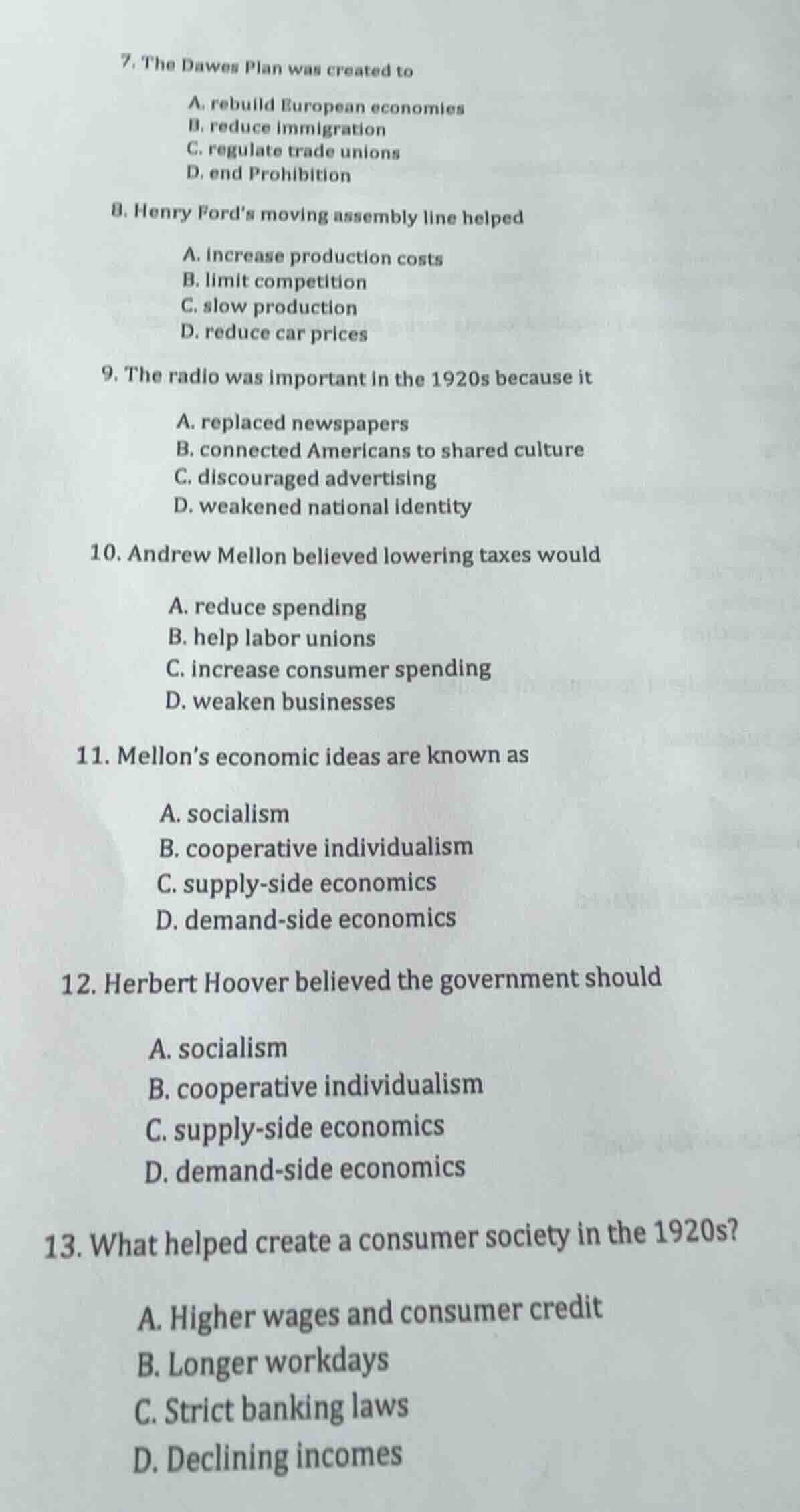
- the dawes plan was created to
a. rebuild european economies
b. reduce immigration
c. regulate trade unions
d. end prohibition
- henry ford’s moving assembly line helped
a. increase production costs
b. limit competition
c. slow production
d. reduce car prices
- the radio was important in the 1920s because it
a. replaced newspapers
b. connected americans to shared culture
c. discouraged advertising
d. weakened national identity
- andrew mellon believed lowering taxes would
a. reduce spending
b. help labor unions
c. increase consumer spending
d. weaken businesses
- mellon’s economic ideas are known as
a. socialism
b. cooperative individualism
c. supply - side economics
d. demand - side economics
- herbert hoover believed the government should
a. socialism
b. cooperative individualism
c. supply - side economics
d. demand - side economics
- what helped create a consumer society in the 1920s?
a. higher wages and consumer credit
b. longer workdays
c. strict banking laws
d. declining incomes
- The Dawes Plan was designed to address Germany's war reparations and stabilize European economies after WWI.
- Ford's moving assembly line streamlined production, cutting costs, which allowed lower car prices.
- 1920s radios broadcasted national content, uniting Americans through shared cultural experiences.
- Andrew Mellon's tax cut theory held that more disposable income would boost consumer spending.
- Mellon's focus on cutting taxes for businesses/wealth to drive growth defines supply-side economics.
- Herbert Hoover promoted cooperative individualism, where businesses and citizens collaborate without heavy government intervention.
- Higher wages gave people spending power, and consumer credit let them purchase goods upfront, fueling the 1920s consumer society.

Snap & solve any problem in the app
Get step-by-step solutions on Sovi AI
Photo-based solutions with guided steps
Explore more problems and detailed explanations
- A. rebuild European economies
- D. reduce car prices
- B. connected Americans to shared culture
- C. increase consumer spending
- C. supply-side economics
- B. cooperative individualism
- A. Higher wages and consumer credit