QUESTION IMAGE
Question
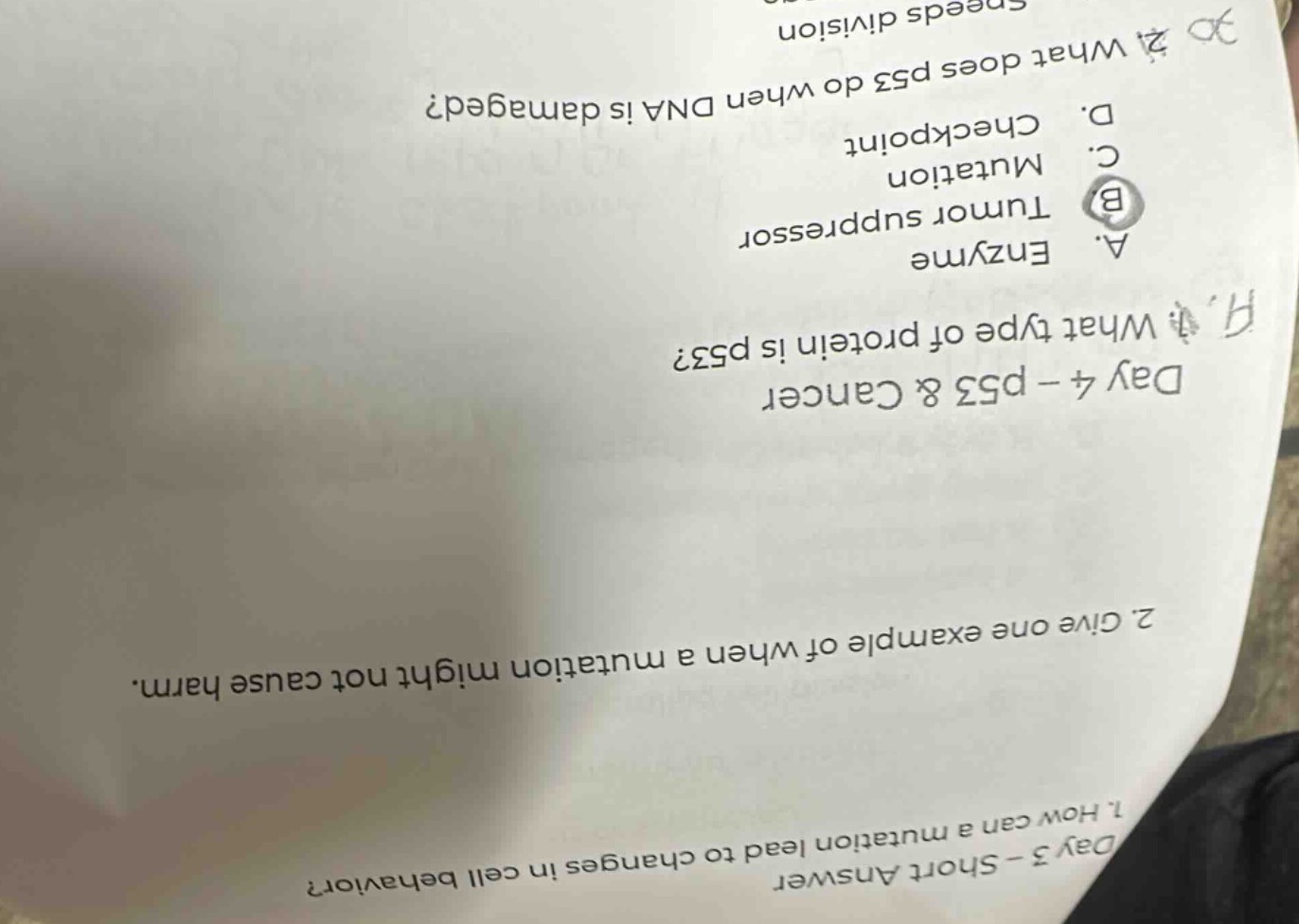
day 3 - short answer
- how can a mutation lead to changes in cell behavior?
- give one example of when a mutation might not cause harm.
day 4 - p53 & cancer
- what type of protein is p53?
a. enzyme
b. tumor suppressor
c. mutation
d. checkpoint
- what does p53 do when dna is damaged?
speeds division
Brief Explanations
- For the first question: Mutations alter the DNA sequence, which changes the structure/function of proteins that regulate cell growth, division, or repair. This can lead to unregulated cell behavior like excessive division.
- For the second question: A silent mutation changes a DNA nucleotide but does not change the amino acid encoded (due to the genetic code's redundancy), so the protein's function stays normal, causing no harm.
- For the multiple-choice question (What type of protein is p53?): p53 is a protein that prevents cells with damaged DNA from dividing, stopping tumor formation.
- For the question "What does p53 do when DNA is damaged?": p53 activates pathways that pause the cell cycle (checkpoint) to allow DNA repair, or triggers apoptosis (cell death) if repair is not possible.

Snap & solve any problem in the app
Get step-by-step solutions on Sovi AI
Photo-based solutions with guided steps
Explore more problems and detailed explanations
- A mutation can change the structure of proteins that control cell growth, division, or repair, leading to unregulated cell division, impaired DNA repair, or loss of normal cell cycle checkpoints, all of which alter cell behavior.
- A silent mutation (a change in a DNA base pair that does not change the corresponding amino acid in the protein, due to the degeneracy of the genetic code) is an example of a mutation that does not cause harm.
- B. Tumor suppressor
- When DNA is damaged, p53 triggers cell cycle checkpoints to halt cell division, allowing time for DNA repair. If the damage is irreparable, p53 initiates programmed cell death (apoptosis) to prevent the damaged DNA from being passed to daughter cells.