QUESTION IMAGE
Question
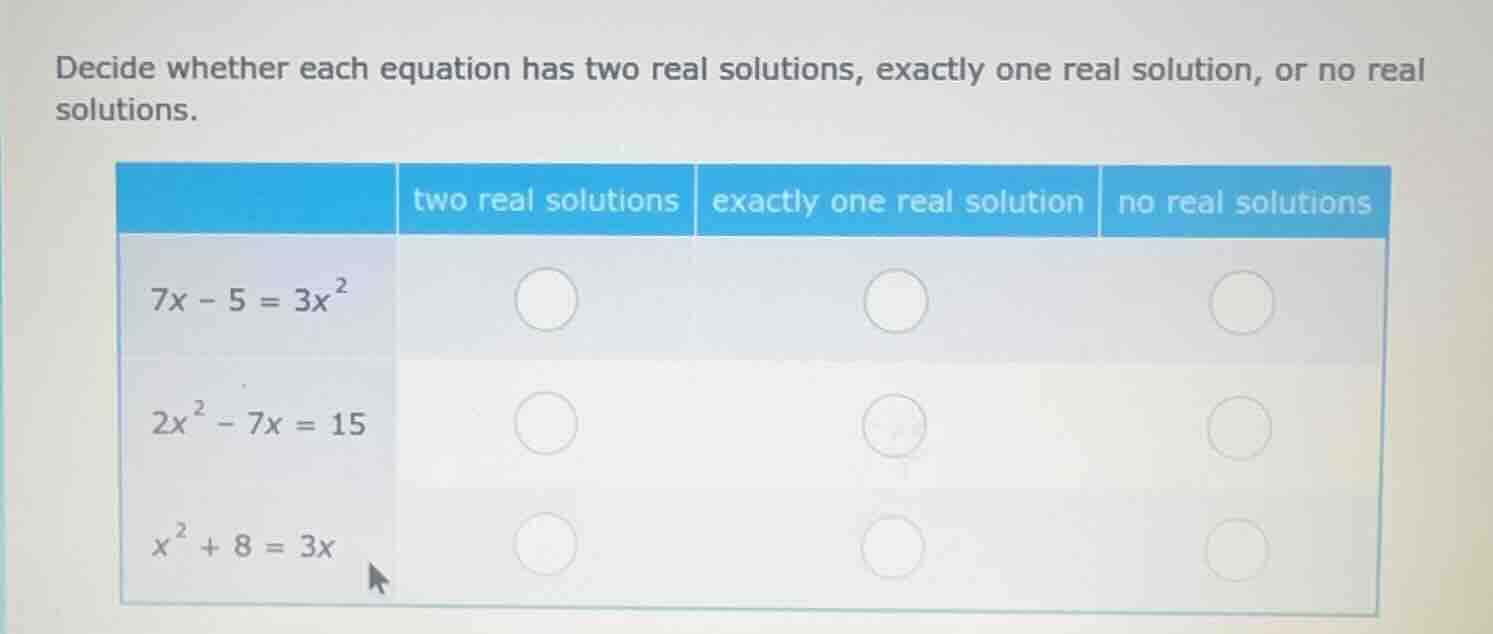
decide whether each equation has two real solutions, exactly one real solution, or no real solutions.
$7x - 5 = 3x^2$
$2x^2 - 7x = 15$
$x^2 + 8 = 3x$
To determine the number of real solutions for a quadratic equation \( ax^2 + bx + c = 0 \), we use the discriminant \( D = b^2 - 4ac \):
- If \( D > 0 \): Two real solutions.
- If \( D = 0 \): Exactly one real solution.
- If \( D < 0 \): No real solutions.
Equation 1: \( 7x - 5 = 3x^2 \)
Rewrite in standard form: \( 3x^2 - 7x + 5 = 0 \)
Here, \( a = 3 \), \( b = -7 \), \( c = 5 \).
Step 1: Calculate the discriminant
\( D = (-7)^2 - 4(3)(5) = 49 - 60 = -11 \)
Since \( D = -11 < 0 \), the equation has no real solutions.
Equation 2: \( 2x^2 - 7x = 15 \)
Rewrite in standard form: \( 2x^2 - 7x - 15 = 0 \)
Here, \( a = 2 \), \( b = -7 \), \( c = -15 \).
Step 1: Calculate the discriminant
\( D = (-7)^2 - 4(2)(-15) = 49 + 120 = 169 \)
Since \( D = 169 > 0 \), the equation has two real solutions.
Equation 3: \( x^2 + 8 = 3x \)
Rewrite in standard form: \( x^2 - 3x + 8 = 0 \)
Here, \( a = 1 \), \( b = -3 \), \( c = 8 \).
Step 1: Calculate the discriminant
\( D = (-3)^2 - 4(1)(8) = 9 - 32 = -23 \)
Since \( D = -23 < 0 \), the equation has no real solutions.
Final Answers:
- \( 7x - 5 = 3x^2 \): no real solutions
- \( 2x^2 - 7x = 15 \): two real solutions
- \( x^2 + 8 = 3x \): no real solutions
(To mark the table:
- For \( 7x - 5 = 3x^2 \), select "no real solutions".
- For \( 2x^2 - 7x = 15 \), select "two real solutions".
- For \( x^2 + 8 = 3x \), select "no real solutions".)

Snap & solve any problem in the app
Get step-by-step solutions on Sovi AI
Photo-based solutions with guided steps
Explore more problems and detailed explanations
To determine the number of real solutions for a quadratic equation \( ax^2 + bx + c = 0 \), we use the discriminant \( D = b^2 - 4ac \):
- If \( D > 0 \): Two real solutions.
- If \( D = 0 \): Exactly one real solution.
- If \( D < 0 \): No real solutions.
Equation 1: \( 7x - 5 = 3x^2 \)
Rewrite in standard form: \( 3x^2 - 7x + 5 = 0 \)
Here, \( a = 3 \), \( b = -7 \), \( c = 5 \).
Step 1: Calculate the discriminant
\( D = (-7)^2 - 4(3)(5) = 49 - 60 = -11 \)
Since \( D = -11 < 0 \), the equation has no real solutions.
Equation 2: \( 2x^2 - 7x = 15 \)
Rewrite in standard form: \( 2x^2 - 7x - 15 = 0 \)
Here, \( a = 2 \), \( b = -7 \), \( c = -15 \).
Step 1: Calculate the discriminant
\( D = (-7)^2 - 4(2)(-15) = 49 + 120 = 169 \)
Since \( D = 169 > 0 \), the equation has two real solutions.
Equation 3: \( x^2 + 8 = 3x \)
Rewrite in standard form: \( x^2 - 3x + 8 = 0 \)
Here, \( a = 1 \), \( b = -3 \), \( c = 8 \).
Step 1: Calculate the discriminant
\( D = (-3)^2 - 4(1)(8) = 9 - 32 = -23 \)
Since \( D = -23 < 0 \), the equation has no real solutions.
Final Answers:
- \( 7x - 5 = 3x^2 \): no real solutions
- \( 2x^2 - 7x = 15 \): two real solutions
- \( x^2 + 8 = 3x \): no real solutions
(To mark the table:
- For \( 7x - 5 = 3x^2 \), select "no real solutions".
- For \( 2x^2 - 7x = 15 \), select "two real solutions".
- For \( x^2 + 8 = 3x \), select "no real solutions".)