QUESTION IMAGE
Question
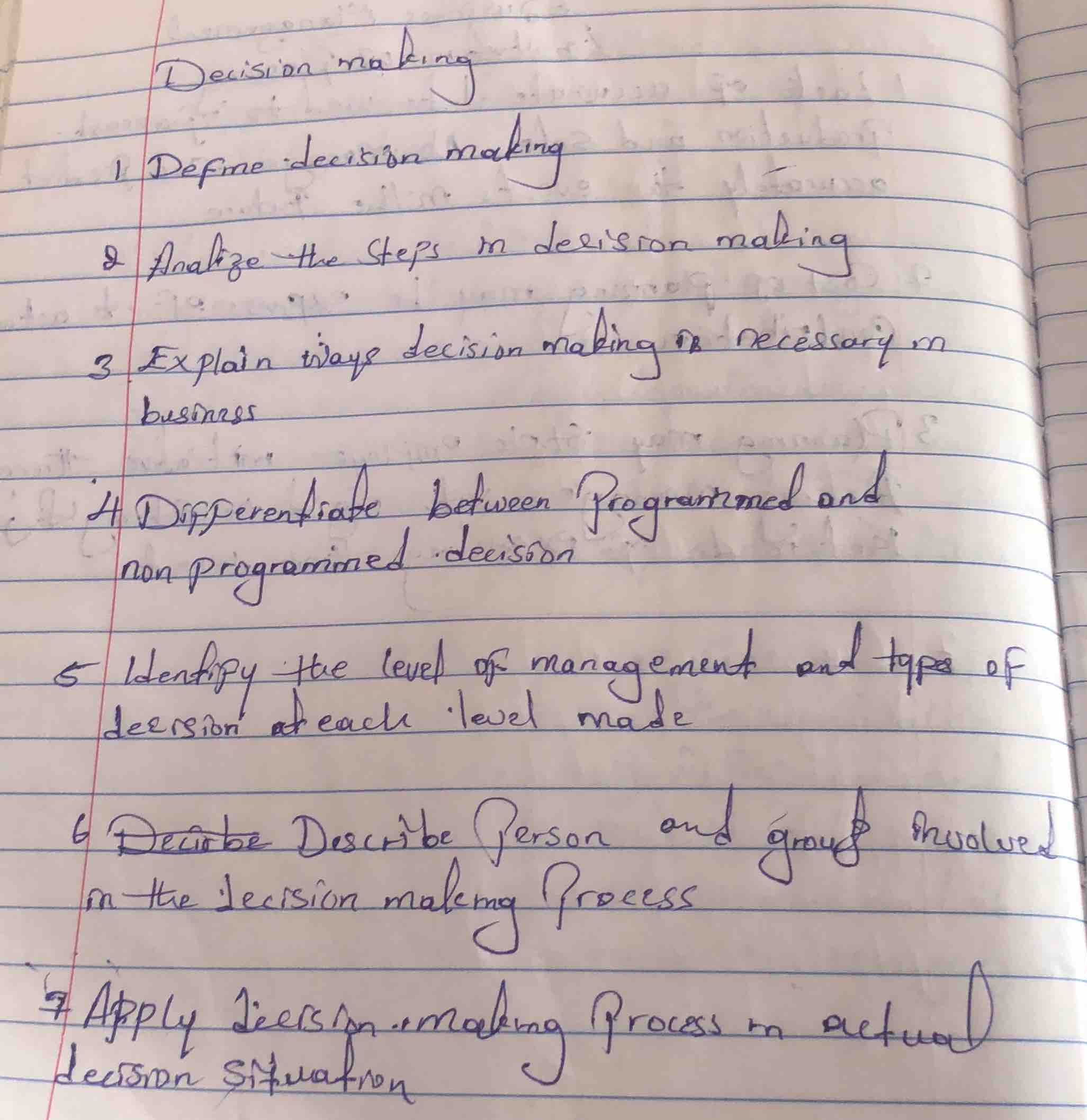
decision making
1 define decision making
2 analyze the steps in decision making
3 explain ways decision making is necessary in business
4 differentiate between programmed and non programmed decision
5 identify the level of management and type of decision at each level made
6 describe person and group involved in the decision making process
7 apply decision-making process in actual decision situation
Brief Explanations
- Define decision making: A cognitive process of selecting a course of action from alternative options to achieve a goal.
- Analyze the steps in decision making: Standard steps include identifying the problem, gathering information, evaluating alternatives, choosing an alternative, implementing it, and reviewing outcomes.
- Explain ways decision making is necessary in business: Guides resource allocation, mitigates risks, capitalizes on opportunities, aligns actions with organizational goals, and supports adaptability to market changes.
- Differentiate between Programmed and non-programmed decision: Programmed decisions are routine, repetitive, guided by rules/policies (e.g., restocking inventory). Non-programmed decisions are unstructured, novel, require creative problem-solving (e.g., launching a new product line).
- Identify the level of management and type of decision at each level made:
- Top management: Non-programmed, strategic decisions (e.g., long-term business expansion).
- Middle management: Semi-programmed, tactical decisions (e.g., departmental budget adjustments).
- Lower management: Programmed, operational decisions (e.g., scheduling daily staff shifts).
- Describe Person and group involved in the decision making Process:
- Individuals: Managers or employees making routine, small-scale decisions independently.
- Groups: Cross-functional teams, executive boards, or committees making complex, high-impact decisions that benefit from diverse input.
- Apply Decision-making Process in actual decision situation: For example, addressing declining sales:
- Identify problem: Falling monthly sales by 15%.
- Gather info: Analyze sales data, customer feedback, competitor actions.
- Evaluate alternatives: Launch a promotion, improve product features, adjust pricing.
- Choose alternative: Launch a limited-time discount promotion.
- Implement: Roll out the promotion across sales channels.
- Review: Track sales post-promotion to measure effectiveness.

Snap & solve any problem in the app
Get step-by-step solutions on Sovi AI
Photo-based solutions with guided steps
Explore more problems and detailed explanations
- Decision making is the cognitive process of selecting a preferred course of action from available alternatives to meet a specific objective.
- The core steps are: Identify the problem, gather relevant information, generate and evaluate alternatives, select the best alternative, implement the choice, and review the results.
- Decision making is critical in business to allocate resources efficiently, manage risks, seize market opportunities, align operations with organizational goals, and adapt to changing market conditions.
- Programmed decisions are routine, rule-based responses to recurring problems (e.g., approving standard expense reports). Non-programmed decisions are unstructured, creative solutions to unique, complex problems (e.g., responding to a sudden market disruption).
- - Top management: Strategic, non-programmed decisions (e.g., merging with another company)
- Middle management: Tactical, semi-programmed decisions (e.g., hiring a department head)
- Lower management: Operational, programmed decisions (e.g., approving employee time-off requests)
- - Individuals: Employees/Managers making independent, small-scale or routine decisions (e.g., a retail associate choosing to restock a shelf)
- Groups: Teams, committees, or executive boards making collaborative, high-stakes decisions (e.g., a leadership team deciding on a company rebranding)
- Example application (addressing low employee productivity):
- Problem: 20% drop in team task completion rates
- Gather data: Survey employees, review workload logs, analyze workflow bottlenecks
- Alternatives: Offer training, adjust workloads, implement incentive programs
- Choose: Implement a performance-based bonus program
- Implement: Communicate the program, set clear metrics, launch it company-wide
- Review: Measure task completion rates 3 months post-implementation to assess improvement