QUESTION IMAGE
Question
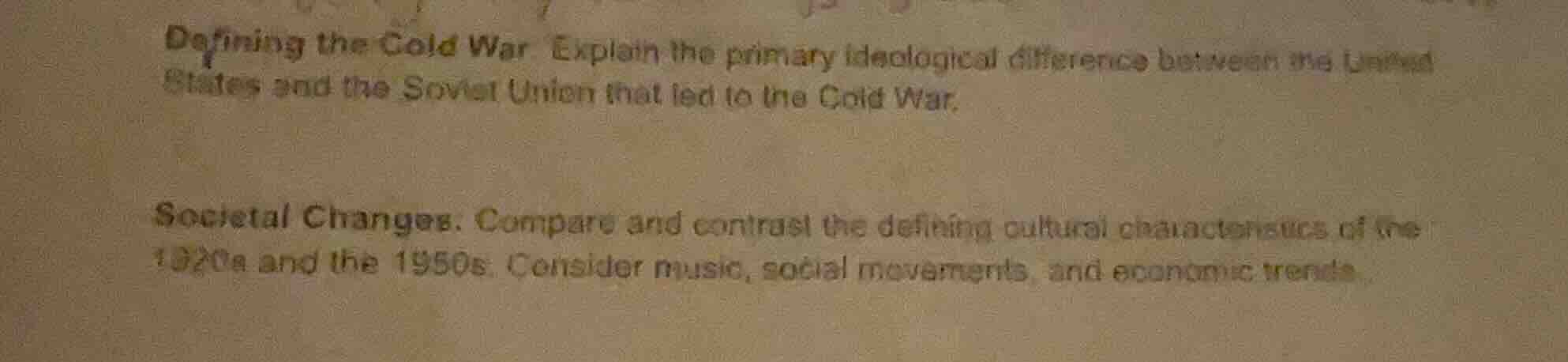
defining the cold war explain the primary ideological difference between the united states and the soviet union that led to the cold war.
societal changes: compare and contrast the defining cultural characteristics of the 1920s and the 1950s. consider music, social movements, and economic trends.
Brief Explanations
- For the Cold War question: The core ideological split was between the U.S.'s capitalist, democratic system (valuing private property, free markets, and liberal democracy) and the Soviet Union's communist, authoritarian system (valuing state-owned property, planned economies, and one-party rule). This clash over how societies should be organized and governed created mutual distrust and competition that fueled the Cold War.
- For the 1920s vs 1950s comparison:
- Music: 1920s saw the rise of jazz (a Black-origin genre that symbolized rebellion and modernity, popular in speakeasies); 1950s saw rock 'n' roll (blended rhythm and blues with country, appealed to youth and challenged traditional norms).
- Social Movements: 1920s had the women's suffrage victory (19th Amendment) and the rise of the flapper culture pushing gender norms, alongside the resurgence of the Ku Klux Klan; 1950s had the early civil rights movement (e.g., Brown v. Board of Education, Montgomery Bus Boycott) challenging racial segregation, and the rise of suburban domesticity as an ideal for women.
- Economic Trends: 1920s was a period of economic boom ("Roaring Twenties") driven by consumerism, stock market growth, and industrialization, followed by the 1929 stock market crash; 1950s was a post-WWII economic boom with suburbanization, growth of the middle class, and expansion of consumer goods (e.g., televisions, cars) due to pent-up demand and government policies like the GI Bill.

Snap & solve any problem in the app
Get step-by-step solutions on Sovi AI
Photo-based solutions with guided steps
Explore more problems and detailed explanations
- The primary ideological difference between the U.S. and Soviet Union was: The U.S. advocated for capitalism, liberal democracy, private property, and free markets, while the Soviet Union advocated for communism, a one-party authoritarian state, state-owned property, and centrally planned economies. This fundamental clash over societal and economic organization was the key ideological driver of the Cold War.
- Comparison of 1920s and 1950s cultural characteristics:
- Music: 1920s = Jazz (rebellious, speakeasy-associated, Black cultural influence); 1950s = Rock 'n' Roll (youth-focused, cross-racial genre blending R&B and country)
- Social Movements: 1920s = Women's suffrage success, flapper gender norm challenges, KKK resurgence; 1950s = Early civil rights movement (anti-segregation actions), emphasis on suburban domesticity for women
- Economic Trends: 1920s = "Roaring Twenties" consumer boom, stock market growth, followed by the 1929 crash; 1950s = Post-WWII middle-class expansion, suburbanization, consumer goods boom fueled by GI Bill and pent-up demand